
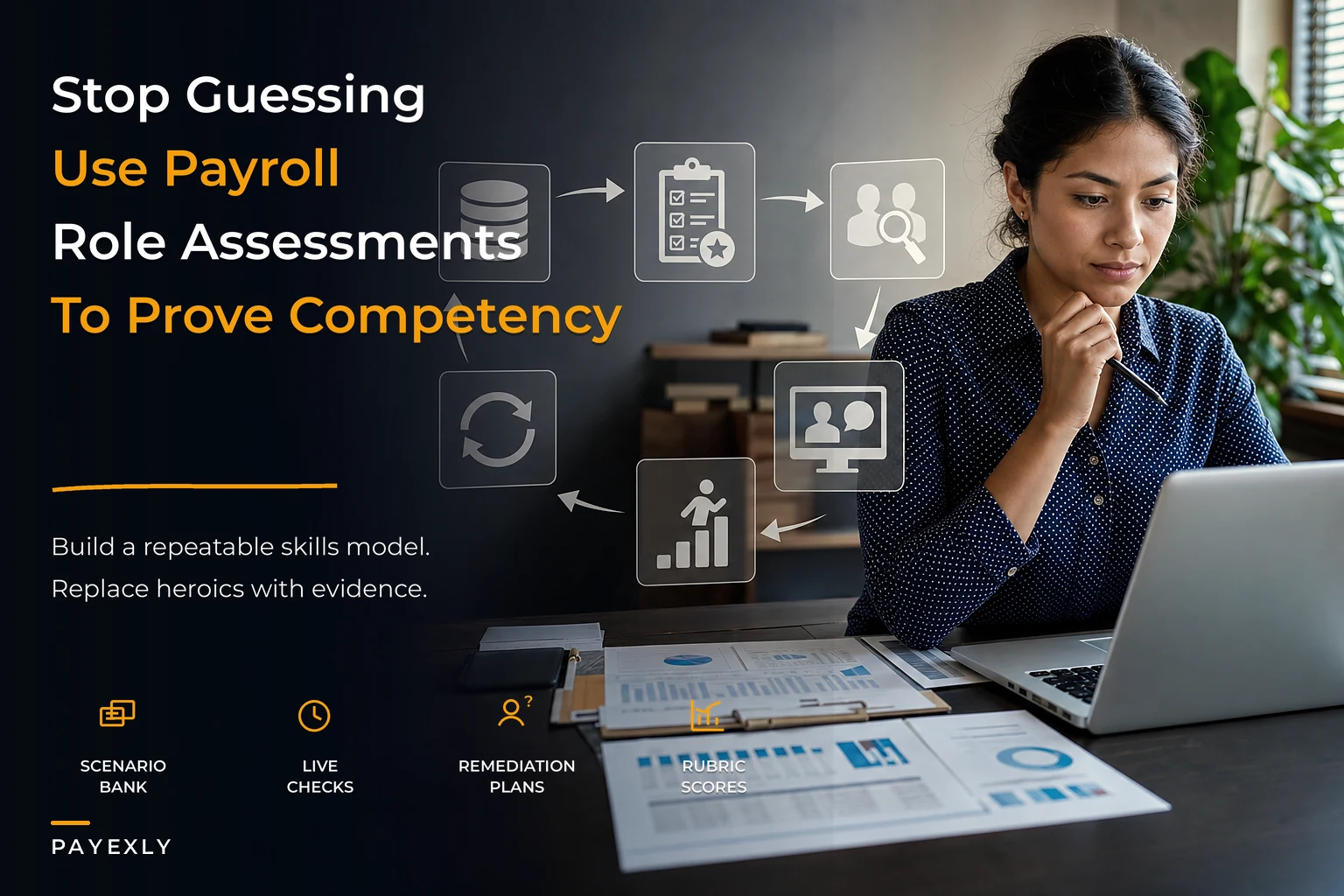

Every midmarket payroll function has a "that person." The one who knows why the Ohio local tax code is hardcoded weird, who remembers that the union dues file needs to be reformatted before upload, who can eyeball a gross-to-net variance and know within thirty seconds that a benefits deduction didn't load. When that person is out, payroll doesn't run smoothly. It runs on prayer.
This is the quiet risk sitting inside most payroll teams between 50 and 2,000 employees. The process technically works, so nobody looks under the hood. But the reason it works is undocumented knowledge living in one or two people's heads. That's not a team. That's a dependency wearing a team costume.
A payroll competency model is the fix, and it's a lot less bureaucratic than it sounds. At its core it answers one question: what does each role need to actually know and do, and how do we prove they can do it? Get that right and you stop depending on heroics — the late-night saves, the "I'll just handle it" moments that feel like dedication but are really structural fragility.
Why payroll teams end up running on individuals instead of roles
Payroll grows by accident. A company hires a payroll clerk when they hit maybe 40 employees. That clerk figures things out, builds workarounds, learns the quirks. The company grows to 300 people, adds a second processor, and instead of designing roles, they clone the first person's tribal knowledge — badly. The new hire learns maybe 60% of what the original knew, and the rest stays trapped.
A few patterns keep showing up when this happens:
-
No distinction between senior and junior work. Everyone does everything, which means everyone half-knows the hard stuff and nobody fully owns it.
-
Training is shadowing, not structure. New hires "sit with" someone for two weeks, absorb whatever comes up during those two weeks, and miss anything that happens to be off-cycle — like quarter-end filings or a garnishment order.
-
Nobody measures competency. People are assumed capable because they've "been doing it a while." Tenure gets confused with skill.
The result is a team where capability is invisible. You can't see who's actually strong at multi-state tax versus who's just been lucky enough not to break anything yet. And you definitely can't see it before a mistake proves it.
In practice, this usually surfaces during a crisis. Someone resigns, goes on leave, or gets poached, and suddenly there's a scramble to document a process that should have been documented years ago. The knowledge transfer happens in a two-week notice window, compressed and panicked — exactly when it's least reliable.
What actually breaks as the team scales
The failure isn't dramatic at first. It's a slow accumulation of small gaps.
Eliminate payroll errors and delays.
Payexly streamlines every payroll cycle ensuring accuracy and compliance.
- Automated payroll processing
- Real-time tax compliance
- Benefits & deductions management
No credit card required
At 100 employees, one processor can hold the whole thing in their head. At 500, spread across three or four states with a mix of hourly and salaried and a couple of benefit plans, the mental model stops fitting. Now you need specialization — someone who owns tax, someone who owns time and attendance integration, someone who owns garnishments and levies. Most teams don't formalize that. They let it happen informally, which means responsibilities overlap in some places and fall through cracks in others.
What the cracks look like in practice:
-
A retro correction gets processed by whoever's free, using whatever method they personally prefer, so the same type of correction gets handled three different ways.
-
Tax notices land and sit because it's genuinely unclear whose job it is to respond.
-
A new benefit deduction goes live and nobody validates it end-to-end because "the person who usually checks that" assumed someone else did.
None of these are knowledge problems in the abstract. They're role clarity problems. And they compound. Error rates don't climb steadily — they spike right around transition points, when the team is too big for one brain but hasn't been rebuilt around defined roles yet.
This is also where governance and access control start to matter more than people expect. When roles are fuzzy, permissions get fuzzy too — everyone ends up with edit rights to everything because it's easier than figuring out who actually needs what. If that sounds familiar, the mechanics of tightening it down are worth reading in role-based access models and audit-trail cadence, because competency and access really should be designed together.
The competency model, broken down by role
A competency matrix doesn't need to be elaborate. It needs to be honest about what each role requires and specific enough to assess against. The trick is separating knowledge (does this person understand multi-state nexus rules?) from execution (can they process a five-state pay run without errors?) from judgment (do they know when to escalate versus fix it themselves?).
Here's a simplified version of how the levels typically stack up:
| Role level | Core competencies | Typical failure if under-skilled | Judgment expectation |
|---|---|---|---|
| Payroll Clerk / Processor | Data entry accuracy, timecard imports, basic gross-to-net, standard deductions | Silent input errors that surface at net pay | Follows checklist, escalates anything unusual |
| Senior Payroll Specialist | Multi-state tax, garnishments, retro corrections, off-cycle runs | Mishandled corrections, incorrect withholding | Fixes routine exceptions, escalates novel ones |
| Payroll Lead / Analyst | Reconciliations, GL mapping, variance analysis, vendor coordination | Recon gaps that hide errors until quarter-end | Owns judgment calls, defines when leadership needs to know |
| Payroll Manager | Controls, compliance ownership, filing accountability, team capability | Systemic control failures, audit findings | Sets policy, owns risk decisions |
The value isn't the grid itself. It's what the grid forces you to admit. Once you lay it out, you can score your actual people against it and see the gaps. A common finding: you have three "senior" processors on paper, but only one can actually handle a multi-state garnishment without help. That's a real risk you couldn't see before because everyone had the same job title.
One mistake to avoid — don't build the matrix around the tools you happen to use. Build it around the outcomes. "Can accurately process a mid-period benefit change with correct proration" is a competency. "Knows how to click through the deductions screen in [vendor X]" is a task. Tasks change when you switch systems. Competencies don't.
Assessment: how to actually test for it
Self-assessment is nearly worthless here. Ask a payroll processor to rate their multi-state tax knowledge and they'll rate it based on the situations they've encountered, not the ones they haven't. Confidence and competence drift apart fast in payroll because so much of the hard stuff only shows up occasionally.
Better assessments are scenario-based. Give someone a realistic problem and watch what they do.
-
Build a scenario bank. Pull real (anonymized) situations from your own history — a bonus run that hit the wrong tax rate, a terminated employee who got a final check in the wrong state, a garnishment that arrived mid-cycle. Ten to fifteen scenarios covering the range of what the role actually faces.
-
Score against a rubric, not a gut feel. For each scenario, define what "meets expectations" looks like versus "needs development." Did they identify the issue? Did they know the correct fix? Did they know the downstream filing impact? Did they know when to escalate?
-
Separate diagnosis from resolution. Some people can spot that something's wrong but can't fix it. Others fix things without understanding why they were wrong. Both matter, and the rubric should score them separately.
-
Do it live, not on paper. Watching someone work through a scenario tells you more than a written answer. You see where they hesitate, what they check first, what they overlook.
A sample rubric line for "handle a mid-cycle garnishment" might break down like this:
-
- Needs development Applies the garnishment but misses priority ordering when multiple orders exist.
-
- Meets expectations Correctly applies withholding limits and priority rules, remits to the right agency.
-
- Exceeds Also flags the CCPA disposable-earnings calculation edge case and documents it for the file.
The point of scoring this way isn't to grade people harshly. It's to make development targeted. When you know exactly where someone lands, you don't send them to a generic training. You close the specific gap.
Here's a quick visual of the assessment workflow.
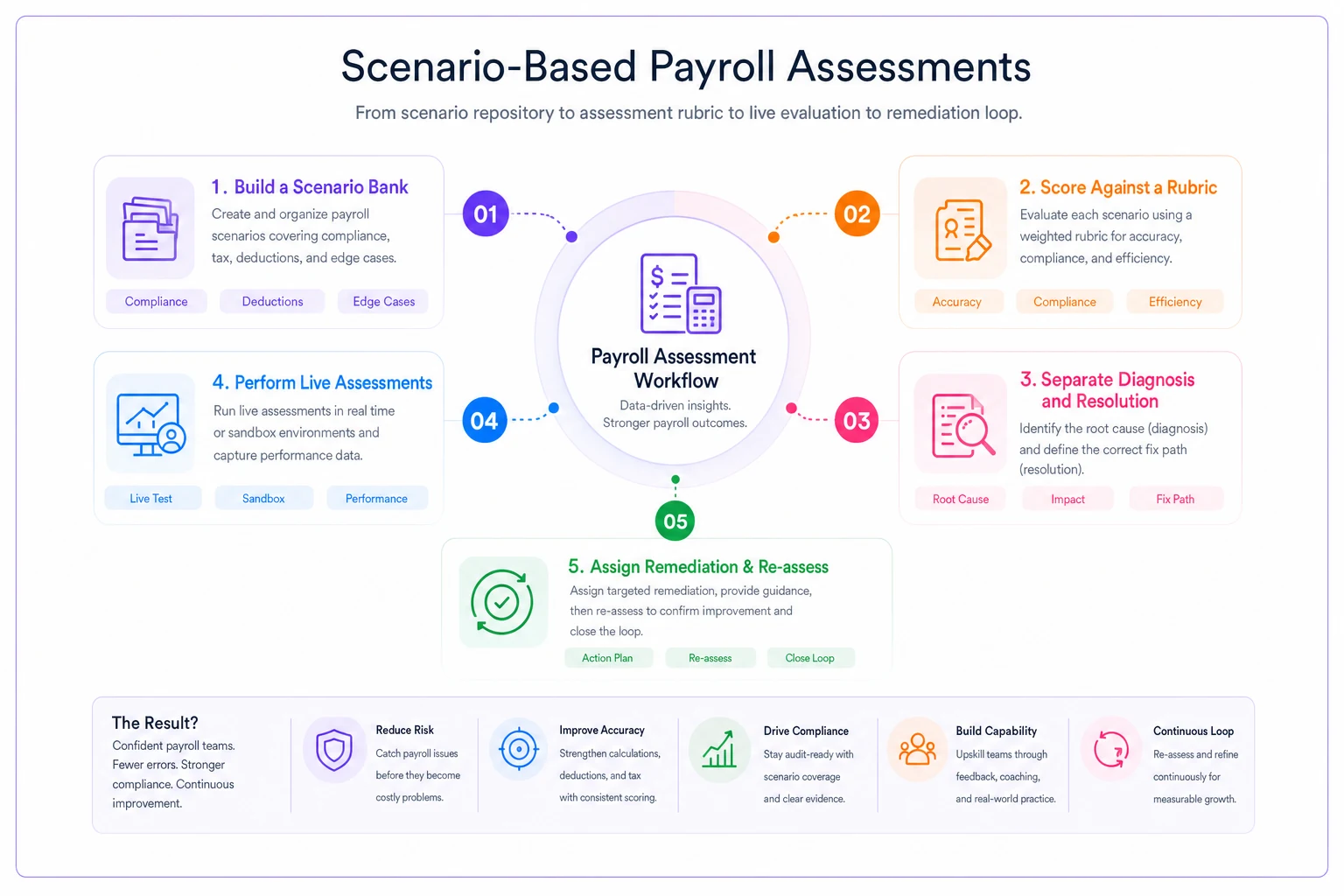
This diagram shows the flow from collecting scenarios through to remediation and reassessment, emphasizing the looped nature of targeted development.
Training modules that map to the gaps, not to a curriculum
Most payroll training fails because it's generic. Someone buys a compliance course, the whole team sits through it, and nothing changes because the course wasn't aimed at anyone's actual weak spots. Effective training modules are short, specific, and tied directly to a competency in the matrix.
A module library for a midmarket team might include:
-
Multi-state tax fundamentals — nexus, reciprocity, local taxes, work-from-home complications.
-
Garnishments and levies — priority rules, withholding formulas, state-specific remittance.
-
Retro corrections and off-cycle runs — when to use each, how to document, filing impacts.
-
Reconciliation and variance analysis — reading a gross-to-net recon, spotting anomalies before they hit.
-
Escalation and incident handling — knowing what's an emergency versus a routine fix.
Each module should end in an assessment against the same rubric you used to identify the gap. That closes the loop: identify weakness → train → re-assess → confirm. Without the re-assessment, you're just hoping the training worked.
Run short tabletop-style walkthroughs at the end of judgment-focused modules to build escalation instincts rather than just technical steps.
One pattern worth calling out: the highest-leverage training is almost never the fancy technical stuff. It's judgment — teaching people when to escalate. A processor who fixes something they shouldn't have touched can cause more damage than one who escalates something trivial. Building that instinct is best done through tabletop-style walkthroughs, which pairs naturally with the approach in the payroll incident-response playbook. Run the scenario, ask "what do you do," discuss why. That's where real judgment gets built.
Remediation: what to do when someone's below the bar
Assessment without a remediation path is just judgment. And that's where teams stall — they identify who's weak and then don't know what to do about it, so they do nothing, and the risk stays.
A remediation plan should be concrete and time-bound. Not "improve at multi-state tax" but "complete the multi-state module, then process the next three multi-state runs under review, then re-assess in six weeks." Specific competency, specific activities, specific checkpoint.
-
Gap is knowledge. The person is capable but hasn't been taught. This is the easy case — targeted training plus supervised repetition usually closes it.
-
Gap is experience. They know the theory but haven't done it enough. Structured exposure fixes this: route the relevant work to them deliberately, under review, until it's routine.
-
Gap is fit. Occasionally someone's in a role they can't grow into. This is rare but real, and pretending otherwise just moves the risk around. Better to move them to work that matches their strengths.
The mistake most managers make is treating all three the same — usually as knowledge gaps — and sending everyone to training. Training doesn't fix an experience gap or a fit gap, so it fails, and everyone concludes "training doesn't work" when the real problem was misdiagnosis.
A real scenario: what this looks like when it works
A manufacturing company with roughly 600 employees across four states, running weekly and biweekly cycles. Their payroll team was three people, all titled "Payroll Specialist," all supposedly interchangeable. In reality, one person — the linchpin — handled all multi-state tax, all garnishments, and all quarter-end reconciliations. The other two did data entry and standard runs.
When the linchpin took eight weeks of medical leave, the wheels came off. Two tax notices went unanswered past their deadline, triggering penalties in the low four figures. A garnishment was applied with the wrong priority order, which required a correction and an apologetic call to an employee. Quarter-end took nearly three weeks longer than usual because nobody else could run the reconciliations cleanly.
Afterward they built a competency matrix and assessed the two remaining specialists honestly. Both scored strong on standard processing but had real gaps on tax and garnishments — which the team had suspected but never confirmed. Over the next quarter they ran targeted modules and supervised reps. By the following quarter-end, both could handle multi-state runs and reconciliations independently, with the manager reviewing rather than doing.
The number that mattered most wasn't a cost saving. It was that the next time someone was out, payroll ran without a scramble. The team stopped having a single point of failure.
When this is worth the effort — and when it isn't
Building a full competency model isn't free. It takes time to design, assess, and maintain. So it's worth being clear about where it actually pays off.
It makes sense when:
-
You're past roughly 150–200 employees, or multi-state, or both. Complexity is what breaks single-person dependencies.
-
You've had a near-miss — a key person almost left, or was out during a critical cycle.
-
You're heading toward an audit, funding event, or acquisition where documented capability matters.
It's probably overkill when:
-
You're under 50 employees, single-state, with one competent processor. A good SOP and a documented backup plan cover you.
-
Your payroll is fully outsourced and your internal team just reviews. You still need someone who can catch errors, but the depth of a full matrix isn't necessary.
Who should not skip this: any company where the honest answer to "what happens if your best payroll person quits tomorrow?" is a long pause. That pause is the whole risk, quantified.
The competency work also sits directly on top of your governance structure. If roles and responsibilities aren't clearly defined at the process level, a competency matrix ends up assessing people against jobs that were never properly scoped. The two reinforce each other, which is why it's worth reading this alongside the payroll governance framework with RACI, SOPs and approval workflows — governance defines what the roles are, competency defines whether people can actually perform them.
Where systems and tooling fit
Once you've built a competency model, the ongoing work is keeping it alive — scoring people, tracking gaps, assigning training, re-assessing. Done in spreadsheets, this decays fast. The matrix gets stale, assessments happen once and never again, and within a year you're back to invisible capability.
Keeping competency records, assessment history, and role assignments in a shared system — rather than in one manager's head or a forgotten folder — means the model stays current as people join, grow, and leave. Payroll operations platforms that track role assignments and surface where knowledge concentrates make it easier to spot single points of failure before they become incidents, and to keep training tied to actual measured gaps rather than guesses. But that's secondary. The real work is the thinking: defining what each role must be able to do, testing honestly, and closing gaps deliberately.
The bottom line
Payroll teams that depend on heroics feel fine right up until they don't. The competency model is how you convert individual brilliance into institutional capability — so that being good at payroll is a property of the team, not a lucky feature of one person who happens to still work there.
Start small. Build the matrix. Assess honestly, even when it's uncomfortable. Train against the real gaps. Then re-check. Do that consistently and the panic-driven, two-week-notice knowledge transfers disappear, replaced by a team where anyone being out is an inconvenience instead of a crisis. That's the difference between a payroll function that survives its people leaving and one that doesn't.
Ready to simplify your payroll operations?
Join 2,000+ businesses using Payexly to reduce payroll overhead, ensure compliance, and enhance employee satisfaction.