



Three months ago, a 400-person logistics company almost missed payroll because their controller was out sick and nobody else had the passwords to approve the ACH batch. The backup person? They'd left the company six weeks earlier. The tertiary approver listed in their policy manual? That role hadn't existed for two years.
This wasn't some chaotic startup. They had policies. They had procedures. They even had a 47-page payroll manual that someone spent weeks creating. But their payroll governance framework was built for a different company—the 150-person operation they were four years ago, not the distributed beast they'd become with warehouse teams across three states and a remote back-office spread across seven time zones.
Mid-market companies occupy this weird operational space where you're too big to run payroll from a spreadsheet but not large enough to justify the byzantine control structures that Fortune 500s use. You need governance that actually works—something between "the owner approves everything" and "six committees review every timecard adjustment."
The governance gap that kills mid-market payroll operations
Most payroll frameworks fail because they're designed for the wrong company. Either they're enterprise templates dumbed down (badly) or they're small business processes that someone tried to scale up by adding more approval layers.
A manufacturing company with 280 employees recently showed me their payroll approval matrix. Seven different people had to sign off on overtime approvals. Not for the entire overtime batch—for each individual employee's overtime. Their payroll team was spending 18 hours every pay period just routing approvals through email chains. Meanwhile, actual payroll errors were happening because everyone was so focused on getting signatures that nobody was reviewing the underlying data.
The real problem wasn't too little control or too much. Their governance framework treated all decisions the same way. A $50 timecard adjustment required the same approval chain as a $15,000 commission calculation. A routine PTO entry needed the same documentation as a retroactive pay adjustment.
When everything requires maximum control, nothing actually gets controlled. People start rubber-stamping approvals just to keep things moving. Documentation becomes about checking boxes rather than creating useful audit trails. The framework becomes something to work around rather than work with.
RACI matrices that actually match how payroll works
A functional RACI matrix for payroll needs to reflect how work actually flows, not how an org chart says it should flow. Companies map RACI roles to job titles instead of actual workflows.
Eliminate payroll errors and delays.
Payexly streamlines every payroll cycle ensuring accuracy and compliance.
- Automated payroll processing
- Real-time tax compliance
- Benefits & deductions management
No credit card required
Take timecard approvals. In theory, the department manager is accountable. But what happens during month-end when that manager is traveling? Or when you have overnight warehouse crews whose manager works days? Or remote teams across time zones where "end of day Friday" means different things?
| Task | Responsible | Accountable | Consulted | Informed |
|---|---|---|---|---|
| Time entry validation | Payroll Specialist | Payroll Manager | Department Managers | — |
| Exception review (<$500) | Payroll Specialist | Payroll Manager | — | HR |
| Exception review (>$500) | Payroll Manager | Controller | Department Head | HR, Finance |
| Payroll calculation | Payroll Specialist | Payroll Manager | — | — |
| Final approval | Payroll Manager | Controller | — | CFO (if >$50k variance) |
| ACH release | Controller | CFO | Payroll Manager | — |
The escalation triggers are built into the workflow, not bolted on afterward. If the payroll specialist can't reach a department manager for timecard clarification within 4 hours of the processing deadline, it automatically escalates to the payroll manager who can make a provisional decision.
Notice what's not here? Multiple layers of "consulted" stakeholders who slow everything down. HR doesn't need to be consulted on routine time entries. The CFO doesn't need to approve every payroll run—only when something unusual happens.
You might think this leaves too much power with individual specialists. But when someone has clear accountability and the system escalates appropriately, you get faster decisions with better oversight than endless committee approvals.
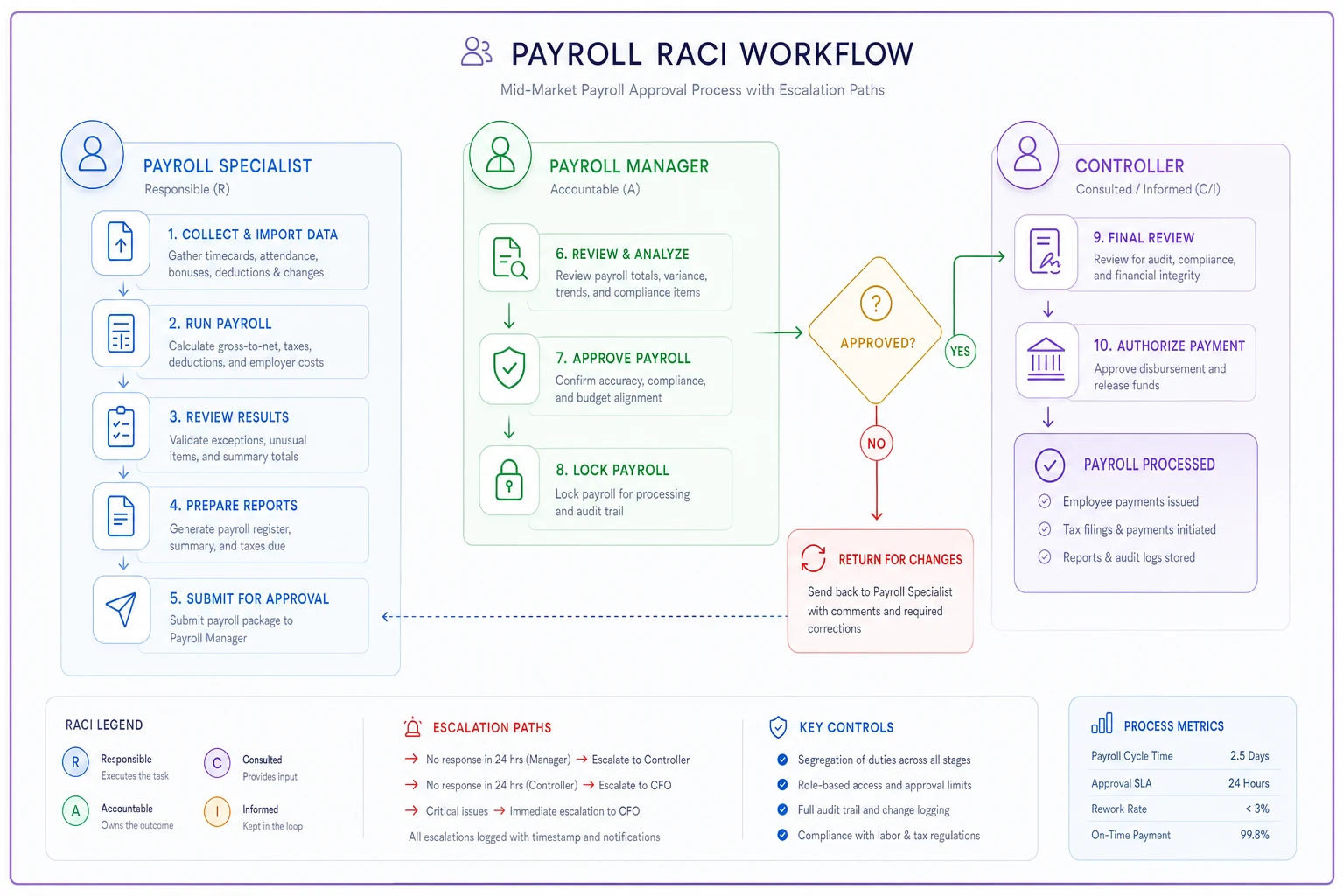
A simple workflow visualization of escalation and approvals.
SOPs that people will actually follow
The best SOP I've reviewed recently was three pages long. Not thirty. Three. It covered biweekly payroll processing for a 350-person distribution company, and their error rate was under 0.5%.
They built their SOPs around exception handling, not routine processing. The routine stuff was built into their workflow system—automated checks, required fields, system-enforced deadlines. The SOP focused on what happens when things go sideways.
Overtime Exception Processing
-
System auto-emails department manager at 3pm Thursday
-
Manager approves/adjusts via mobile app by 10am Friday
-
Auto-approved if no response by deadline (for amounts <$200)
-
Payroll processes normally
Exception Path:
-
Amount >$200 with no manager response
Routes to department VP
-
Amount >$500 total
Requires written justification (template provided)
-
Pattern detection (3+ weeks consecutive OT)
Triggers HR review
Documentation:
-
System logs all approvals with timestamp and IP
-
Justifications attached to employee record
-
Exception report generated weekly for finance review
The magic isn't the steps—it's that the SOP acknowledges managers won't always respond on time and builds in automatic handling instead of letting things pile up. Too many SOPs assume perfect compliance and break down the first time reality doesn't match the plan.
Approval workflows that balance speed with control
A healthcare services company with around 450 employees restructured their approval workflows after their payroll team nearly revolted. The old system required seventeen different approvals for a standard biweekly payroll run. Not for exceptions—for the normal, nothing-weird-happened, regular payroll.
They rebuilt around risk tiers instead of approval layers:
Tier 1: Auto-approved
-
Regular hours for salaried employees
-
Standard hours for hourly (within 5% of average)
-
Pre-approved PTO
-
Standard deductions
Tier 2: Single approval
-
Overtime under 10 hours per employee
-
Timecard adjustments under $200
-
PTO requests submitted late
-
New hire first paycheck (if properly onboarded)
Tier 3: Dual approval
-
Overtime over 10 hours
-
Retroactive adjustments
-
Manual checks
-
Commission calculations over $5,000
-
Termination final pays
The key shift was moving from "approve everything" to "approve what matters." Their payroll processing time dropped from 14 hours to about 6 hours per cycle. Error rate actually decreased because people were focusing attention where it mattered instead of blindly clicking through approval screens.
Building audit trails that protect without paralysis
Audit trails in mid-market companies usually fail in one of two ways. Either they capture everything in such detail that finding anything useful becomes impossible, or they capture so little that when something goes wrong, you can't figure out what happened.
A retail chain with 380 employees learned this the hard way during a Department of Labor audit. They had every timecard saved as a PDF. Every approval email. Every adjustment form. Thousands of documents, perfectly organized by pay period. But they couldn't answer the simple question: "Show us who approved this employee's reclassification from non-exempt to exempt status six months ago."
The approval was buried in an email thread that spanned three weeks and involved eight people. They had the documentation but couldn't produce a clean audit trail showing the decision path.
Capture these decision points:
-
Who made the change
-
When they made it
-
What the change was (before and after values)
-
Why they made it (category, not essay)
-
Who approved it (if required)
Skip these:
-
Every screen view
-
Every report run
-
Routine data entry
-
System-calculated values
-
Automatic processing steps
A distribution company implemented this approach using a simple change log structure. Every significant payroll decision gets logged with:
Date: 10/15/2024 14:32 User: Sarah Martinez Action: Adjust hours Employee: John Smith (ID: 4823) Previous value: 40.0 hours New value: 44.5 hours Reason: Missing punch correction Approval: Auto (under threshold) Note: Employee forgot clock-out 10/12
Clean, searchable, tells the story without requiring investigation. When auditors came through, they could pull any employee's history in seconds, not hours.
The real challenge: Maintaining velocity while adding control
Payroll governance frameworks decay. Fast. The beautiful RACI matrix you build today will be half-obsolete in six months as people change roles, teams restructure, and workflows evolve.
A technology company with around 300 employees discovered this when they realized their payroll errors were creeping up despite having "strong governance." Investigation revealed that roughly 40% of the approval paths in their system pointed to people who'd changed roles or left the company. The system kept working because people found workarounds—sharing passwords, doing approvals that weren't technically their job, asking IT for emergency access.
The framework hadn't failed. The maintenance had.
This is where AI-powered operational software starts making a real difference. Not by replacing human judgment, but by maintaining the governance framework automatically. When someone changes roles in the HRIS, the approval matrices update automatically. When someone's out sick, the system knows who the backup approver is without requiring a frantic Slack conversation.
The bigger value is in intelligent escalation. Instead of rigid approval paths, the system learns what's normal and what's not. A $300 overtime payment for a warehouse worker during busy season? Normal, process it. The same $300 overtime for an accounting clerk who's never worked overtime before? That gets flagged for review.
These operational platforms can spot patterns humans miss. Maybe certain types of adjustments happen repeatedly because there's a systematic issue with time tracking. Maybe specific managers consistently approve everything without question. The system can surface these patterns for process improvement instead of just logging them.
Making governance frameworks that evolve instead of decay
The best payroll governance framework wasn't the most comprehensive or sophisticated. It was built by a 420-person food service company, and its genius was in how it was designed to evolve.
Every quarter, they review their exception report. Not to punish errors, but to identify patterns:
-
Are certain approvals always getting delayed?
-
Are specific types of adjustments happening repeatedly?
-
Are some controls catching nothing while real issues slip through?
Then they adjust. Not overhaul—adjust. They might change a threshold from $200 to $300 if every single override gets approved anyway. They might add a control if they notice a new type of error emerging. They might remove an approval layer if it's become pure rubber-stamping.
Their framework isn't perfect. But it's alive, which beats perfect and static every time.
They track four metrics to gauge if their governance is working:
-
Processing time per payroll run
-
Error rate (by dollar value, not count)
-
Time to resolve exceptions
-
Number of emergency overrides needed
When any of these trends the wrong way for two consecutive periods, they dig into why. Usually, it's because the business changed but the framework didn't. New team structure, different types of workers, changed business patterns—something shifted and the governance needs to catch up.
Modern operational software makes this continuous improvement much more feasible. Instead of manually tracking metrics and patterns, the system generates insights automatically. It can tell you which approval steps are consistently the bottleneck, which exception types are increasing, and where your controls might be redundant.
The path forward for mid-market payroll governance
Building a payroll governance framework for a mid-market company isn't about copying what enterprises do or scaling up small business processes. It's about finding that sweet spot where you have enough control to prevent disasters but enough flexibility to actually operate.
Start with your highest-risk areas. For most companies, that's overtime approval, off-cycle payments, and retroactive adjustments. Build controls there first. Get those working smoothly before you add governance to lower-risk areas.
Document decisions, not activities. Your audit trail should tell the story of what changed and why, not create a second-by-second replay of every mouse click.
Build in evolution from the start. Your governance framework should have its own governance—a regular review cycle, clear ownership, and defined triggers for updates.
Remember that governance serves operations, not the other way around. Every control you add should solve a real problem you've actually experienced, not a theoretical risk someone might imagine. The moment your payroll team starts working around your governance framework instead of with it, you've lost the plot.
The companies that get this right aren't the ones with the thickest policy manuals or the most complex approval matrices. They're the ones where payroll runs smoothly, errors get caught before they matter, and the team can focus on accuracy instead of bureaucracy. That's what a functional payroll governance framework actually looks like.
The companies that get this right aren't the ones with the thickest policy manuals or the most complex approval matrices. They're the ones where payroll runs smoothly, errors get caught before they matter, and the team can focus on accuracy instead of bureaucracy. That's what a functional payroll governance framework actually looks like.
Ready to simplify your payroll operations?
Join 2,000+ businesses using Payexly to reduce payroll overhead, ensure compliance, and enhance employee satisfaction.