

Most first-time SOX projects treat payroll like an afterthought. It's usually one of the last cycles scoped, partly because everyone assumes payroll "already works" and partly because nobody wants to open that box. Then the external auditor asks for a control narrative on how you approve off-cycle payments, and suddenly there's a scramble to document a process that lives half in someone's head and half in a spreadsheet named payrollFINALv3.xlsx.
The pain isn't the controls themselves. It's the rework. Teams write narratives that don't match what actually happens, design controls they can't sustain, and then spend the quarter before filing re-testing everything because the first design failed. This article is about avoiding that loop — translating SOX objectives into payroll-specific control designs, writing narratives that survive walkthroughs, building test scripts that mean something, and sequencing remediation so your payroll team doesn't grind to a halt.
Why payroll SOX controls fail the first time
The core problem is a translation gap. SOX objectives are written in the language of financial reporting: completeness, accuracy, valuation, existence, cutoff, presentation. Payroll runs in the language of pay cycles, deductions, tax jurisdictions, and timecards. Someone has to sit in the middle and translate "accuracy of the payroll expense assertion" into "gross-to-net calculations are reviewed before the pay run posts."
When that translation is done badly — usually by a consultant who's never actually run a payroll — you get controls that sound rigorous but describe nothing real. A classic example: a control that reads "management reviews payroll for reasonableness each period." Reviews it how? Against what? Who signs off, and where's the evidence? During the walkthrough, the auditor asks the payroll manager to show them the last review, and there's nothing to show. That's a design deficiency before you've even tested operating effectiveness.
The second failure pattern is over-engineering. A company gets nervous and designs fifteen controls over a single pay cycle, half of which overlap. Now the payroll team has fifteen sign-offs to produce every two weeks, most of them redundant, and by month three they're rubber-stamping everything just to close the cycle on time. Controls that are too heavy don't get followed, and controls that don't get followed fail testing.
What works sits in the middle: a small number of well-placed controls at the points where money and data can go wrong, with evidence that's produced naturally as part of doing the work — not manufactured afterward for the auditor.
Mapping SOX objectives to payroll risk points
Before writing a single control, map where payroll can actually misstate the financials. Payroll touches the P&L (wage expense, employer taxes, benefits), the balance sheet (accrued payroll, tax liabilities, garnishment payables), and cash (net pay disbursement, tax deposits). Each of those is an assertion waiting to break.
Eliminate payroll errors and delays.
Payexly streamlines every payroll cycle ensuring accuracy and compliance.
- Automated payroll processing
- Real-time tax compliance
- Benefits & deductions management
No credit card required
Here's the translation most teams should start from:
| SOX objective (assertion) | What it means in payroll terms | Primary risk point |
|---|---|---|
| Completeness | All hours worked and all employees who should be paid are paid | Timecard capture, new-hire onboarding, terminations |
| Accuracy | Gross-to-net, tax withholding, and deductions are calculated correctly | Pay-rate changes, tax setup, benefit deductions |
| Existence / Occurrence | Only real employees for real work are paid | Ghost employees, duplicate payments, unauthorized off-cycle runs |
| Cutoff | Wages land in the correct period | Accruals for split pay periods, retro adjustments |
| Valuation | Accrued liabilities and PTO are measured correctly | PTO accrual logic, bonus and commission accruals |
| Presentation / Disclosure | Payroll is classified and disclosed properly in the GL | GL mapping, related-party comp, executive disclosures |
The insight most teams miss: you don't need a control for every cell. You need controls at the risk points in the third column, and those risk points often cover multiple assertions at once. A strong approval control over pay-rate changes protects accuracy, existence, and — indirectly — valuation. One well-designed control can carry a lot of weight if it sits at the right chokepoint.
If you already have a governance layer in place, this mapping is much easier. A clear RACI and defined approval workflows — the kind covered in a proper payroll governance framework with RACI, SOPs and approval workflows — gives you named owners and existing sign-off steps that can be formalized into SOX controls rather than invented from scratch.
Designing payroll controls that hold up
A control design is only as good as its five attributes: what it does, who performs it, how often, what evidence it leaves, and what happens when it catches something. Vague on any of these and you'll fail the walkthrough.
Here's the difference between a control that fails and one that holds, using pay-rate changes as the example.
Weak design: "Payroll reviews rate changes for accuracy each pay period."
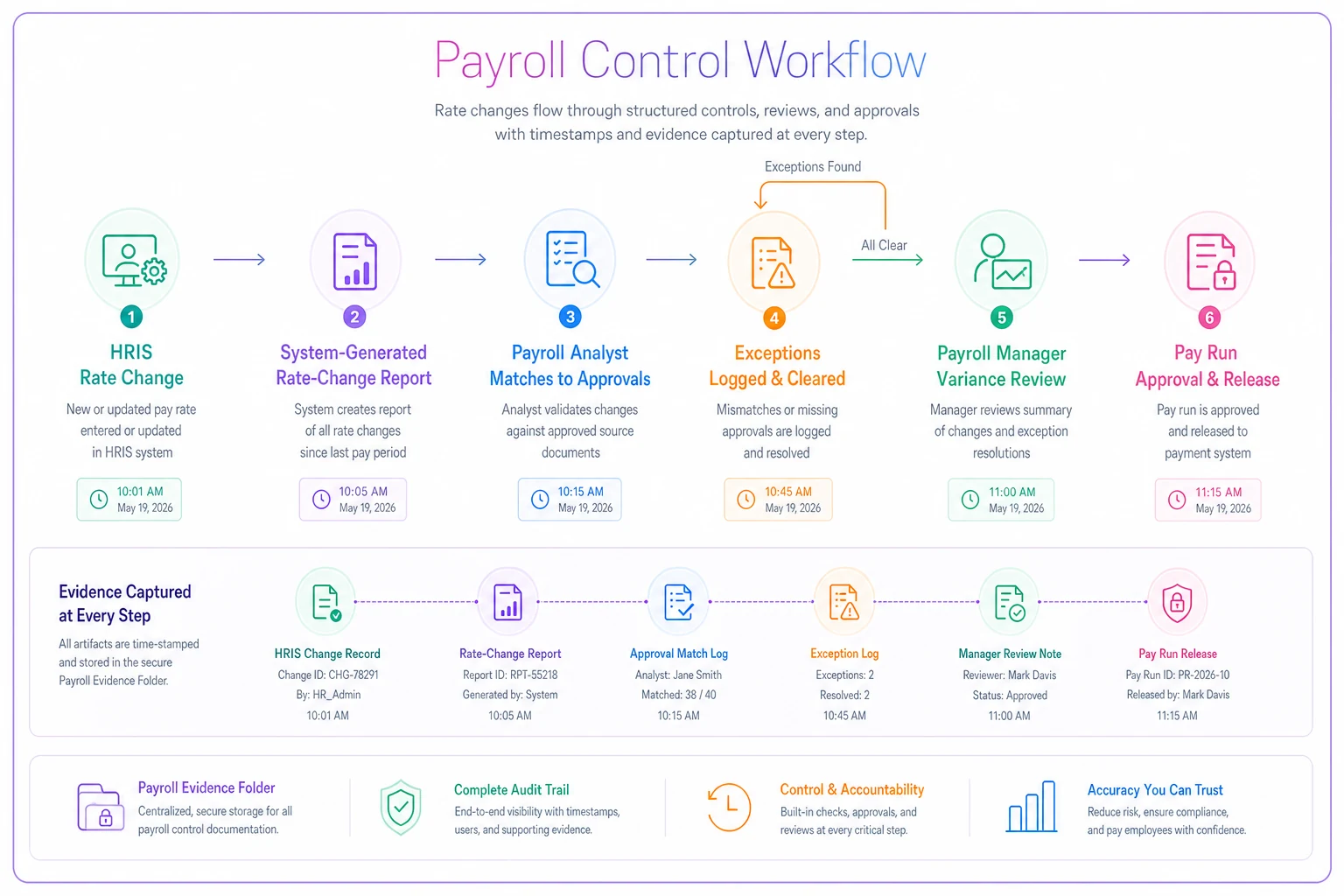
Strong design: "Before each pay run posts, the payroll analyst pulls the rate-change report from the HRIS covering all rate modifications since the prior cycle. Each change is matched to an approved change form (or HRIS approval record) authorized by the employee's manager and, for changes above 15%, by an HR business partner. The analyst signs and dates the report; exceptions are logged and cleared before the run is released. The signed report and underlying approvals are retained in the period's payroll evidence folder."
The second version tells the auditor exactly what to test and where to find evidence. It also tells the payroll team exactly what to do — a good control design is also a good SOP. That part often gets overlooked.
A few design principles that separate controls that survive from ones that don't:
-
Anchor to a system-generated report, not a manual list. Auditors trust a report the analyst can't quietly edit. If the rate-change report comes straight out of the HRIS, its completeness is defensible.
-
Define the threshold that triggers escalation. "Reviews for reasonableness" is untestable. "Investigates any employee whose net pay changed more than 20% versus prior period" is testable.
-
Make evidence a byproduct of the work. If the analyst has to do something extra to create evidence, it won't happen consistently. The best controls generate their own paper trail.
-
Separate preparation from approval. The person who enters a change should not be the person who approves the pay run. This one attribute resolves a large share of existence and fraud risk.
Below is a workflow of a strong control design from change to approval.
One pattern worth calling out: preventive controls beat detective controls in payroll, because once a bad pay run posts and hits people's bank accounts, unwinding it is expensive and visible. A control that catches a duplicate payment before disbursement is worth far more than a reconciliation that finds it a week later.
Writing sample narratives that match reality
The narrative is the document the auditor reads before they ever talk to your team. If it describes a process nobody actually follows, the walkthrough exposes it immediately and you're rewriting under time pressure.
> Timecards are captured in the timekeeping system and approved by direct managers by end of day Monday of pay week. On Tuesday the payroll analyst imports approved time into the payroll system. The analyst reconciles imported hours to the timekeeping system's approved-hours report and investigates any variance greater than the defined threshold; the reconciliation is documented and retained. The analyst then processes rate changes, new hires, terminations, and deduction updates, each supported by an approved HRIS record. A preliminary payroll register is generated. The payroll manager performs a period-over-period variance review of gross pay, headcount, and net pay, investigating movements above defined thresholds, and signs the register. Following approval, the pay run is released for direct deposit; tax deposits are scheduled per the applicable deposit schedule. After posting, the payroll journal entry is reviewed against the register before it is posted to the GL by finance.
Notice that the narrative embeds the controls — the reconciliation, the variance review, the register approval, the JE review — inside the flow. You're not writing a separate "controls list" and a separate "process story." The narrative is the process story, with control points called out where they happen.
The common mistake is writing the narrative in the aspirational voice — describing the process you wish you had. Write what happens today. If today's process has a gap, that gap is what remediation is for. A narrative that oversells current reality just guarantees a painful walkthrough and a control failure.
For the year-end and quarterly disclosure side, your narrative should tie into how you package reconciliations and evidence at close. The mechanics of that — the reconciliations, the W-2/1099 packaging, the evidence binder — are worth documenting consistently, and the approach in this year-end payroll close and auditor-ready evidence guide maps cleanly onto the cutoff and completeness assertions auditors focus on at period end.
Building test scripts auditors can actually run
A test script is the auditor's recipe for checking whether a control operated as designed, across a sample of periods. If your design is strong, the test script almost writes itself, because you've already specified the evidence.
A usable test script has four parts: the control being tested, the population and sample, the specific attributes to verify, and the pass/fail criteria. Here's a worked example for the pay-rate change control described earlier:
-
Control reference Rate-change review, performed each pay period by the payroll analyst.
-
Population and sample All pay periods in the testing window (say 26 for a bi-weekly cycle). Select a sample of periods — for a control operating this frequently, a sample of 25 is common for full-year operating-effectiveness testing.
-
Attributes to verify for each sampled period - The rate-change report was generated from the HRIS and dated within the period. - Each change on the report ties to an approved change record. - Changes above the 15% threshold show HR business partner approval. - The analyst's sign-off is present and dated before the pay run's release date. - Any logged exceptions were cleared prior to release.
-
Pass/fail criteria The control passes for a period if all attributes are met. Any period missing evidence, showing an unapproved change, or showing sign-off dated after release is a deviation. The number of allowable deviations depends on the sample size and your firm's methodology — but plan for zero if you can, because a single "approved after the fact" finding tends to draw scrutiny.
The thing that trips people up: auditors don't just test that the control happened — they test that it happened in the right order and at the right time. A sign-off dated the day after the pay run released technically shows a review, but it can't have prevented anything. Timestamps matter. This is exactly why your evidence trail needs to be time-stamped and tamper-evident, and why a solid approach to payroll event logging and telemetry pays off during testing — when the auditor asks "how do you know this review happened before release?", a system log showing the sequence is a much better answer than a signature on a printout.
A phased remediation plan that doesn't freeze payroll
This is where most IPO-track companies hurt themselves. They discover a stack of design gaps three months before their target readiness date and try to fix everything at once — new approval workflows, new segregation of duties, new reconciliations, all dropped on the payroll team in the same cycle. Payroll is a hard deadline every two weeks; you cannot afford to have the team learning five new controls while also making sure 400 people get paid on time. Something breaks, usually the actual payroll.
Phase 1 — Documentation and low-friction fixes (weeks 1–4). Formalize what already works. If the payroll manager already reviews the register but doesn't sign it, add the sign-off. If reconciliations happen but aren't retained, start retaining them. These changes require almost no behavior change and immediately close a batch of "design exists but no evidence" gaps. This phase is mostly about capturing reality, not changing it.
Phase 2 — Segregation of duties and access (weeks 4–10). This is where real change starts. Separate whoever enters changes from whoever approves the run. Tighten system access so people can't both create a vendor/employee and pay them. This phase is disruptive because it changes who does what, so pilot it over two or three cycles before declaring it "in operation" — testing a control that's only existed for one cycle gives you a tiny population and shaky evidence.
Phase 3 — Preventive controls and thresholds (weeks 8–14). Layer in the variance reviews, the duplicate-payment checks, the pre-release exception clearing. Define the actual thresholds (net pay change %, headcount variance) using a few periods of your own data so they're calibrated, not arbitrary. A threshold set too tight floods the team with false exceptions; set too loose and it catches nothing.
Phase 4 — Sustained operation and evidence buildup (weeks 12+). Controls need an operating history before an auditor can conclude they're effective. You want several clean cycles under each control before your testing window closes. This is why starting remediation early matters — you can't compress the requirement that a control simply run for a while.
A short checklist for keeping remediation from derailing payroll:
-
Never introduce more than one net-new control per pay cycle to a given role.
-
Pilot every new approval step for at least two cycles before it's "live" for SOX purposes.
-
Calibrate every threshold against your own historical pay data, not a generic benchmark.
-
Keep a running gap-remediation log with owner, target cycle, and current status.
-
Freeze new control changes in the two cycles before your testing window closes so operating history is clean.
Pilot every new approval step for at least two cycles before it's "live" for SOX purposes.
Freeze new control changes in the two cycles before your testing window closes so operating history is clean.
A realistic scenario
A mid-market SaaS company, roughly 380 employees across four states, started SOX readiness about ten months before their target filing. Their payroll ran fine operationally, but the first control gap assessment found the usual problems: the payroll manager reviewed each run but left no evidence, the same analyst who entered rate changes also approved the pay run, and off-cycle payments went out on email approval with nothing retained.
Instead of fixing everything in one quarter, they phased it. Documentation and sign-offs went in first — that alone closed about a third of the gaps within a month, because the work was already happening. Segregation of duties took longer; splitting entry from approval meant training a second person and re-sequencing the Tuesday-to-Thursday workflow, and they piloted it across three cycles before calling it operational. Threshold-based variance reviews came last, calibrated off six months of their own registers so the exception queue stayed manageable — around five to eight flagged items per cycle rather than the fifty-plus they'd have gotten from an arbitrary 10% rule.
By the time the external auditors tested, most controls had six or more clean cycles behind them. The controls with the least operating history drew the most testing questions, which is exactly the pattern you'd predict. Total payroll headcount didn't change. No pay run was late during the transition. The rework loop that usually eats a quarter mostly didn't happen, because they never tried to test a control that had only run once.
When to bring in outside help — and when not to
Not every company needs a Big Four readiness team for payroll. If your pay is largely standard — hourly and salaried, a couple of states, a mainstream payroll platform — your own team plus a competent internal audit or controls consultant can usually design and document payroll controls without heavy outside spend. The process is well-trodden and the risk points are predictable.
Where outside help earns its cost: complex or non-standard compensation. Heavy commission structures, equity comp, multi-country payroll, large populations of contractors near the classification line, or acquisitions that left you running two payroll systems in parallel. In those cases the assertions get genuinely hard — valuation and cutoff on commission accruals, presentation on equity comp — and an experienced hand saves you from designing controls that miss the real risk.
Who should not rush this: a company that's 18-plus months from any realistic filing. Designing controls too early, before your processes and systems have stabilized, means you'll rewrite most of them anyway. Get your governance, your data, and your workflows stable first. Controls layered on a shaky process just make the shakiness official.
Bringing it together
Payroll SOX readiness fails when it's treated as a documentation exercise done in a rush, and it succeeds when it's treated as a translation problem solved early. Map the assertions to real risk points. Design a small number of controls at the chokepoints where money and data actually go wrong. Write narratives that describe today, not the fantasy version. Build test scripts straight off your evidence. Sequence remediation so your payroll team gets one change at a time and every control has room to build an operating history.
The companies that sail through payroll testing aren't the ones with the most controls. They're the ones whose controls describe what genuinely happens, leave evidence as a natural byproduct, and were in place long enough to prove they work. Give yourself the runway, resist the urge to over-engineer, and the endless rework loop mostly disappears.
Payroll SOX readiness fails when it's treated as a documentation exercise done in a rush, and it succeeds when it's treated as a translation problem solved early. Map the assertions to real risk points. Design a small number of controls at the chokepoints where money and data actually go wrong. Write narratives that describe today, not the fantasy version. Build test scripts straight off your evidence. Sequence remediation so your payroll team gets one change at a time and every control has room to build an operating history.
The companies that sail through payroll testing aren't the ones with the most controls. They're the ones whose controls describe what genuinely happens, leave evidence as a natural byproduct, and were in place long enough to prove they work. Give yourself the runway, resist the urge to over-engineer, and the endless rework loop mostly disappears.
Ready to simplify your payroll operations?
Join 2,000+ businesses using Payexly to reduce payroll overhead, ensure compliance, and enhance employee satisfaction.