
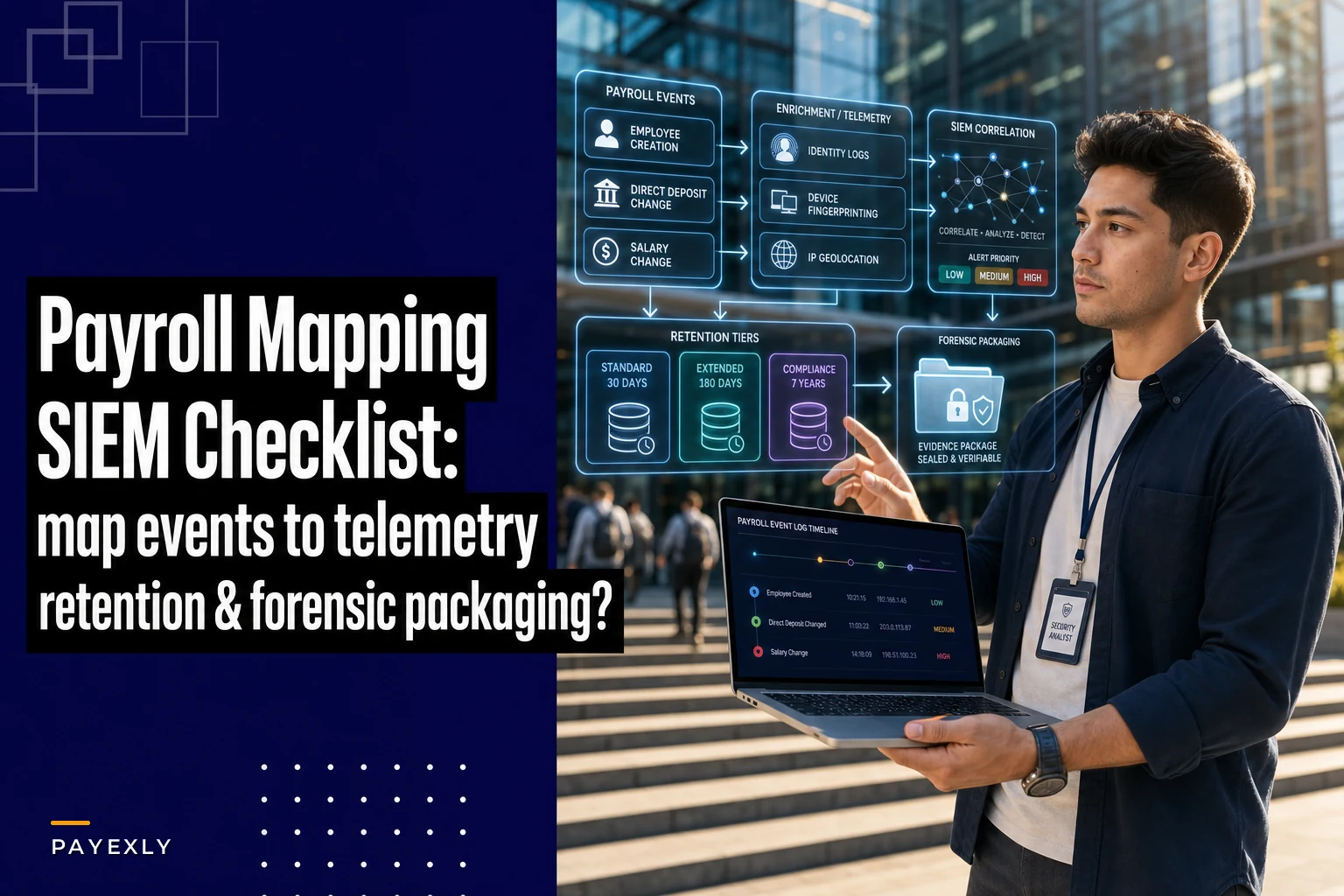

Most companies discover their payroll logging SIEM setup is broken at the worst possible moment—during an actual incident. Whether it's a payroll supervisor running ghost employees, a terminated IT admin still accessing systems weeks after departure, or an external breach targeting direct deposit changes, the gap between what you logged and what investigators need becomes painfully obvious, painfully fast.
By the time you realize your telemetry is insufficient, the evidence has either been overwritten, anonymized too aggressively, or never captured in the first place. You're left explaining to auditors, law enforcement, or insurance companies why critical payroll events simply vanished.
The disconnect between payroll systems and security infrastructure
Payroll platforms and SIEM tools speak entirely different languages. Your payroll system tracks business events—salary changes, tax withholding adjustments, direct deposit modifications. Your SIEM thinks in network packets, authentication attempts, and API calls. The translation layer between these two worlds is where forensic readiness typically falls apart.
Take a mid-sized company running ADP or Paychex alongside Splunk or Sentinel. The payroll system logs that "User X changed Employee Y's bank account" but the SIEM only sees "HTTP POST to /api/v2/employees/update at 14:32:07." When investigators ask who authorized that change and from what device, good luck correlating those two data points six months later.
It gets worse when you factor in retention requirements. Payroll data often needs seven years of storage for tax purposes, but your SIEM might rotate logs every 90 days because of storage costs. Meanwhile, privacy regulations push toward anonymization or deletion, creating a situation where compliance with one requirement directly conflicts with another.
Critical payroll events that demand SIEM correlation
Not all payroll activity carries equal forensic weight. Certain events show up consistently across incident timelines—these are your priority targets for payroll logging SIEM integration.
Eliminate payroll errors and delays.
Payexly streamlines every payroll cycle ensuring accuracy and compliance.
- Automated payroll processing
- Real-time tax compliance
- Benefits & deductions management
No credit card required
Direct deposit changes sit at the top of the risk pyramid. A single unauthorized routing number modification can drain thousands before anyone catches it. Your SIEM needs to capture not just the change itself but the surrounding context—was this during business hours? Did the request come from a recognized device? Were there failed attempts beforehand?
New employee creation events are another high-risk vector, especially when paired with immediate direct deposit setup and an accelerated first payment. Ghost employee schemes tend to follow recognizable patterns—employees added just before payroll runs, minimal deduction elections, addresses that match existing employees. Your telemetry needs to preserve those relationship indicators.
Salary and rate modifications warrant attention when they exceed certain thresholds or land outside standard review cycles. A 3% annual increase is noise. A 47% bump three days before termination is a red flag. The SIEM correlation should factor in both magnitude and timing.
Tax withholding adjustments can look benign but are a common manipulation vector. Dropping federal withholding to zero generates an immediate cash flow bump that might go unnoticed for months. When combined with address changes or banking modifications, these events start painting a clear picture.
Mapping payroll workflows to security telemetry
Translating payroll events into SIEM telemetry requires deliberate field mapping and event enrichment. Raw payroll logs rarely contain the security context investigators need.
-
Employee ID
47293
-
Old salary
67500
-
New salary
71000
-
Changed by
hradmin
-
Timestamp
2024-01-15 09:47:23
Forensic investigators need something more like:
-
Source IP address and geolocation
-
Device fingerprint and OS details
-
Authentication method (password, MFA, SSO)
-
Session duration and prior actions in that session
-
Approval chain and authorization documents
-
Historical baseline for that user's activities
That enrichment comes from correlating your payroll platform's audit logs against identity management systems, network infrastructure, and endpoint telemetry. Each payroll vendor exposes different fields through their APIs and log exports—understanding those limitations shapes the entire logging architecture.
For businesses already running robust access control frameworks, SIEM integration becomes an extension of existing audit trails. The key is making sure those trails survive long enough and contain enough detail for forensic reconstruction.
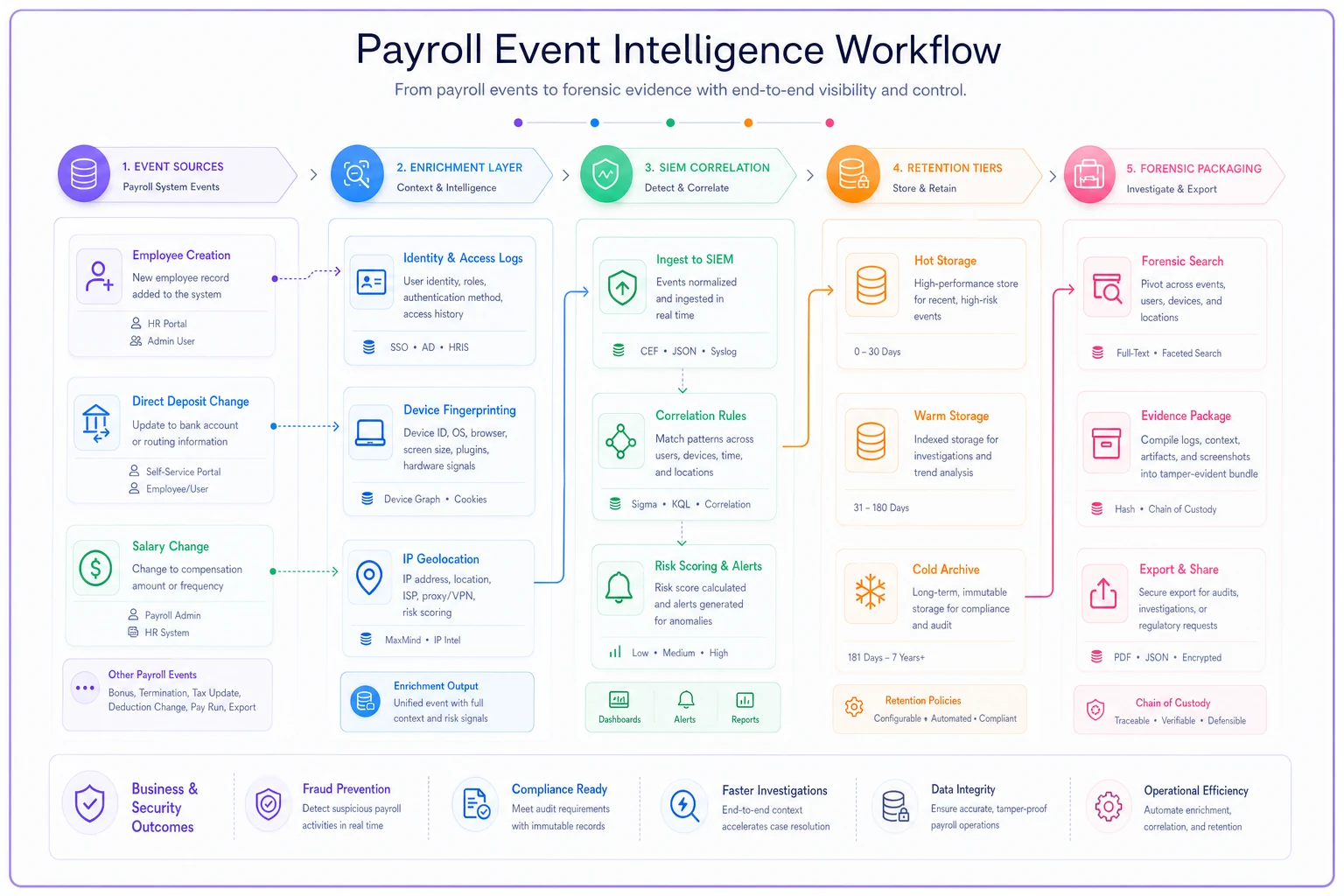
This diagram shows how payroll events flow through enrichment, correlation, and storage tiers to produce a forensic-ready trail.
Retention windows that balance compliance, storage, and investigation needs
The retention equation involves competing pressures that don't resolve neatly. Tax authorities want seven years. Privacy regulations demand minimization. Storage costs push toward shorter windows. And investigation timelines stretch in unpredictable directions.
| Tier | Retention | Description |
|---|---|---|
| Tier 1 (0–90 days) | 0–90 days | Full fidelity logs with complete user identification, IP addresses, and session details. This covers most fraud discovered within typical detection windows. Storage stays in hot/warm SIEM tiers for rapid querying. |
| Tier 2 (91 days–1 year) | 91 days–1 year | Pseudonymized user identifiers with reversible encryption keys held in escrow. IP addresses truncated to subnet level. Detailed session data compressed but recoverable. This tier moves to cold storage but remains searchable within 24-hour SLAs. |
| Tier 3 (1–3 years) | 1–3 years | Aggregated event statistics with anonymized actors. Individual transactions are preserved but stripped of personally identifiable details except where legally required. The focus shifts from who did what to what patterns occurred. |
| Tier 4 (3–7 years) | 3–7 years | Regulatory minimum dataset. Only events with tax or legal implications retained. Full anonymization except for data explicitly required by statute. |
Implementation varies by platform. Splunk users might use data models with scheduled searches populating summary indexes. Sentinel customers could use Logic Apps triggering Azure Data Factory pipelines to archive and transform data between storage tiers.
Keep reversible encryption keys in a separate escrow solution to allow timely, auditable de-anonymization for investigations without exposing keys in the SIEM.
A tiered retention approach with progressive anonymization is what actually works in practice:
Anonymization techniques that preserve investigative value
The tension between privacy and forensics doesn't have a clean answer—you can't just pick one. The goal is strategic anonymization that protects employee privacy while keeping enough signal for investigation.
Tokenization works better than deletion. Replace employee IDs with rotating tokens that maintain referential integrity within bounded time windows. An employee's January 15th actions share the same token as their January 20th activities, but February generates a new token. Behavioral analysis stays intact; long-term tracking doesn't.
For salary and compensation data, differential privacy makes sense. Store ranges or percentiles instead of exact figures. A $72,000 salary becomes "60th–70th percentile for role" or a "$70k–$75k band." Statistical significance for fraud detection is preserved; individual exposure is reduced.
Geographic data requires progressive truncation—full IP for 30 days, then /24 subnet, then /16, then geographic region. More detail than most investigations actually need beyond the immediate response window is rarely justified.
Timestamp fuzzing offers another protection layer for low-risk events. Rounding check-in times to the nearest 15 minutes or batching routine transactions into hourly windows limits the ability to build detailed individual profiles without destroying trend visibility.
Building forensic-ready evidence packages
When incidents occur, the quality of your evidence package determines whether investigations go anywhere. Poor packaging leads to inadmissible evidence, failed prosecutions, or denied insurance claims. Structure matters as much as content here.
Chain of custody documentation tracking every system that touched the data, every transformation applied, and every person who accessed the evidence. Not just timestamps and usernames—cryptographic hashes proving data integrity and detailed logs of every query run against the dataset.
Context mapping connecting payroll events to business processes. Investigators unfamiliar with your payroll cycles need to understand why a particular change matters. Include organizational charts, approval hierarchies, and standard operating procedures active during the incident window.
Timeline reconstruction with correlated events from multiple sources. Don't just dump raw logs. Build a narrative showing the sequence of actions across systems—if someone changed direct deposit information, show the email access, payroll login, change submission, and approval in chronological order with supporting evidence from each system.
Baseline comparisons that give anomalies context. Provide historical patterns for comparison—typical login times, common IP ranges, normal transaction volumes. This turns suspicious events into clear deviations from established behavior.
Technical metadata about log sources, retention policies, and anonymization procedures. Include SIEM configuration exports, parsing rules, and field mappings. Transparency here helps external investigators understand potential gaps or limitations in the evidence.
For companies following structured governance frameworks, these packages become extensions of existing documentation. The RACI matrices and approval workflows provide crucial context for determining whether observed actions violated established procedures.
A realistic implementation scenario
A 200-employee manufacturing company found their payroll logging SIEM gap during a routine audit. Three ghost employees had collected around $47,000 over eight months. The perpetrator—a payroll supervisor—had deleted local logs, and the SIEM had only been ingesting authentication events, not payroll changes.
They started by mapping their UKG Ready platform's audit capabilities to Elastic Security. UKG's API exposed 43 different event types, but only 12 carried real forensic value. They prioritized:
-
Employee creation and termination
-
Pay rate changes exceeding 10%
-
Direct deposit modifications
-
Tax withholding adjustments
-
Manual check requests
-
Timecard overrides
Each event got enriched with data from Okta SSO logs, Office 365 audit trails, and VPN connection records. Correlation happened through email address as the common key, with fallback to employee ID when email wasn't available.
Storage costs shaped their retention strategy. Hot storage for 90 days ran about $1,200/month for 50GB daily ingestion. Older data moved to S3 with Athena queries available for investigations, dropping costs to roughly $140/month for the same volume. Critical events got duplicated to an immutable compliance bucket with seven-year retention.
Anonymization rolled out in phases. Month one established the tokenization system. Month two added salary banding and IP truncation. Month three implemented the full tiering system. They kept parallel non-anonymized data for 60 days to verify the anonymization didn't break existing detection rules.
Six months later, they caught another fraud attempt in real-time. A terminated employee's credentials were used to create a new ghost employee. The SIEM correlation between the termination event, unauthorized access, and new employee creation triggered an immediate alert. The forensic package took four hours to compile instead of three weeks and contained everything needed for prosecution.
Technical checklist for payroll-SIEM integration
Event collection validation:
-
Verify all high-risk payroll events generate logs
-
Confirm log delivery to SIEM within acceptable latency
-
Test failover mechanisms for log shipping
-
Validate parsing rules extract all required fields
-
Ensure timezone normalization across all sources
Retention and storage verification:
-
Document storage tiers and transition rules
-
Test data recovery from each tier
-
Verify compression ratios meet capacity planning
-
Confirm backup procedures for compliance data
-
Validate immutability controls on forensic archives
Anonymization testing:
-
Verify tokenization maintains referential integrity
-
Test reversal procedures for active investigations
-
Confirm geographic truncation preserves enough detail
-
Validate salary banding maintains statistical properties
-
Ensure timestamp fuzzing doesn't break correlations
Forensic package generation:
-
Test evidence export under time pressure
-
Verify chain of custody documentation completeness
-
Validate cryptographic hashing of evidence files
-
Confirm package includes all required metadata
-
Test import into common forensic analysis tools
Correlation rule effectiveness:
-
Validate cross-system event correlation accuracy
-
Test detection rules with anonymized data
-
Verify baseline calculations remain accurate
-
Confirm alert generation within required timeframes
-
Measure false positive rates after anonymization
Validate cross-system event correlation accuracy
Maintaining forensic readiness as systems evolve
Payroll systems change constantly. New features appear, APIs evolve, log formats shift. Your payroll logging SIEM integration needs regular maintenance to stay forensically sound.
Schedule quarterly reviews of event mappings. Payroll vendors rarely announce logging changes prominently—they're buried in release notes or discovered when correlations quietly break. A systematic review catches those changes before they create investigation gaps.
AI automation in payroll processing introduces new logging challenges worth thinking through. When automated systems process exception requests or adjust calculations, the audit trail needs to capture not just the outcome but some record of the decision logic—model versions, confidence scores, the kind of metadata that didn't exist in traditional payroll workflows and that most SIEM configurations aren't built to handle yet.
Test your forensic packages regularly. Tabletop exercises where teams compile evidence packages for simulated incidents reveal gaps in documentation, missing correlations, and unclear procedures that would derail a real investigation. Running one of these annually at minimum is worth the time.
Monitor storage costs and compression effectiveness monthly. As data volumes grow and retention windows extend, small inefficiencies compound into real expenses. A 10% improvement in compression or a smarter tiering strategy can save thousands annually while maintaining forensic readiness.
Update anonymization procedures as privacy regulations evolve. Building flexibility into the anonymization pipeline—through configurable rules rather than hard-coded transformations—makes adaptation far less disruptive when requirements shift.
Beyond compliance to operational insight
Effective payroll logging SIEM integration does more than satisfy auditors. The same telemetry that catches fraud also identifies operational inefficiencies. Patterns of retroactive adjustments can signal training gaps. Clusters of password resets might point to UI problems. Unusual approval delays often reveal workflow bottlenecks that nobody has bothered to surface yet.
When you build payroll logging infrastructure with forensic readiness in mind, you end up with a foundation for operational intelligence as a side effect. The enhanced telemetry, careful retention planning, and thoughtful anonymization that serve investigation needs also enable analytics that basic logging simply can't support.
The businesses that treat payroll logging SIEM integration as a pure compliance checkbox miss most of the value. Those that recognize it as critical operational infrastructure—protection against threats while revealing optimization opportunities—extract significantly more from the same investment.
Your payroll data tells a story about your organization's operations, culture, and risk exposure. Building forensic-ready logging ensures you can actually read that story when it matters, whether during an investigation, an audit, or a planning conversation. The key is starting with the end in mind—not just collecting logs, but creating an evidence foundation that holds up under scrutiny.
Your payroll data tells a story about your organization's operations, culture, and risk exposure. Building forensic-ready logging ensures you can actually read that story when it matters, whether during an investigation, an audit, or a planning conversation. The key is starting with the end in mind—not just collecting logs, but creating an evidence foundation that holds up under scrutiny.
Ready to simplify your payroll operations?
Join 2,000+ businesses using Payexly to reduce payroll overhead, ensure compliance, and enhance employee satisfaction.