

Most payroll teams have policies. What they don't have is any reliable way to prove those policies are being followed on any given Tuesday. The policy PDF says "all off-cycle payments require secondary approval." The actual pay run has three off-cycle checks that went out with one approver because the second person was on PTO and someone had a flight to catch.
That gap — between what the policy says and what the system does — is where most payroll risk actually lives. And it's not a policy-writing problem. The policies are usually fine. The problem is that nobody built the chain connecting a sentence in a policy doc to a configured access control, to a documented SOP step, to a log-review test, to an alert that fires when the control breaks.
This article is about building that chain. Policy → RBAC → SOP → log-review test → automated alert. It's a translation process, and once you have a repeatable template for it, you stop re-litigating the same control every audit cycle.
Why the policy-to-SOP gap exists in the first place
Policies get written by one group — often legal, compliance, or a senior finance lead. SOPs get written by whoever actually runs the pay cycle. Access controls get configured by IT or a platform admin. Log review, if it happens at all, is a quarterly scramble before an audit. These four things are owned by different people, created at different times, and almost never reconciled against each other.
So you end up with predictable mismatches:
-
The policy references a control that was never translated into a system setting.
-
The SOP describes a workflow the current software config doesn't actually enforce.
-
Access roles exist in the payroll system that no policy ever authorized.
-
Logs capture events nobody reviews, and the events people actually care about aren't captured at all.
In practice, this usually surfaces during an audit when someone asks, "Show me evidence that this control operated for the last four pay cycles." The team can produce the policy. They can sometimes produce the SOP. They almost never can produce the test results and alert history that prove the control did anything.
The deeper issue: payroll policy-to-SOP translation gets treated as documentation work, when it's really closer to an engineering problem. You're building a pipeline where each stage has to hand off cleanly to the next. If one stage is missing, the whole chain becomes unverifiable.
The five-layer model: what each layer actually does
Before the templates, it helps to be precise about what each layer is responsible for. People blur these together and that's part of why the chain breaks.
Eliminate payroll errors and delays.
Payexly streamlines every payroll cycle ensuring accuracy and compliance.
- Automated payroll processing
- Real-time tax compliance
- Benefits & deductions management
No credit card required
| Layer | What it answers | Who owns it | Typical artifact |
|---|---|---|---|
| Policy | What are we committing to? | Compliance / Finance lead | Policy statement with an ID |
| RBAC | Who is technically allowed to do it? | Payroll admin / IT | Role-to-permission matrix |
| SOP | How is the work actually performed? | Payroll operations | Step-by-step runbook |
| Log-review test | How do we check it happened correctly? | Internal audit / payroll lead | Query + pass/fail criteria |
| Automated alert | What tells us when it breaks in real time? | Payroll ops / platform | Trigger + routing rule |
The thing people miss: each layer should reference the one above it by ID. A policy statement gets an ID like PAY-POL-014. The RBAC role that implements it carries that reference. The SOP step cites it. The log-review test is named for it. The alert carries it in the payload. When an auditor asks about PAY-POL-014, you can trace it end to end in under a minute instead of reconstructing the connection from memory.
This traceability is also what makes governance scale. A payroll governance framework built on RACI and approval workflows only works if the roles it defines can actually be mapped down to enforced permissions and verifiable tests. Without the ID chain, governance stays a slide deck.
Here's a simple workflow showing the handoff from policy to alert.
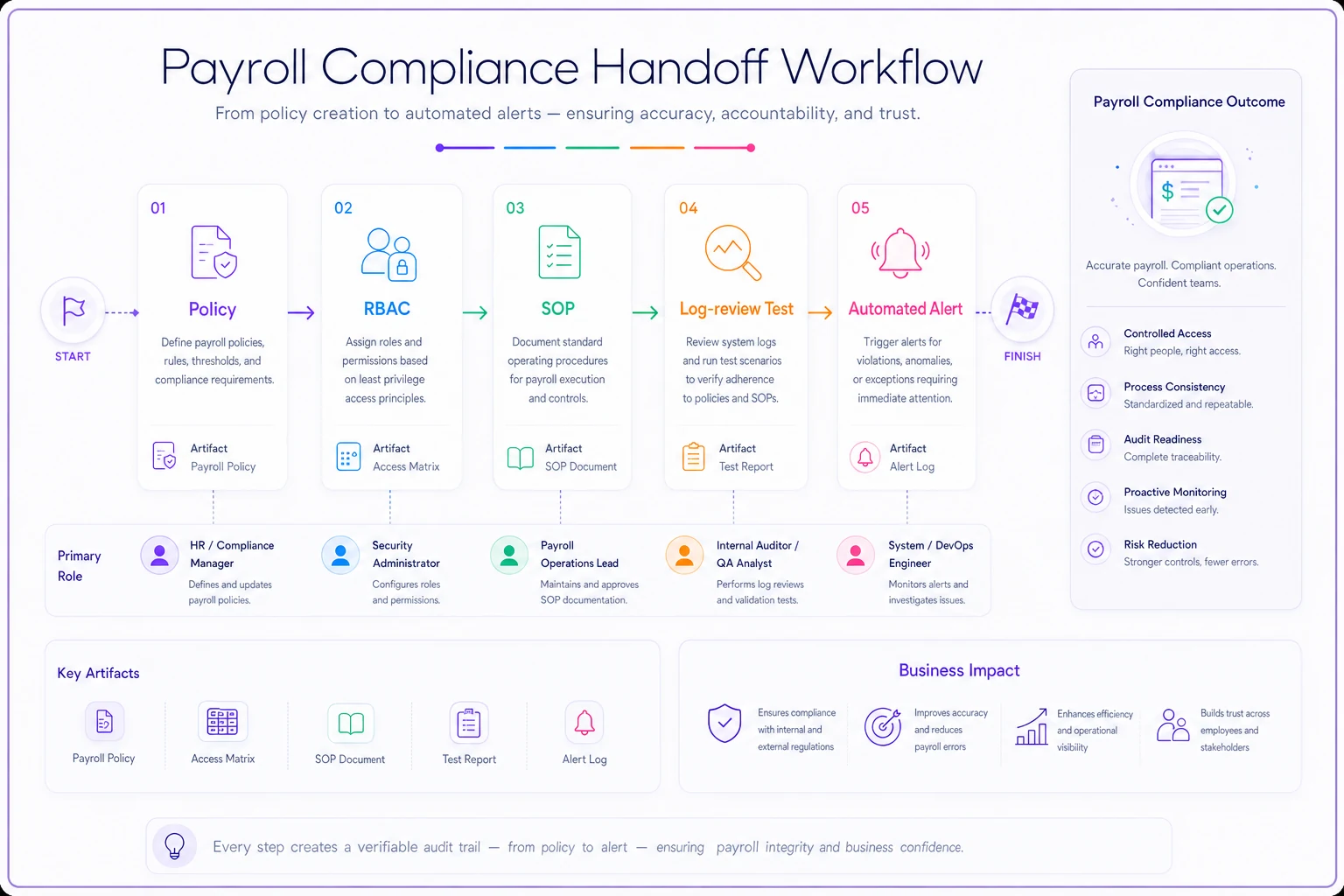
The diagram above illustrates the ideal handoff: policy IDs flowing down into role definitions, SOP steps, observable events, tests, and finally alerts.
A worked example: translating one policy end to end
The policy statement:
> PAY-POL-014: Any change to an employee's bank account details must be entered by one user and verified by a second user before the next pay run. No single user may both enter and approve a banking change.
Clean, common policy. Now the translation.
Step 1 — RBAC layer. This policy implies a separation of duties, so the role matrix needs two distinct permissions that can't both sit on one person for banking changes:
-
BANKCHANGEENTER— can input new bank details -
BANKCHANGEAPPROVE— can approve a pending banking change
Configuration rule: no user profile may hold both permissions simultaneously. This is the kind of control covered in depth when you design role-based access models with an audit-trail cadence — the policy is only real once the permission set physically prevents the violation.
Step 2 — SOP layer. The procedure documents how the work happens, referencing PAY-POL-014:
-
Employee submits banking change request through the HRIS portal.
-
Payroll clerk (holds
BANKCHANGEENTER) enters the new details, attaches the request, marks status "Pending Verification." -
A different team member (holds
BANKCHANGEAPPROVE) opens the pending item, confirms the request matches the entry, and approves. -
System records both user IDs and timestamps against the change.
-
Change becomes active only after the approval timestamp precedes the pay-run lock.
Step 3 — Log-review test. Now you need a test that runs against event logs to prove step 3 actually happened and wasn't skipped. In plain terms, the test looks for any banking change where the entering user ID equals the approving user ID, or where no approval event exists before the pay-run lock.
SELECT changeid, enteredby, approvedby, approvedat, payrunlockat FROM bankchangeevents WHERE (enteredby = approvedby) OR (approvedat IS NULL) OR (approvedat > payrunlockat)
Pass criteria: zero rows returned. Any row is a control failure that needs a documented explanation.
Step 4 — Automated alert. The log-review test is retrospective. The alert is the real-time version. It fires the moment a banking change reaches the pay-run lock without a valid second approval, routing to the payroll lead with the change_id and both user IDs. The alert carries PAY-POL-014 in its payload so whoever receives it knows exactly which control tripped.
That's the whole chain for one policy. One sentence became two permissions, a five-step SOP, a query with a defined pass condition, and a routed alert. Replicate that structure across your policies and you have a validation system, not a pile of documents.
The translation template you can reuse
The point of a blueprint is that you don't reinvent the chain for every policy. Here's the repeatable template. For each policy statement, fill in:
-
Policy ID and statement — the exact sentence, with a stable ID.
-
Control type — separation of duties, authorization limit, timing constraint, data accuracy, access restriction.
-
RBAC implication — which permissions this creates, splits, or restricts.
-
SOP steps — the numbered procedure, citing the policy ID.
-
Observable event — what the system actually logs when this happens (and if it logs nothing useful, that's your first finding).
-
Log-review test — the query or check, with an explicit pass/fail condition.
-
Alert trigger — the real-time condition, severity, and routing.
-
Validation artifact — what evidence this produces for an audit (test output, alert history, approval records).
The field people skip most often is observable event. They write a solid SOP and a sensible test, then discover the payroll platform doesn't log the thing they want to test. If the event isn't captured, the test is fiction. Run that column early — it tells you whether your logging needs to change before any of the downstream work matters.
Where this breaks at scale
With 40 employees and one payroll person, you can get away with loose translation because one human holds the whole chain in their head. The policy, the procedure, the "I always double-check the bank changes" — it all lives in one person's practice.
Then you grow. Three payroll staff. Multiple states. An outsourced tax filer. A benefits platform feeding deductions. The informal chain shatters in specific, predictable ways.
Role sprawl. Permissions get granted ad hoc during busy cycles and never revoked. Someone covering for a vacation gets BANKCHANGEAPPROVE added temporarily, and eighteen months later they still have it. The policy still says separation of duties. The system quietly violates it.
SOP drift. The documented procedure describes last year's software. A platform update moved the approval screen, people adapted, and nobody updated the SOP. Now the SOP and the real workflow disagree, and neither matches the policy cleanly.
Test decay. The quarterly log review was written when logs had five fields. Now there are twelve, a schema changed, and the query silently returns zero rows — not because the control is working, but because the query no longer matches the data. A passing test that's actually broken is worse than no test.
Alert fatigue. Early on, alerts were tuned well. At scale, a poorly-scoped alert fires dozens of times a week on false positives, people mute it, and the one real violation slips through in the noise.
The pattern across all four: the chain was built once and never maintained. The payroll teams who survive audits cleanly aren't the ones with the best policy writing — they're the ones who treat the translation chain as something that gets re-validated every cycle, not every three years.
Validating that the chain itself works
There's a subtlety here that trips people up. You can have all five layers in place and still have a broken control, because the test might not test what you think it tests. The translation chain needs its own validation — you have to prove the test actually catches the failure it's supposed to catch.
The method is straightforward: deliberately create the violation in a controlled environment and confirm the test flags it and the alert fires. If you're testing PAY-POL-014, run a synthetic banking change where one user does both entry and approval, and verify the log-review query returns that row and the alert routes correctly. If either stays silent, your control is decorative.
This is the same logic behind payroll regression tests and synthetic pay runs — you inject known-bad data and confirm the system reacts as designed. A control you've never watched fail is a control you can't trust.
Build a small library of these negative test cases, one per policy, and run them whenever the payroll platform updates. A config change or schema migration will eventually break one of your tests silently, and the only way to catch it is to keep deliberately trying to trip the controls.
A real scenario
A regional services company, around 380 employees across four states, had the usual situation: a solid policy binder and a payroll team that genuinely knew what they were doing. What they didn't have was traceability. When their first serious audit hit, the auditor asked for evidence that off-cycle payment approvals had operated for the prior two quarters.
The team spent close to three weeks reconstructing it — pulling emails, screenshots, and memory to prove controls that were, in fact, happening, but not provably. They passed, barely, with a management note about evidence weakness.
The fix wasn't new policy. They took their existing policy statements, assigned IDs, and ran each through the translation template. The painful discovery: two policies referenced controls the payroll platform didn't log at all. One was the off-cycle approval itself. The system enforced it in the UI but didn't write a clean, queryable event — which is exactly why evidence had been so hard to produce.
They adjusted logging, wrote log-review tests for each policy, and stood up alerts on the four highest-risk controls. The next audit, the same evidence request took about a day. Not because they worked harder, but because the chain produced the artifact automatically. The team stopped dreading evidence requests.
When this full treatment makes sense — and when it doesn't
This blueprint is real work. Worth being honest about where it pays off.
When it makes sense:
-
You're past roughly 150–200 employees, or operating across multiple jurisdictions, where no single person holds the whole chain in their head.
-
You have an audit, SOX scoping, or IPO prep on the horizon where evidence gaps become expensive.
-
You've had a control failure — a duplicate payment, an unauthorized banking change — and "we have a policy about that" wasn't a good enough answer.
When it's overkill:
-
A 25-person company with one trusted payroll person and no regulatory pressure. Formalizing the full chain for every policy will cost more attention than it returns. Pick your two or three highest-risk controls — banking changes, off-cycle payments, access grants — and translate only those.
Who should not do this yet: teams whose underlying payroll data is still a mess. If your event logs are unreliable or your role assignments are undocumented, fix that foundation first. The translation chain sits on top of clean logging and defined roles. Build it on a bad foundation and you'll get tests that pass for the wrong reasons.
Making it a living process
The last piece is turning this from a project into a cadence. Translation done once decays. Here's the minimum rhythm that keeps the chain honest:
-
Every pay cycle alerts run live; any firing gets dispositioned and logged.
-
Every quarter run all log-review tests, review results, and run your negative test cases to confirm the tests still catch failures.
-
Every platform update re-run the negative test library before trusting any control — config and schema changes are the top cause of silent test decay.
-
Every policy change re-run the translation template end to end. A new policy sentence with no RBAC, SOP, test, and alert behind it is just a wish.
The teams that handle payroll audits without drama aren't necessarily the ones with the strictest policies. They're the ones who can trace any policy statement through the roles that enforce it, the procedure that performs it, the test that checks it, and the alert that catches it when it breaks — and who keep that chain maintained instead of letting it rot between audits.
Policy without translation is a liability dressed up as a control. Build the chain once, with real IDs connecting each layer, validate that it catches the failures it claims to catch, and keep it alive on a cadence. That's the difference between having a policy and being able to prove it operated.
Ready to simplify your payroll operations?
Join 2,000+ businesses using Payexly to reduce payroll overhead, ensure compliance, and enhance employee satisfaction.