

Most payroll teams produce evidence reactively. A notice shows up, an auditor sends a request list, a vendor disputes an invoice — and someone spends two days reconstructing what happened eight months ago from emails, screenshots, and whatever got exported before the system archived it. The work gets done, but it's expensive, inconsistent, and the quality depends entirely on who happened to pull it together.
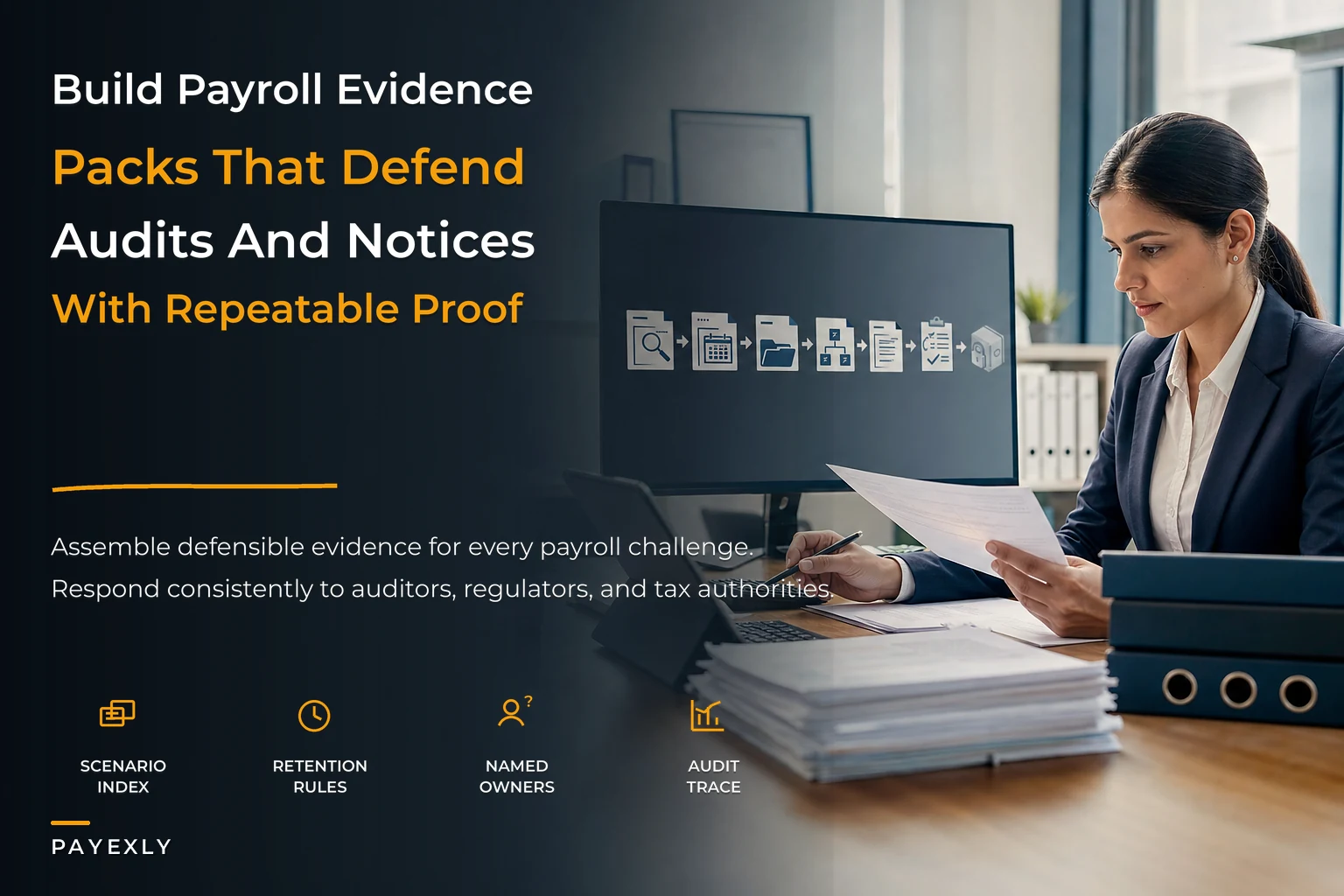
The teams that stop living this way share one thing: they stopped treating evidence as something you find and started treating it as something you assemble from components that already exist in a known shape. That shift is what a payroll evidence pack standard actually is. Not a binder. A system for producing the right proof, named the right way, retained the right length, and packaged so an auditor, a state tax examiner, or your own CFO can follow it without needing a guided tour.
This article is about the system underneath that — how the pieces connect, where it breaks when you grow, and what a defensible standard actually looks like in practice.
Why scattered evidence costs more than you think
The hidden cost isn't retrieval time, though that's real enough. It's that inconsistent evidence creates inconsistent outcomes with the people judging you.
The pattern tends to go like this. A company responds to a state unemployment agency notice by pulling a payroll register, a bank confirmation, and a screenshot of the filing portal. Six months later a different person responds to a 941 discrepancy and sends a slightly different set — a GL export instead of a register, a PDF confirmation instead of a portal screenshot. Both responses "worked," but neither matches the other, and neither matches what the external auditor asked for at year-end. Now the same underlying payroll run is documented three different ways, and when a regulator cross-references two of them, the mismatch creates a question that didn't exist before.
That's the part people miss. Weak evidence doesn't just fail to defend you — inconsistent evidence actively manufactures new problems. An examiner who sees two versions of the same quarter's wages doesn't assume you're sloppy. They assume there's something to find.
The second cost is key-person risk. In a lot of small and mid-sized shops, one person knows where the real proof lives — which folder, which export, which vendor portal, which login. When they're out, on leave, or gone, the evidence doesn't disappear but the map does. Companies miss response deadlines on tax notices not because they lack documentation, but because the only person who knew how to assemble it was unreachable.
The three scenarios that drive almost every evidence request
Nearly every payroll evidence request maps to one of three scenarios. The smart move is to index your evidence by scenario up front, so you're assembling from a template instead of improvising each time.
Eliminate payroll errors and delays.
Payexly streamlines every payroll cycle ensuring accuracy and compliance.
- Automated payroll processing
- Real-time tax compliance
- Benefits & deductions management
No credit card required
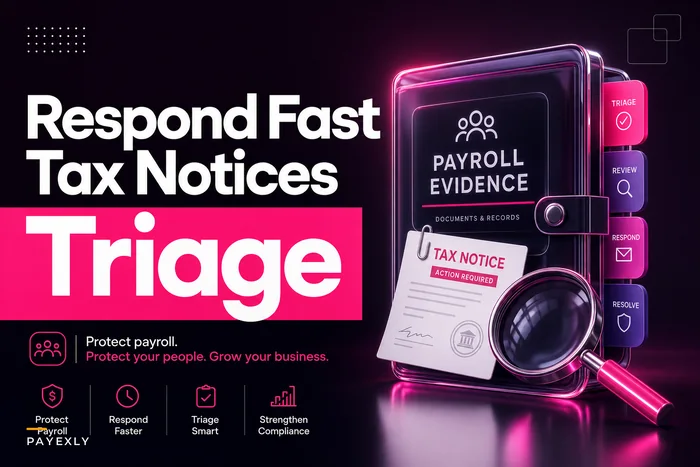
Tax notice. A federal or state agency flags a discrepancy — underpayment, mismatch between deposits and filings, a late deposit penalty, a wage/withholding variance. The evidence here is narrow and deadline-driven. You need to prove what was owed, what was paid, when, and reconcile the delta. Our deeper walkthrough on how to respond to payroll tax notices fast with a triage-by-severity flow covers the response mechanics; the evidence pack is the raw material that flow runs on.
Audit. Internal, external financial, workers' comp, or a benefits plan audit. This is broad and sampling-based. The examiner picks periods and employees and expects you to trace each one end to end — from time capture to gross pay to deductions to net to GL to bank. The evidence here isn't about one number; it's about demonstrating that your process produces reliable numbers repeatedly.
Vendor dispute. Your payroll provider, benefits administrator, or tax-filing vendor bills something wrong, misses a deposit, or files late and the penalty lands on you. The evidence here is about establishing who was responsible and when. SLA timestamps, submission confirmations, support tickets, the contractual obligation versus what actually happened.
These three look different on the surface, but the underlying components overlap heavily. That overlap is the whole opportunity.
| Evidence component | Tax notice | Audit | Vendor dispute |
|---|---|---|---|
| Payroll register (period-level) | Core | Core | Supporting |
| Employee-level detail trace | Supporting | Core | Rarely |
| Bank/deposit confirmations | Core | Supporting | Core |
| Filing confirmations + timestamps | Core | Supporting | Core |
| GL reconciliation | Supporting | Core | Rarely |
| Vendor SLA + submission logs | Rarely | Supporting | Core |
| Approval/change audit trail | Supporting | Core | Supporting |
| Control narrative / SOP reference | Rarely | Core | Rarely |
Once you see it laid out, the point is obvious: you're not building three evidence libraries. You're building one component library and three assembly recipes.
What actually breaks at scale
A five-person payroll team running one jurisdiction can survive on tribal knowledge. The components live in a few predictable places, one person can reconstruct anything, and the volume of requests is low enough that reactive assembly is annoying but survivable.
Jurisdiction sprawl. The moment you're filing in six or eight states, the number of possible notices multiplies and each state wants evidence in its own shape. The reactive model collapses because no single person holds the map anymore, and the exports that worked for one agency are the wrong format for another.
System turnover. You migrate payroll platforms, switch tax-filing vendors, or move benefits administrators. Now some of your evidence lives in a system you no longer have a login for. This is the one that bites hardest — companies routinely lose the ability to retrieve clean evidence for periods processed on a prior platform, right when an audit reaches back into those periods. If you didn't export and retain at cutover, the proof is effectively gone.
Headcount and transaction volume. Off-cycle runs, retro corrections, garnishments, mid-period benefit changes. Each generates its own evidence trail, and at volume the exceptions become the majority of your audit requests. An examiner almost never asks about the clean runs. They ask about the weird ones.
The failure mode across all three is the same: evidence that was technically produced at the time becomes practically unavailable later because nobody defined where it would live, what it would be called, or how long it would survive.
Naming and retention: the boring part that decides everything
This is the section people skip, and it's the one that determines whether the whole system works. Evidence you can't name consistently is evidence you can't find, and evidence you discard too early is evidence you can't produce.
Naming. The goal is that any file's name tells you what it is, what period it covers, what entity and jurisdiction it belongs to, and what version it is — without opening it. A workable convention looks like:
[Entity][Jurisdiction][Period][ComponentType][Version]_[Date]
So a California Q2 2024 payroll register becomes something like ACMECA2024Q2Registerv120240715. It reads cold. Six months later, in the middle of a notice response, you don't have to open twelve files to find the right one. This sounds trivial until you've watched someone sort through a folder of forty files named export(3)final_FINAL.pdf.
Retention. Different evidence types carry different legal minimums, and you should retain to the longest applicable requirement, not the shortest. A rough working frame:
-
Payroll tax records (federal) minimum four years after the tax is due or paid — in practice, retain longer because state examination windows vary.
-
Wage and hour records generally two to three years for the detail, longer for the underlying payroll records — hold to the longer side.
-
Benefits and ERISA-related records six years or more depending on plan type.
-
Filing and deposit confirmations match to the tax-record window at minimum, because these are your proof the deposit actually happened.
-
Vendor SLA logs and submission timestamps retain for the life of the contract plus the longest downstream penalty window, since vendor disputes often surface well after the fact.
Export and archive evidence at cutover to avoid losing access after a migration.
The mistake isn't usually keeping too little in the active system — it's discarding at system migration. Your retention policy has to survive platform changes, which means retention lives in your archive, not the vendor's. If your evidence retention depends on a vendor keeping their portal accessible, you don't have a retention policy. You have a hope.
The assembly playbook
Here's the actual workflow for turning scattered components into a pack an examiner will accept. The point of writing it down is that anyone on the team can run it, not just the one person who's always handled it.
-
Identify the scenario. Tax notice, audit, or vendor dispute. This determines which assembly recipe you pull and which components are "core" versus "supporting."
-
Scope the periods and entities. Pull the exact periods, jurisdictions, and employees in question. Over-scoping buries the real evidence; under-scoping gets you a follow-up request and a blown timeline.
-
Pull core components from the library. Using your naming convention, retrieve the register, confirmations, reconciliations, or SLA logs the scenario requires. If they're named right, this step is minutes, not hours.
-
Build the trace. For audit scenarios especially, assemble the end-to-end chain for each sampled item — time capture → gross → deductions → net → GL → bank. The trace is what turns a pile of files into proof of process.
-
Attach the narrative. One short cover document per pack
what's included, what each component proves, and the reconciliation of any delta the examiner flagged. This is the single highest-leverage thing you can add, and almost nobody does it. An examiner who can read your logic in two minutes asks fewer follow-up questions.
-
Log the pack. Record what was assembled, for whom, on what date, covering what periods. The next request on the same periods starts from this log instead of from scratch.
-
Archive the assembled pack as its own artifact. The finished pack is evidence too. If the same quarter gets questioned again, you reproduce the exact package you already defended, not a slightly different one.
That consistency across responses is the entire game. The same quarter, documented the same way, every time it's challenged.
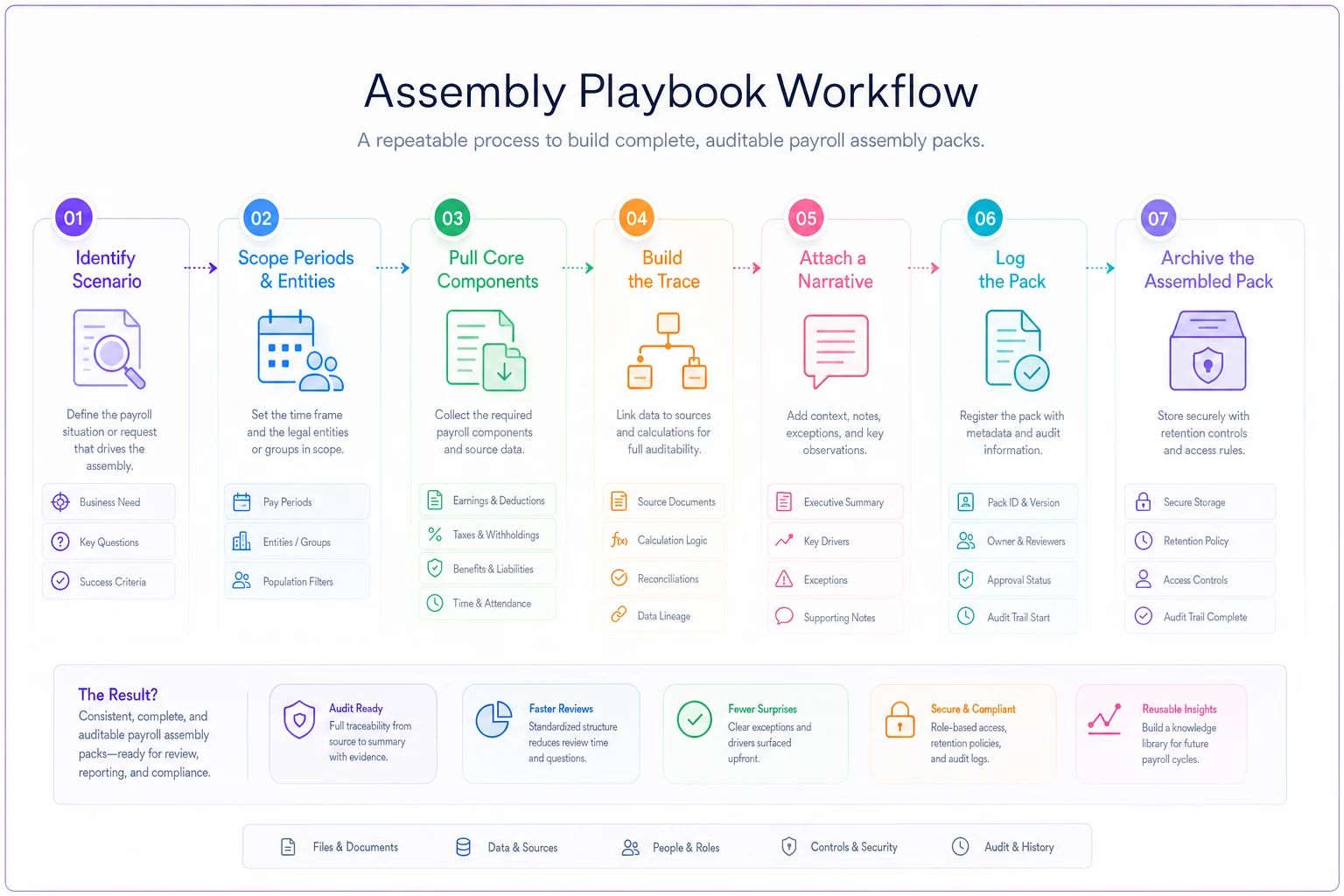
A simple diagram showing the assembly playbook steps can make the workflow easier for the whole team to follow.
A quick checklist for whether your evidence will actually hold
Run your current setup against this. If you're missing more than a couple, you're relying on luck.
-
Can someone who didn't process the run assemble a complete pack for any period in the last four years?
-
Does every evidence file name tell you period, entity, jurisdiction, and version without opening it?
-
Do you retain evidence in your archive, independent of any vendor portal?
-
Did you export and retain clean evidence at your last system or vendor migration?
-
Can you produce filing and deposit confirmation for any tax period, with timestamps?
-
Do you attach a short narrative to each pack explaining what it proves?
-
Is there a log of what was assembled, for whom, and when?
-
Do your three scenarios (notice, audit, dispute) pull from one shared component library rather than three separate improvised piles?
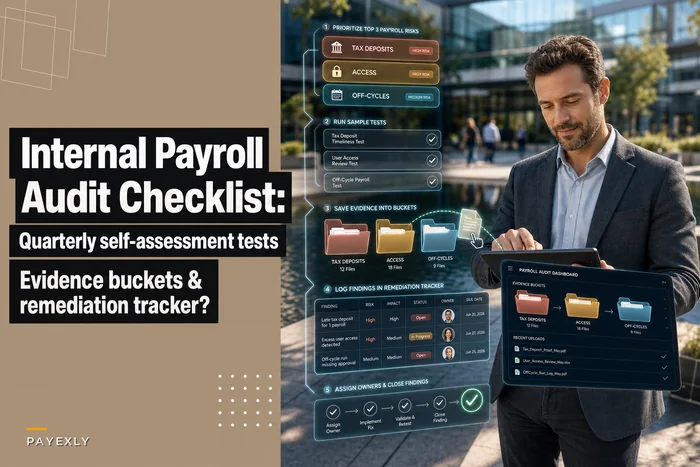
Your quarterly self-review is the right place to pressure-test most of these — the internal payroll audit checklist is a natural home for an "can we actually produce this evidence" test, rather than waiting for a real examiner to find the gap for you.
A real scenario
A regional services company, roughly 280 employees across four states, got a state withholding notice questioning about $11k in variances across two quarters. The initial reaction was the usual fire drill — someone pulled registers, someone else chased deposit confirmations, and the response took the better part of a week because the prior quarter had been processed on their old payroll platform, which they'd since migrated off. The confirmations existed somewhere; nobody was sure exactly where.
They eventually responded, paid a small penalty on one quarter they couldn't cleanly prove in time, and treated the whole thing as a trigger to build a proper standard rather than just closing the ticket.
They did three things. Exported and archived clean evidence from the legacy platform before access lapsed. Adopted a naming convention and reorganized four years of evidence into a scenario-indexed library. Wrote the assembly playbook so it wasn't trapped in one person's head.
The payoff came about seven months later when a different state sent a comparable notice — same type of request, roughly similar dollar amount. The response went out in under a day, with a narrative cover that reconciled the variance directly. No penalty, no follow-up request. The difference wasn't better payroll. The payroll was the same. The difference was that the evidence was already assembled in a known shape.
When this level of rigor makes sense — and when it's overkill
A full scenario-indexed standard with naming conventions, retention policy, and a written playbook is clearly worth it once you're multi-jurisdiction, past a hundred or so employees, or running on vendors you might someday leave. The combination of request volume and system turnover is what makes reactive assembly unsustainable.
It's also worth building ahead of any known event — a financing round, an acquisition, an IPO track, or a benefits plan audit you can see coming. Building the standard under deadline pressure is miserable; building it in a quiet quarter is just work.
Where it's overkill: a genuinely small, single-state shop with stable systems and low exception volume can get most of the benefit from just two things — a consistent naming convention and a disciplined export-at-migration habit. The full three-scenario library is more structure than that business needs.
The one group that should never skip it: anyone who has already lost access to evidence from a prior system. If that's happened once, it will happen again at the next migration, and the standard is the only thing that prevents it.
The real shift
The teams that handle notices, audits, and disputes calmly aren't the ones with perfect payroll. Everybody has exceptions, retro corrections, and the occasional late deposit. The calm ones are the ones who decided, before the request arrived, what their evidence would look like — what it's called, where it lives, how long it survives, and how it gets assembled.
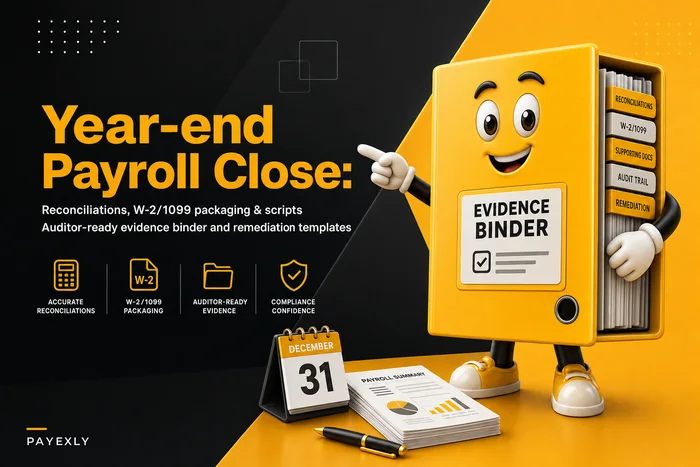
That decision moves evidence from something you anxiously reconstruct to something you confidently retrieve. And the same discipline that makes an evidence pack hold up for a state examiner is what makes your year-end close and W-2/1099 packaging go smoothly too — because it's the same underlying components, assembled with the same care, indexed so you can always find them.
Build the standard once. Then stop reconstructing the past every time someone asks you to prove it.
Ready to simplify your payroll operations?
Join 2,000+ businesses using Payexly to reduce payroll overhead, ensure compliance, and enhance employee satisfaction.