

The envelope sits in a stack for four days. By the time someone actually reads the CP136 or the state UI rate-change notice, you've already burned through a chunk of your response window and half your options. That single delay causes more penalty escalations than any actual filing error.
Responding to a payroll tax notice isn't really about writing a good letter. It's about how fast you can figure out whether the notice is a nothing-burger or a five-alarm fire, pull the exact documents that prove your position, and get something defensible out the door before the abatement window closes. Most teams are slow because they treat every notice the same — either panic-reading all of them, or ignoring all of them equally. Neither works.
So this covers the part that actually matters: sorting, evidence, and the response itself.
First: sort by severity, not by who's shouting loudest
The instinct is to respond to whatever looks scariest. That's backwards. The scary-looking ones — bold red "FINAL NOTICE" language — are often just the third mailing of something small. The dangerous ones are quiet: a proposed assessment with a 30-day clock, or a state agency reclassifying your deposit schedule.
Here's the triage frame that holds up under a full inbox:
| Severity | What it looks like | Clock | First move |
|---|---|---|---|
| P1 – Assessment / lien risk | Proposed additional tax, penalty assessment, intent to levy, deposit-schedule reclassification | 10–30 days, hard | Same-day acknowledgment, pull evidence immediately |
| P2 – Discrepancy | 941 vs W-3 mismatch, wage totals don't tie, missing deposit flagged | 30–45 days | Reconcile within 3 business days, respond within a week |
| P3 – Informational | Rate change, address update, EIN confirmation, "no action needed" | Often none | Log it, file it, verify it's actually accurate |
| P4 – Duplicate / already resolved | Second or third copy of a notice you already answered | N/A | Match to prior response, note in file, close |
The mistake that comes up most: a P2 discrepancy notice gets treated like P4 ("we already filed that, it's fine") and quietly ages into a P1 assessment because nobody actually reconciled the numbers. A 941-to-W-3 mismatch of a few thousand dollars in reported wages doesn't disappear because you're confident. The agency's system already flagged it — your confidence isn't in their database.
Severity is set by the consequence and the clock, never by the tone of the letter. A politely worded proposed assessment outranks a shouty duplicate every time.
What each severity level actually requires before you respond
P1 and P2 notices live or die based on whether your evidence ties out. Most delayed responses aren't delayed because the team is lazy — they're delayed because someone starts writing the letter before they've confirmed the numbers, then stalls when the reconciliation doesn't match.
Eliminate payroll errors and delays.
Payexly streamlines every payroll cycle ensuring accuracy and compliance.
- Automated payroll processing
- Real-time tax compliance
- Benefits & deductions management
No credit card required
-
Confirm the period and form the notice references. Sounds obvious. But a surprising number of notices reference a quarter you're not thinking about, and people end up responding about the wrong period entirely.
-
Pull the as-filed return for that exact period — the actual submitted 941, 940, or state equivalent, not a re-run report that may have changed since filing.
-
Pull the deposit records for the same period, matched to EFTPS or state confirmations.
-
Reconcile the two against the notice's stated figures. Three numbers have to agree: what you filed, what you deposited, what they say you owe.
-
Identify the variance and its source before writing a single sentence of your response.
That fifth step is where good responses separate from bad ones. If your variance traces back to a retroactive adjustment or a correction made after the original filing, you need that documented cleanly. Teams that handle retroactive pay corrections with proper journal trails have a real advantage here — the paper already exists, they just attach it.
The evidence-collection checklist
Keep this as a standing checklist so nobody's inventing it under a 15-day deadline. For a wage/tax discrepancy notice, you want:
-
- [ ] The as-filed return (PDF of the actual submission, with confirmation number)
-
- [ ] EFTPS / state deposit confirmations for every deposit in the period
-
- [ ] Payroll register for each pay date in the quarter
-
- [ ] Reconciliation extract showing filed wages → deposited amounts → notice figures side by side
-
- [ ] Any amended returns (941-X, etc.) filed for the period, with their own confirmations
-
- [ ] Correspondence log — prior notices, prior responses, dates and tracking numbers
-
- [ ] Explanation memo — two or three sentences naming the variance source in plain language
-
- [ ] Supporting adjustment docs — journal entries, correction approvals, retro-pay backup
The reconciliation extract is the single most persuasive item and the one most people skip. Agencies aren't hostile — they're processing volume. When you hand a reviewer a clean three-column extract that ties your filed figure to your deposits to their number, you've essentially done their job for them. That's what turns a 45-day back-and-forth into a one-touch resolution.
The teams that respond fastest aren't the ones with the best writers. They're the ones whose pre-filing validation already caught most mismatches before submission, so when a notice does arrive, the evidence practically assembles itself.
Response templates that hold up
Don't freehand every response. You need three base templates, and the skill is knowing which one applies.
Template A — Agree and correct. The notice is right, you owe it. Fastest path: acknowledge, pay or arrange payment, request penalty abatement if you qualify (first-time abatement is real and underused). Keep it short. Fighting a correct notice burns goodwill and time.
Template B — Disagree with evidence. You've reconciled and you're right. Structure it as: reference the notice number and period, state your position in one sentence, present the reconciliation, attach the exhibits, request they adjust their records. No emotion, no story — just the tie-out.
Template C — Partial / needs-time. You agree on part, dispute part, or can't pull the documents inside the window. Send a timely acknowledgment that preserves your rights and states a specific follow-up date. A dated acknowledgment inside the window is worth more than a perfect response that arrives late.
The skeleton for Template B looks roughly like:
> Re: Notice [number], Form [941/940/etc.], Period ending [date], EIN [xxx] > > We are responding to the above notice, which proposes [agency's figure]. Based on our records, the reported figure is correct as filed. Our reconciliation is enclosed: filed wages of [X] correspond to deposits totaling [Y], confirmed via [EFTPS trace numbers]. We respectfully request the proposed adjustment be removed. Supporting documentation is attached as Exhibits 1–[n].
Boring is the goal. Reviewers approve boring.
When speed matters more than perfection
For P1 notices with a hard clock, get the acknowledgment out even if the full evidence package isn't ready. Preserving the response window is the priority — you can supplement later.
For P3 informational notices, resist the urge to respond at all. Verify the change is accurate (a wrong new UI rate is common and worth disputing), file it, move on. Responding to a "no action needed" notice just creates a thread that can confuse things later.
Who should NOT be freelancing here: if a notice references potential worker-classification exposure, trust-fund recovery penalties, or anything that sounds remotely criminal, that's not a template situation. Acknowledge to preserve the clock, then get a tax professional involved before you put your position in writing. A defensible response written by the wrong person can lock you into a bad position fast.
A real scenario
A regional HVAC contractor — around 40 employees, in-house bookkeeper handling payroll — got a state notice proposing roughly $6,800 in additional withholding tax plus penalty for a quarter eighteen months back. The bookkeeper's first read: "we filed that, it's fine." It sat.
When it finally got triaged as a P2, the reconciliation took under an hour. The variance traced to a mid-quarter retro adjustment that had been filed correctly on a 941-X the agency's system never matched to the original period. The whole dispute was a linking problem on their end. The response was Template B: one page, a three-column extract, the 941-X confirmation attached. The proposed assessment was removed within about three weeks. The lesson wasn't that they won — they were always going to win, the numbers were right. It's that the four months the notice aged before anyone reconciled it added penalty exposure and stress for a problem that was an hour of work.
Where tooling actually helps
None of this requires software. But the friction that causes slow responses — hunting for the as-filed PDF, matching deposits to confirmations, rebuilding a reconciliation from scratch each time — is exactly what a workflow platform with AI-assisted reconciliation removes.
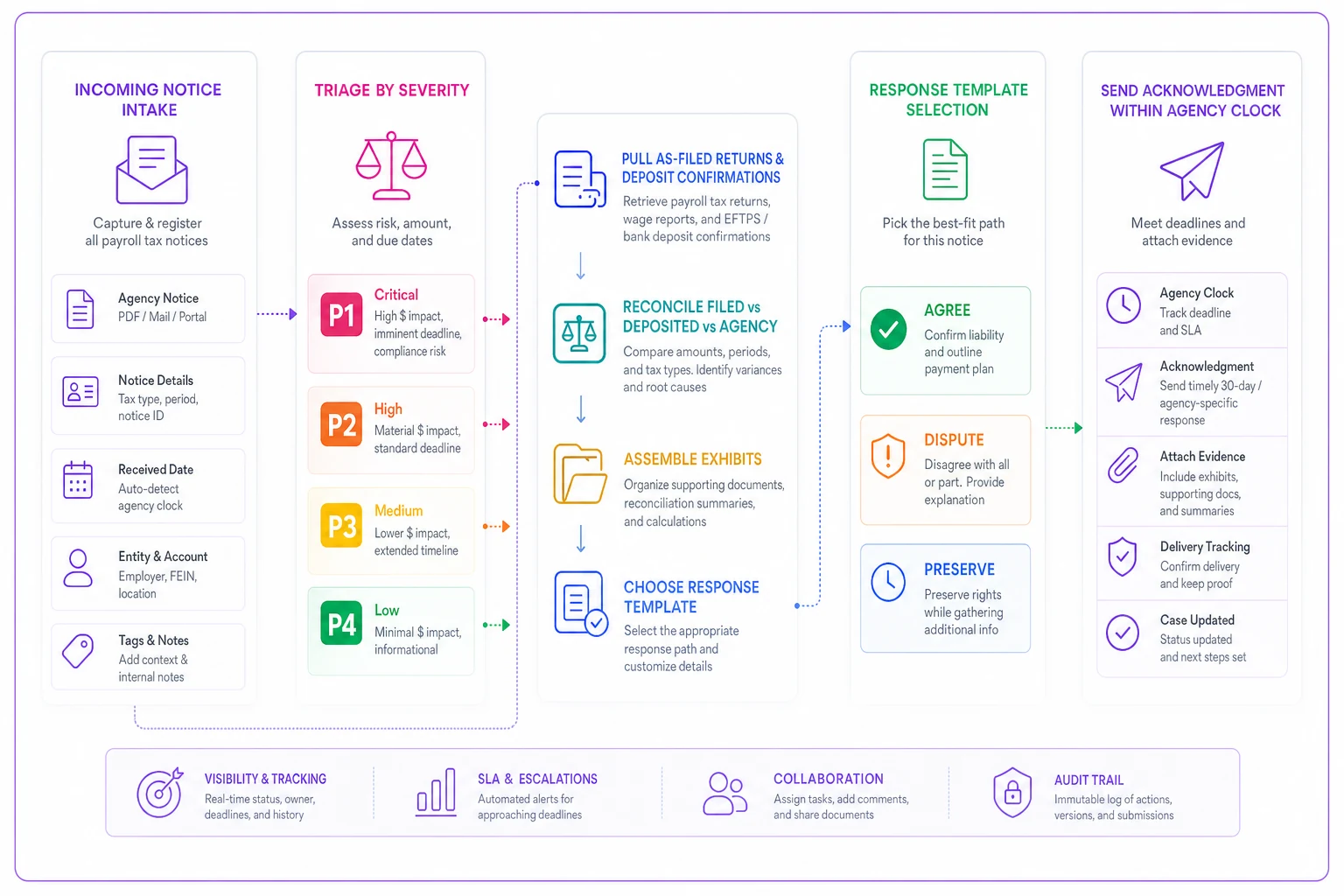
Store as-filed PDFs and EFTPS confirmations indexed by period so you can pull a reconciliation in minutes.
When as-filed returns, deposit confirmations, and correction journals live in one place and the system can pull the tie-out for a given period on demand, "collect the evidence" stops being a two-day scramble and becomes a two-minute pull. The value isn't automation for its own sake. It's that the evidence for a defensible payroll tax notice response already exists in a clean, linked form the moment a notice arrives — so severity triage, not document archaeology, is the only thing standing between you and a filed response.
The short version
Sort every notice by consequence and clock, not by tone. Reconcile before you write.
Keep a standing evidence checklist so nobody's improvising under a deadline. Pick the right template — agree, dispute, or preserve-and-follow-up — and keep it boring. The teams that handle notices well aren't smarter; they just refuse to let a P2 quietly age into a P1.
Sort every notice by consequence and clock, not by tone. Reconcile before you write. Keep a standing evidence checklist so nobody's improvising under a deadline. Pick the right template — agree, dispute, or preserve-and-follow-up — and keep it boring. The teams that handle notices well aren't smarter; they just refuse to let a P2 quietly age into a P1.
Ready to simplify your payroll operations?
Join 2,000+ businesses using Payexly to reduce payroll overhead, ensure compliance, and enhance employee satisfaction.