

Most payroll teams treat "audit" as something that happens to them once a year. Someone external shows up, asks for 40 documents, and everyone spends two weeks pulling screenshots and re-running reports they should have saved back in March. By the time findings come back, the mistakes are three quarters old and half the people who touched them have moved to different teams.
The teams that avoid that scramble run a quarterly self-audit instead. Not a full mock audit — that's overkill four times a year. A tight, repeatable pass through the areas that actually blow up: tax deposits, off-cycle payments, terminations, garnishments, and access. Ninety minutes to half a day, done the same way every quarter, with evidence saved as you go instead of reconstructed later.
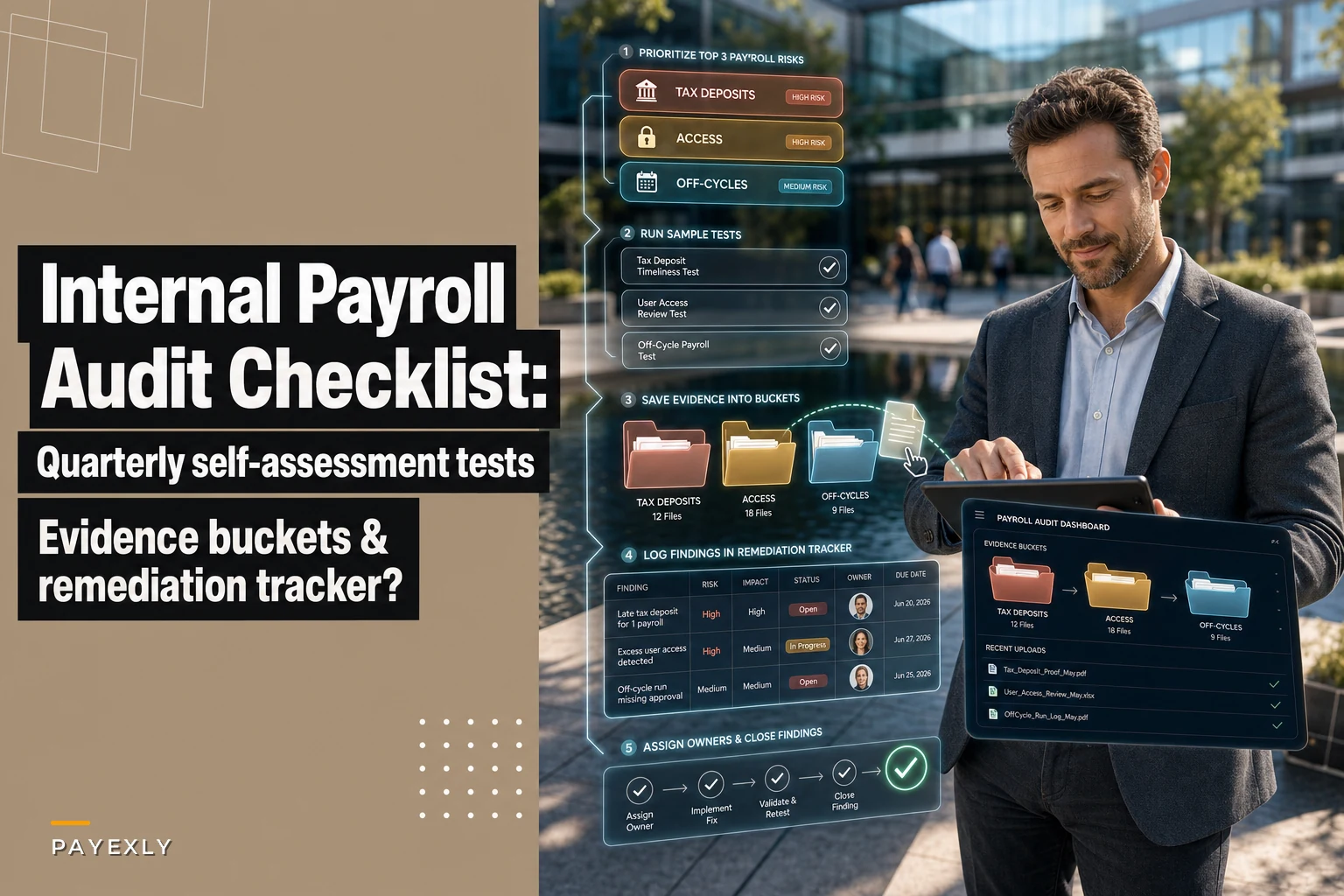
This is the checklist we'd hand a mid-market payroll team that wants to stop reacting. It's built around three things: high-risk areas mapped to sample tests, evidence buckets so you're never hunting for proof, and a remediation tracker so findings don't just get noted and quietly forgotten.
Why quarterly beats annual (and beats "continuous" for most teams)
Annual audits find problems that are already expensive. A misapplied tax rate discovered in Q4 has been wrong for nine months — nine months of amended deposits, penalty exposure, and reconciliation cleanup. The same error caught in a Q1 self-audit is a one-time fix.
Continuous monitoring sounds better in theory, but most mid-market teams don't have the tooling or headcount to actually watch controls in real time. What ends up happening is "continuous" becomes "never" — nobody owns it, so it drifts. A fixed quarterly cadence is something a team of three or four can actually sustain, and that's the only property that really matters. A control you run inconsistently is worse than no control, because it gives you false confidence.
The pattern we see most: teams that audit annually spend more total hours per year on payroll cleanup than teams that run a half-day pass each quarter. The annual crowd just doesn't count the scattered firefighting as "audit work," so it feels cheaper. It isn't.
The high-risk areas worth testing (and the ones that aren't)
You don't test everything. A quarterly self-audit that tries to cover all 200 payroll controls collapses under its own weight by the second quarter. You test the areas where errors are frequent, expensive, or hard to reverse.
Eliminate payroll errors and delays.
Payexly streamlines every payroll cycle ensuring accuracy and compliance.
- Automated payroll processing
- Real-time tax compliance
- Benefits & deductions management
No credit card required
| High-risk area | Why it's on the list | Sample test |
|---|---|---|
| Tax deposits & rates | Penalties compound, IRS notices are slow to resolve | Pull 3 random deposits per jurisdiction; confirm rate, amount, and deposit date against schedule |
| Off-cycle & manual checks | Bypass normal controls, easy to double-pay | List every off-cycle payment in the quarter; verify approval and reason code |
| Terminations | Final pay timing is state-regulated; access left open | Sample 5 terms; check final pay date vs. state rule and system access revocation |
| Garnishments & levies | Wrong priority or amount = legal exposure | Trace 3 active orders from source document to net deduction |
| Access & permissions | Unauthorized changes hide here | Compare current admin list to last quarter's; flag any additions without a ticket |
| New hire setup | Wrong tax setup follows an employee for months | Sample 5 new hires; verify W-4 fields, work state, and exemptions match records |
| Retro & correction runs | Frequent source of miscoded earnings | Review all retro adjustments; confirm journal coding and approval trail |
What to deliberately leave off the quarterly list: standard on-cycle runs with no exceptions, unchanged salaried employees, and anything already covered by automated pre-run validation. If a check runs every pay cycle, re-testing it quarterly is wasted effort. The quarterly audit exists to catch what pay-cycle controls miss, not duplicate them.
Sample tests that actually surface problems
The difference between a checklist that finds things and one that rubber-stamps is specificity. "Review tax deposits" finds nothing. "Pull three random deposits per active jurisdiction and confirm the rate against the current agency schedule" finds the state that quietly changed its unemployment rate in January that nobody updated.
-
Off-cycle reason audit. Export every off-cycle and manual payment for the quarter. For each one, confirm there's a documented reason and an approver who isn't the person who ran it. In practice, this is where you catch the "just this once" manual check that became a monthly habit with no oversight.
-
Termination timing test. Take five terminations, ideally spread across states. Compare the actual final-pay date to the state's required timing. A California term paid on the next regular cycle instead of the last day is a finding, not a rounding issue — the penalty math is real.
-
Access drift check. Pull the list of everyone with payroll admin or approval rights today. Compare it to last quarter's list. Every addition should map to a ticket or an approval. Every person who changed roles should have had access adjusted accordingly. This one test turns up more than most teams expect, especially after reorgs.
-
Garnishment trace. Pick three active orders. Start from the court or agency document and trace forward: correct amount, correct priority against other deductions, correct remittance destination. Then trace one backward from a paycheck deduction to confirm it's still authorized and not a stale order that should have ended.
-
New hire tax setup sample. Five recent hires. Confirm the work state, resident state, and W-4 exemptions in the system match the paperwork. Wrong work-state setup is the quiet error — it doesn't throw an alert, it just under- or over-withholds for months.
The point of sampling instead of full population testing is speed. If your sample is clean, you have reasonable confidence. If you pull five items and find two problems, you stop sampling and go full-population on that area, because you've found something systemic.
Evidence buckets: save proof as you test, not after
The single biggest time-waster in payroll audits is reconstructing evidence months later. You knew the deposit was correct in April, but by the time the auditor asks in November, you're re-pulling reports and hoping the numbers still tie.
-
Deposits & filings — screenshots or exports showing deposit amount, date, and confirmation number per jurisdiction
-
Approvals — the ticket, email, or system log showing who approved each off-cycle, retro, or access change
-
Terminations — final pay calculation, pay date, and access revocation confirmation per sampled term
-
Garnishments — source order, deduction record, and remittance proof per sampled order
-
Access reviews — the quarter-over-quarter admin list comparison, with notes on every delta
-
Setup verification — new hire tax setup screenshots matched to source paperwork
The rule that makes this work: evidence gets a date and a name when it's captured. "DepositQ2TXSUTA2024-04-15_JMorgan.pdf" tells you what it is, when it was pulled, and who pulled it. A folder full of "screenshot(3).png" is not evidence, it's a liability.
Use a consistent filename convention (typequarterjurisdictiondateinitials) so evidence is easy to find during follow-ups.
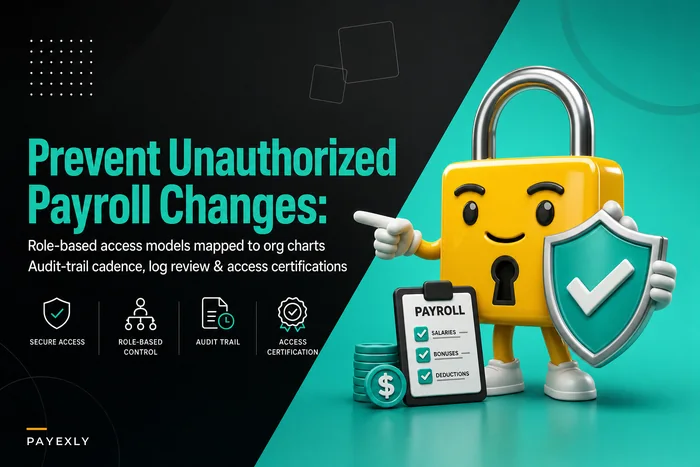
Teams that run their access reviews cleanly usually already have the audit trail cadence in place — if you don't, the groundwork in preventing unauthorized payroll changes with role-based access models is what makes the quarterly access-drift test actually fast instead of a full afternoon of manual digging.
The remediation tracker: where findings go to actually get fixed
Finding a problem is the easy part. What kills most self-audit programs is that findings get noted in a spreadsheet, nobody gets assigned, and by next quarter the same issue surfaces again. Now you have a pattern of repeat findings, which is exactly what an external auditor reads as "no functioning control environment."
| Finding | Risk level | Owner | Due date | Status |
|---|---|---|---|---|
| TX SUTA rate not updated for 2024 | High | Payroll lead | 2 weeks | Open |
| Off-cycle check run without approver | Medium | Payroll manager | 1 week | In progress |
| Terminated admin still had access | High | IT + Payroll | 3 days | Closed |
The discipline that makes it work:
-
Every finding gets a risk level, and high-risk items get a hard deadline measured in days, not "next quarter."
-
Every finding gets one named owner. Shared ownership means nobody owns it.
-
Nothing closes without evidence. "Fixed" needs proof — the corrected deposit, the revoked access, the updated rate. Drop it in the right evidence bucket.
-
Repeat findings escalate. If the same issue appears two quarters running, it stops being a fix and becomes a process change. That's a governance gap, not a one-off mistake.
That last point is where the tracker earns its keep. A finding that recurs isn't a mistake — it's a missing control. When you see the same off-cycle approval gap in Q1 and Q2, the answer isn't to fix it again. It's to build the approval requirement into the workflow so it can't be skipped. That kind of structural fix usually lives at the governance layer, and if your approval workflows and ownership aren't documented, the payroll governance framework for mid-market companies covers the RACI and SOP scaffolding that makes recurring findings actually stop recurring.
A real scenario: what a first clean quarter looks like
A regional healthcare services company, roughly 600 employees across four states, had been running annual audits and getting hit with the same categories of findings every year — usually tax deposit timing and stale access. External audit prep consistently ate about two weeks of the payroll team's time.
They started a quarterly self-audit using roughly this structure. The first quarter was rough: seven findings, including a state unemployment rate that had been wrong since January (around $4k in under-deposited tax across two quarters) and three former employees who still had payroll system access months after leaving. Not fun to find, but far better to find it internally than in a notice.
By the third quarter, findings dropped to two, both low-risk. The access-drift test — which took nearly a full afternoon the first time because they'd never compared admin lists before — became a 20-minute check once they had a clean baseline. When external audit came around, prep took about three days instead of two weeks, because every piece of evidence was already sitting in a dated, named bucket from the quarterly runs.
The number that actually moved the needle for their controller wasn't time saved. It was that the external audit came back with zero findings for the first time, because everything that would have been flagged had already been caught and closed, with proof.
When this makes sense — and when it doesn't
A quarterly self-audit is worth building if you're running multi-state payroll, processing regular off-cycles, or handling garnishments and terminations at any real volume. Those are the environments where errors accumulate quietly between annual reviews.
It's probably overkill if you're a small single-state employer with fully automated deposits, no manual checks, and stable headcount. A lighter semi-annual pass covers that situation fine — a formal quarterly program would burn more hours than the risk justifies.
The teams that absolutely shouldn't skip it are the ones preparing for a financing event, an acquisition, or any situation where someone will eventually do serious diligence on payroll. Walking into that with three quarters of documented self-audits and closed remediation items is a completely different conversation than walking in with a shoebox of screenshots.
Getting the first quarter off the ground
Don't try to build the perfect program on day one. Pick the three highest-risk areas for your business — for most mid-market teams that's tax deposits, access, and off-cycles — and run just those tests. Save the evidence properly. Log every finding in the tracker with an owner and a date.
Here's a quick workflow to follow each quarter.
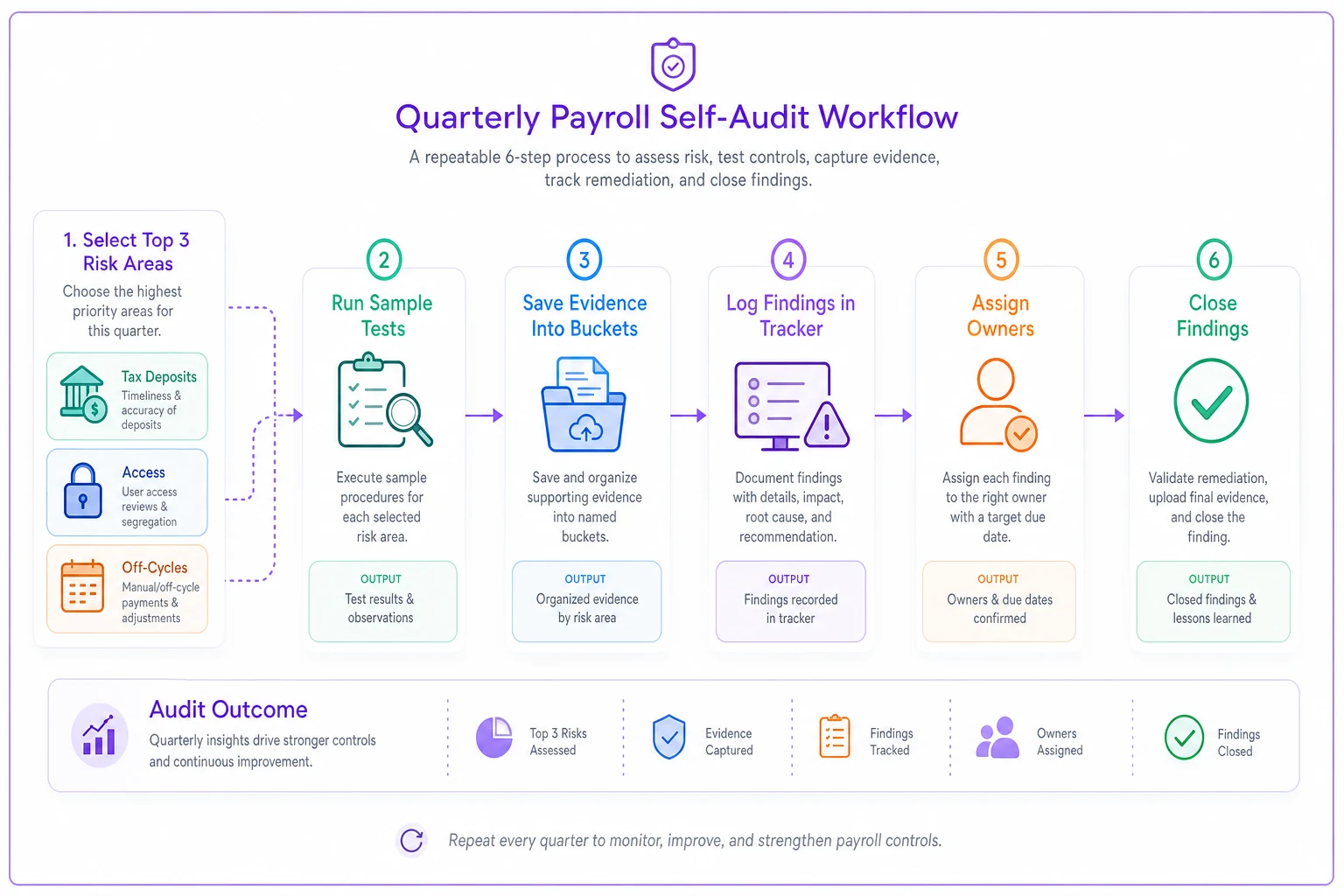
The first quarter will be slow and will turn up more than you expect. That's the point. By the second or third pass, you'll have baselines, the tests will run faster, and the whole thing settles into a rhythm that quietly prevents the expensive surprises. An internal payroll audit checklist isn't about impressing an auditor — it's about never being surprised by your own numbers.
An internal payroll audit checklist isn't about impressing an auditor — it's about never being surprised by your own numbers.
Ready to simplify your payroll operations?
Join 2,000+ businesses using Payexly to reduce payroll overhead, ensure compliance, and enhance employee satisfaction.