


Most labour-cost forecasts are wrong before anyone touches a scenario. Not because the FP&A team is careless, but because they're modelling on a copy of the truth — a headcount tracker someone exported, a comp band spreadsheet that's three months stale, an assumption about loaded cost that hasn't been checked against an actual pay run since the last budget cycle. Meanwhile, payroll already knows exactly what the company paid last period, down to the employer tax, the mid-cycle raise, the retro adjustment, and the benefit deduction that changed in March.
The gap between those two worlds is where labour forecasts quietly drift. And labour is usually the single largest controllable line on the P&L, so a 3–4% drift there swamps whatever precision you gained obsessing over software subscriptions or travel budgets.
The fix isn't a better spreadsheet. It's treating payroll-driven labour cost forecasting as a real pipeline — payroll as the canonical input, with defined fields, reconciliation gates, and an actual SLA between the team that runs pay and the team that builds the forecast. This is about plumbing, not math.
The two-system problem nobody owns
Payroll and FP&A touch the same dollars but answer to different masters.
Payroll's job is to pay people correctly and on time, stay compliant, and close the cycle. Their source of truth is the pay run — immutable, auditable, reconciled to the GL. FP&A's job is to predict the future and explain variances. Their source of truth is the model, which is forward-looking and assumption-heavy by nature.
Neither team is wrong. The problem is that the handoff between them is almost never designed. It's usually one of these:
-
A monthly export that FP&A pulls and re-shapes by hand
-
A headcount report from HRIS that doesn't match the actual pay run because of timing
-
A "fully loaded cost per head" multiplier that someone calculated two years ago and nobody has revisited
In practice, this breaks in a predictable way. FP&A builds a forecast off headcount, applies an assumed loaded rate, and presents it to the CFO. Three months later, actuals come in off by six figures, and now everyone's in a room trying to reconstruct why. Half the variance turns out to be employer taxes nobody modelled correctly, a bonus accrual that landed in a different period, and two contractors who were reclassified to employees without anyone updating the model.
The root cause is that labour cost is being estimated when it could be derived. Payroll has the derived number. It just isn't flowing into FP&A in a usable, trustworthy shape.
The canonical fieldset: what payroll should actually hand over
The first thing to fix is the data contract. Not the dashboard, not the scenario model — the fieldset. If FP&A keeps receiving a different shape of data every cycle, no amount of modelling discipline saves you.
Eliminate payroll errors and delays.
Payexly streamlines every payroll cycle ensuring accuracy and compliance.
- Automated payroll processing
- Real-time tax compliance
- Benefits & deductions management
No credit card required
A canonical labour-cost fieldset is the minimum set of fields, defined once, that every forecast is built from. The point is that payroll and FP&A agree on these definitions and never argue about them again.
Here's a practical starting set. The exact columns vary by business, but the structure holds:
| Field | Source | Why FP&A needs it |
|---|---|---|
| Employee / worker ID | Payroll | Stable key to join across periods |
| Pay group / cost centre | Payroll + GL mapping | Allocates labour to the right P&L line |
| Base pay (period) | Payroll run | The actual, not the band assumption |
| Overtime / variable pay | Payroll run | The line FP&A almost always under-forecasts |
| Employer taxes | Payroll run | Jurisdiction-specific, hard to estimate cleanly |
| Employer benefit cost | Payroll + benefits feed | The "hidden" third of loaded cost |
| Bonus / commission accrual | Payroll + accruals | Timing-sensitive, causes period noise |
| Start / term dates | HRIS → Payroll | Drives ramp and attrition timing |
| Worker type (FTE / PT / contractor) | HRIS → Payroll | Changes tax and benefit treatment |
| Effective-dated comp changes | Payroll | Mid-cycle raises wreck flat-rate models |
The insight most teams miss: the fieldset should carry effective dates, not just current values. A forecast built on "current salary" can't correctly model a raise that took effect halfway through a period or a hire who only worked eleven days of their first month. If the canonical feed carries the effective-dated detail, FP&A can pro-rate correctly instead of smearing an average across the whole period and calling it close enough.
Include effective dates in the canonical feed so pro-rating and mid-period changes are accurate.
If you've already done the work of building a canonical payroll layer for reporting, this is the same spine extended one more consumer downstream. The hard part — agreeing on definitions and source mappings — is mostly shared with the reporting taxonomy work that FP&A should've been plugged into from the start.
Reconciliation gates: don't forecast off numbers you haven't tied out
This is the step that separates a real pipeline from a spreadsheet handoff. Before any labour forecast gets built, the input data has to pass reconciliation gates against payroll's source of truth.
The principle: FP&A never forecasts from a number payroll hasn't reconciled. If the input doesn't tie to the closed pay run and the GL, it doesn't enter the model.
A workable gate sequence looks like this:
-
Pay-run completeness gate. Does the record count and total gross match the closed payroll register? If the feed shows 412 employees but the run closed at 418, stop. Something dropped.
-
GL tie-out gate. Do the labour totals by cost centre match what posted to the general ledger? A mismatch here means the allocation logic is broken, and every departmental forecast built on it inherits the error. This is the same discipline as a rigorous month-end payroll-to-GL reconciliation, just pointed at a forecasting consumer instead of accounting.
-
Period-boundary gate. Are accruals and off-cycle payments landing in the right period? Bonuses and retro pay are the usual culprits. A bonus paid in one period but earned across four will distort a run-rate forecast if nobody flags it.
-
Variance-threshold gate. Does this period's loaded cost per head sit within tolerance of the trailing few periods? A sudden jump might be real (benefit renewal, tax rate change) or might be a feed error. Either way, it gets reviewed before it flows, not after the forecast ships.
Here's a simple workflow showing how the gates sit in the input pipeline.
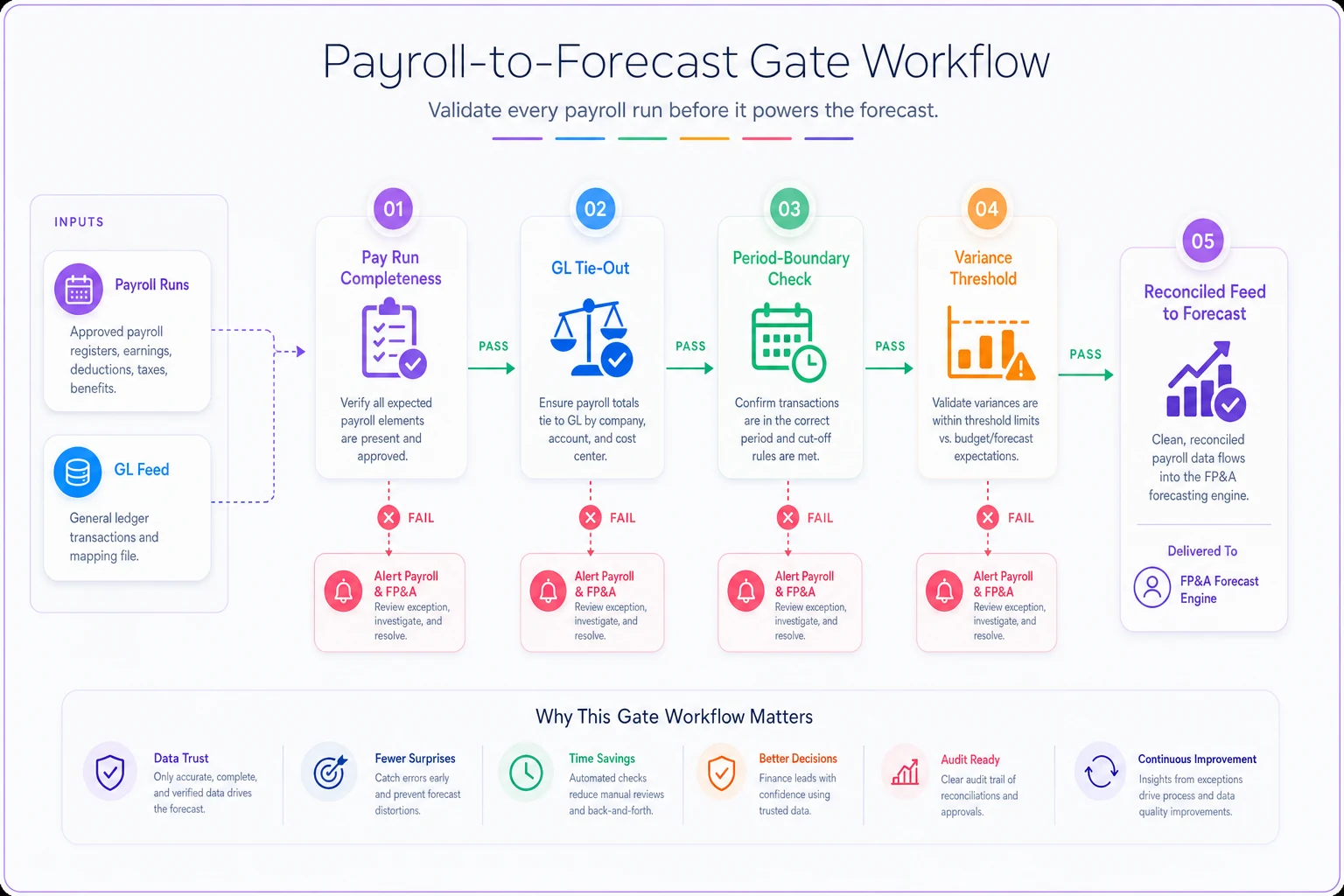
Gates are cheap; post-hoc investigations are expensive. A business that gates its inputs spends maybe twenty minutes a cycle confirming ties. A business that doesn't spends two days every quarter reconstructing why the forecast missed.
One common mistake — teams build these gates as a one-time cleanup, run them once, feel good, and let them lapse. The gates have to run every cycle, because the thing that breaks the feed is almost always something new: a new pay group, a jurisdiction added, a benefit plan changed. The gate catches it on the way in instead of six weeks later in a variance meeting.
Scenario templates: hiring ramp and freeze, done honestly
Once you have a clean, reconciled canonical input, scenario modelling stops being guesswork. The two scenarios every finance partner gets asked for are a hiring ramp and a freeze, and both are routinely modelled badly.
The hiring ramp
The naive ramp model takes an open-roles list, multiplies by an average salary, and adds it to the forecast starting next month. This is wrong in three ways, and all three cost you.
First, start dates slip. A role approved in Q1 doesn't fill in Q1. In real hiring, the lag between approval and first paycheck runs anywhere from six weeks to a few months depending on seniority. Modelling the full cost from the approval date overstates spend and makes you look perpetually under budget — which feels fine until the CFO notices every forecast skews pessimistic and stops trusting the model.
Second, first-period cost is partial. A hire who starts on the 20th costs roughly a third of a month, not a full one. The effective-dated fieldset lets you pro-rate this correctly.
Third, loaded cost isn't base pay. A ramp model built on base salary alone under-forecasts by whatever the employer tax and benefit load is — frequently 20–30% on top of base, sometimes more depending on the benefit package and jurisdiction. Because your canonical feed already carries actual employer tax and benefit cost per head, your ramp assumptions can be anchored to what you actually pay, not an industry rule of thumb.
A better ramp template carries, per planned role: target start date, probability-adjusted start (or a slip assumption), pro-rated first period, and a loaded-cost multiplier derived from your own reconciled data for that cost centre and worker type.
The freeze
The freeze scenario is sneakier because people assume it's just "stop hiring." It isn't. A realistic freeze model has to account for:
-
Attrition that keeps running. A freeze with normal attrition shrinks headcount over time. That's often the point — but you have to model the pace, and that pace comes from your own term-date history, not a guess.
-
In-flight offers. Roles already accepted usually still land. A freeze announced today doesn't stop someone starting in two weeks.
-
Backfill pressure. Pure freezes rarely hold cleanly; critical roles get exceptions. A model that assumes zero hires for six months is as wrong as one that assumes none slip.
-
Overtime creep. When you freeze hiring but keep the workload, the remaining team absorbs it, and variable pay climbs. Your canonical overtime field is what lets you catch this — a freeze that looks like savings on base pay can quietly give a chunk of it back in overtime.
The reason both templates work better off a reconciled payroll input is that your assumptions stop being generic. Instead of "contractors cost about 1.4x," you model what your contractors cost in that cost centre, derived from runs that already tied to the GL.
Reconciled outputs: closing the loop so the forecast self-corrects
A forecast is only as good as the feedback it gets. The final piece of the pipeline is reconciling forecast to actuals every period and feeding the variance back into assumptions.
This is where most labour forecasting dies. The forecast ships, the period closes, and nobody systematically compares the two in a way that improves the next model. The variance gets discussed in a meeting, blamed on "timing," and forgotten.
A reconciled-output loop does three things:
-
Decomposes variance into causes. Not just "we were off by $140k" but how much was rate (people cost more than modelled), volume (more or fewer heads than planned), timing (right amount, wrong period), and mix (more contractors, fewer FTEs, or vice versa). Each of these points at a different assumption to fix.
-
Feeds the big misses back into templates. If the ramp consistently over-forecasts because starts slip, the slip assumption gets updated. If overtime consistently under-forecasts in a freeze, the overtime model gets tightened.
-
Builds trust. A forecast that explains its own misses in payroll terms earns credibility. One that can't gets quietly ignored, and leadership goes back to gut-feel headcount decisions.
Treating variance analysis as a scorecard is the wrong instinct. The goal isn't to prove the forecast was good — it's to make the next one better by learning exactly where the derived number beat the estimate. The teams who do this consistently end up with labour forecasts that converge toward actuals over a few quarters, and the logic is the same as turning raw metrics into KPIs leadership can actually act on — the number has to close a loop, not just sit on a slide.
The SLA between payroll and FP&A
None of this holds together without an agreement on who delivers what, when. Payroll and FP&A need a lightweight SLA — not a legal document, just a written understanding of the handoff.
At minimum it should pin down:
-
What fields payroll delivers (the canonical set) and in what format
-
When — e.g., the reconciled feed is available by day 3 after pay-cycle close
-
What "reconciled" means — which gates must pass before the feed is considered usable
-
Who owns exceptions — when a gate fails, who investigates and by when
-
Change notification — payroll tells FP&A before new pay groups, jurisdictions, or benefit plans change the shape of the data, not after
What makes this work is that it's bidirectional. FP&A owes payroll something too: clear scenario definitions, advance notice of planning cycles so payroll isn't blindsided by a data request mid-close, and feedback when the feed breaks a forecast. The relationship fails when one side treats the other as a data vending machine.
When this level of rigour makes sense — and when it doesn't
This pipeline is worth building when labour is a large share of your cost base, when you operate across multiple jurisdictions or cost centres, or when forecast misses have real consequences — board scrutiny, covenant tests, tight runway.
It's probably overkill for a very small, single-location business with fifteen stable employees and no hiring plans. At that scale, a clean monthly export and a careful spreadsheet genuinely is fine, and building gates and SLAs is ceremony you don't need.
The transition point usually shows up around the time a business adds a second jurisdiction, crosses the threshold where one person can't hold the whole payroll picture in their head, or starts doing scenario planning for a board. That's when the estimate-based model starts missing often enough that the cost of building the pipeline pays for itself.
A real scenario
A regional services company — roughly 240 employees across three states — ran labour forecasting off an HRIS headcount export and a flat 1.25x loaded-cost multiplier. Their quarterly labour variance ran around 4–6%, and because labour was close to 60% of operating cost, that variance alone was blowing their overall forecast accuracy apart. Every quarter-end turned into a scramble to explain the miss.
The actual problems, once they dug in: the 1.25x multiplier understated real loaded cost (their blended employer tax and benefit load was closer to 1.33x in one state), ramp hires were modelled from approval date instead of actual start, and overtime wasn't modelled at all — it just showed up in actuals as a surprise.
They didn't buy new software first. They started by defining a canonical fieldset pulled straight from reconciled pay runs, added a GL tie-out gate so the labour totals had to match what posted, and rebuilt their ramp and freeze templates off their own per-cost-centre loaded rates. The SLA was one page: reconciled feed by day 3, FP&A owns the templates, payroll flags structural changes.
Within two quarters, labour variance settled into the 1–2% range. The bigger win wasn't the number — it was that variance meetings stopped being forensic investigations. When they were off, the decomposition told them why in about ten minutes, and the assumption got fixed for next time.
The real shift
The point of all this isn't precision for its own sake. Labour decisions — hiring, freezing, backfilling, restructuring — are among the highest-stakes calls a business makes, and they're usually made on a forecast that's quietly disconnected from what the company actually pays.
Treating payroll as the canonical FP&A input flips that. The forecast stops being a guess layered on top of a stale headcount tracker and becomes something derived from reconciled, auditable reality, with the assumptions that are genuinely uncertain — start dates, attrition, overtime — isolated and tracked instead of buried inside a blended multiplier.
Payroll already holds the truth. The work is building the plumbing so FP&A can drink from it without getting burned — a clean fieldset, gates that catch bad data on the way in, templates anchored to your own loaded costs, and a reconciliation loop that makes next quarter's forecast a little less wrong than this one's. Once that spine exists, the same reconciled data can feed the executive-level cost and risk view leadership actually needs — because at that point everyone's finally arguing about decisions instead of arguing about the numbers.
Payroll already holds the truth. The work is building the plumbing so FP&A can drink from it without getting burned — a clean fieldset, gates that catch bad data on the way in, templates anchored to your own loaded costs, and a reconciliation loop that makes next quarter's forecast a little less wrong than this one's. Once that spine exists, the same reconciled data can feed the executive-level cost and risk view leadership actually needs — because at that point everyone's finally arguing about decisions instead of arguing about the numbers.
Ready to simplify your payroll operations?
Join 2,000+ businesses using Payexly to reduce payroll overhead, ensure compliance, and enhance employee satisfaction.