

Most payroll reporting doesn't fail loudly. It fails in a meeting when the CFO glances at a labor-cost number, frowns, and says "that doesn't match what finance sent me." Everyone nods, someone promises to "look into it," and from that moment on nobody trusts the dashboard. They go back to pulling their own extracts. The report still exists. It's just dead.
That's the real problem with turning ad-hoc payroll reports into something people rely on. It isn't a charting problem or a "we need better BI" problem. It's an operating-model problem. Numbers become trustworthy when there's a repeatable system behind them — how data comes in, how it's shaped, how often it's checked against a source of truth, and what each consumer is actually promised. Skip any of those and you get pretty charts that quietly lose credibility.
A real payroll analytics operating model is the set of agreements and mechanics that make a number defensible. Not "here's a metric," but "here's where this metric comes from, here's when it was last reconciled, and here's who owns it if it's wrong." This article walks through how that system holds together — and where it breaks as you grow.
Where ad-hoc reporting quietly falls apart
The pattern is almost always the same across small and mid-size teams. Payroll runs, someone exports a few CSVs, drops them into a spreadsheet, and builds a report for whoever asked. It works fine at 40 employees. It starts wobbling around 150. By 400 it's a liability.
Here's what actually breaks, in the order it usually breaks:
-
The extract is a snapshot nobody can reproduce. Somebody pulled the file on a Tuesday. Two adjustments posted Wednesday. Now the report and the payroll system disagree, and nobody remembers the pull time.
-
Field meanings drift. "Gross pay" in one export includes imputed income; in another it doesn't. Two reports, both "correct," both different.
-
Late data has no home. Off-cycle checks, voided runs, retro adjustments — they land after the report was built and silently make it wrong.
-
No one owns the number. When finance and HR both "kind of" own labor cost, nobody reconciles it, because reconciliation is somebody else's job.
The underlying issue is that ad-hoc reporting treats data as a one-time event instead of a flow. Payroll data keeps changing after a run closes — corrections, garnishment updates, benefit true-ups. A report built as a snapshot can't survive that. A system built as a pipeline can.
This is also why a shared vocabulary matters before you build anything. If the organization hasn't agreed on canonical definitions, you're just automating disagreement. The reasoning behind that is worth reading separately in Why a canonical payroll data strategy matters for HR and finance reporting.
Ingestion patterns: how data actually gets in
The way you bring payroll data into your analytics layer decides most of your future headaches. There are really only three patterns worth using, and the right one depends on the source and how fresh the number needs to be.
Eliminate payroll errors and delays.
Payexly streamlines every payroll cycle ensuring accuracy and compliance.
- Automated payroll processing
- Real-time tax compliance
- Benefits & deductions management
No credit card required
| Ingestion pattern | Best for | Freshness | Main risk |
|---|---|---|---|
| Batch file drop (CSV/SFTP) | Legacy payroll systems, vendor exports | Per pay-cycle | Missed files, silent schema drift |
| Scheduled API pull | Modern payroll/HRIS with APIs | Daily or intra-day | Rate limits, partial pulls, pagination gaps |
| Event/webhook stream | Time systems, approval events | Near real-time | Duplicate events, out-of-order delivery |
Most teams end up with a mix. Timecards come in as events, the payroll register comes as a batch file after each run, and benefits data comes from an API. That's fine — the mistake isn't mixing patterns, it's not making each one idempotent and observable.
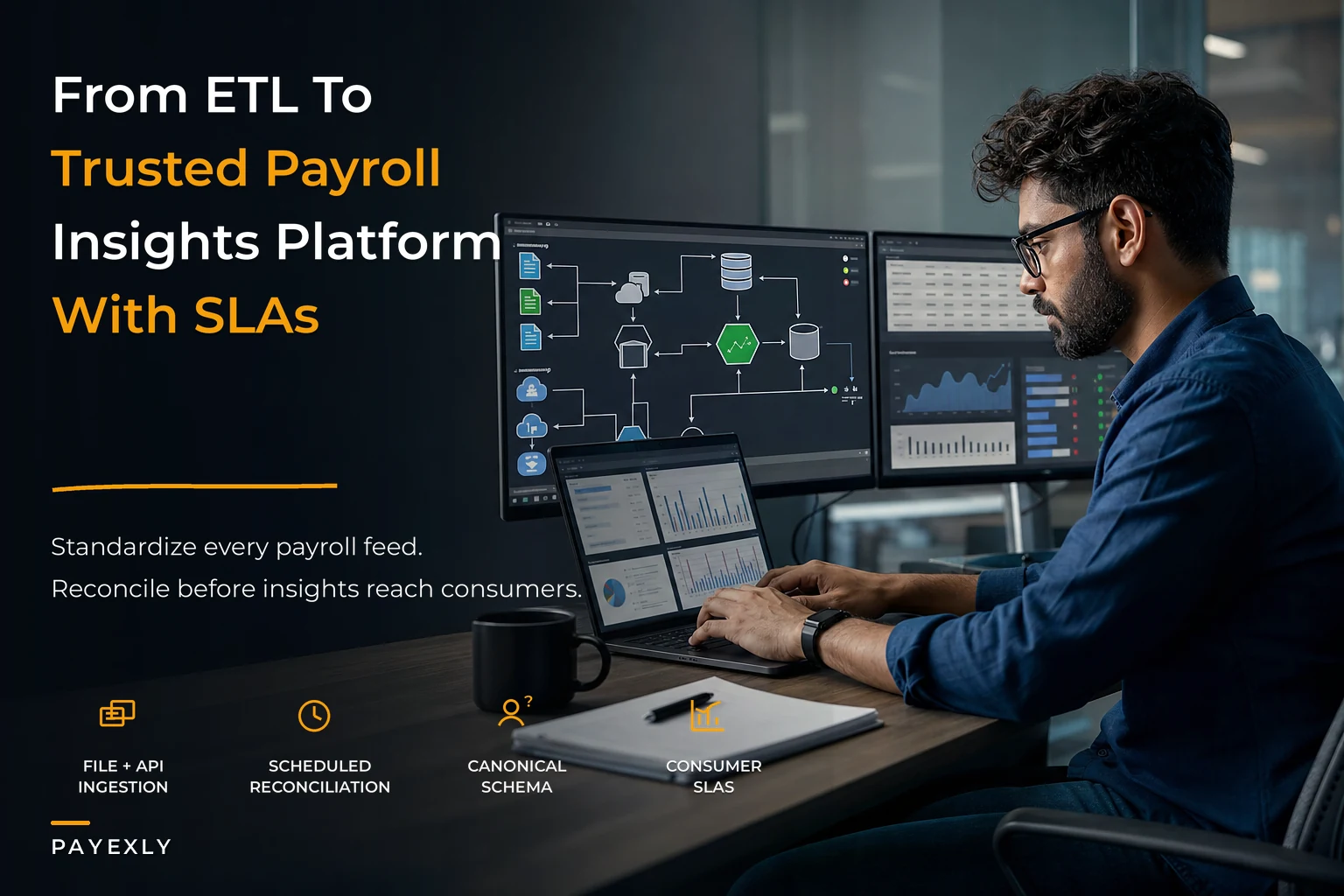
Here's a simple workflow showing how those ingestion patterns flow into the analytics layer and feed monitoring and replay.
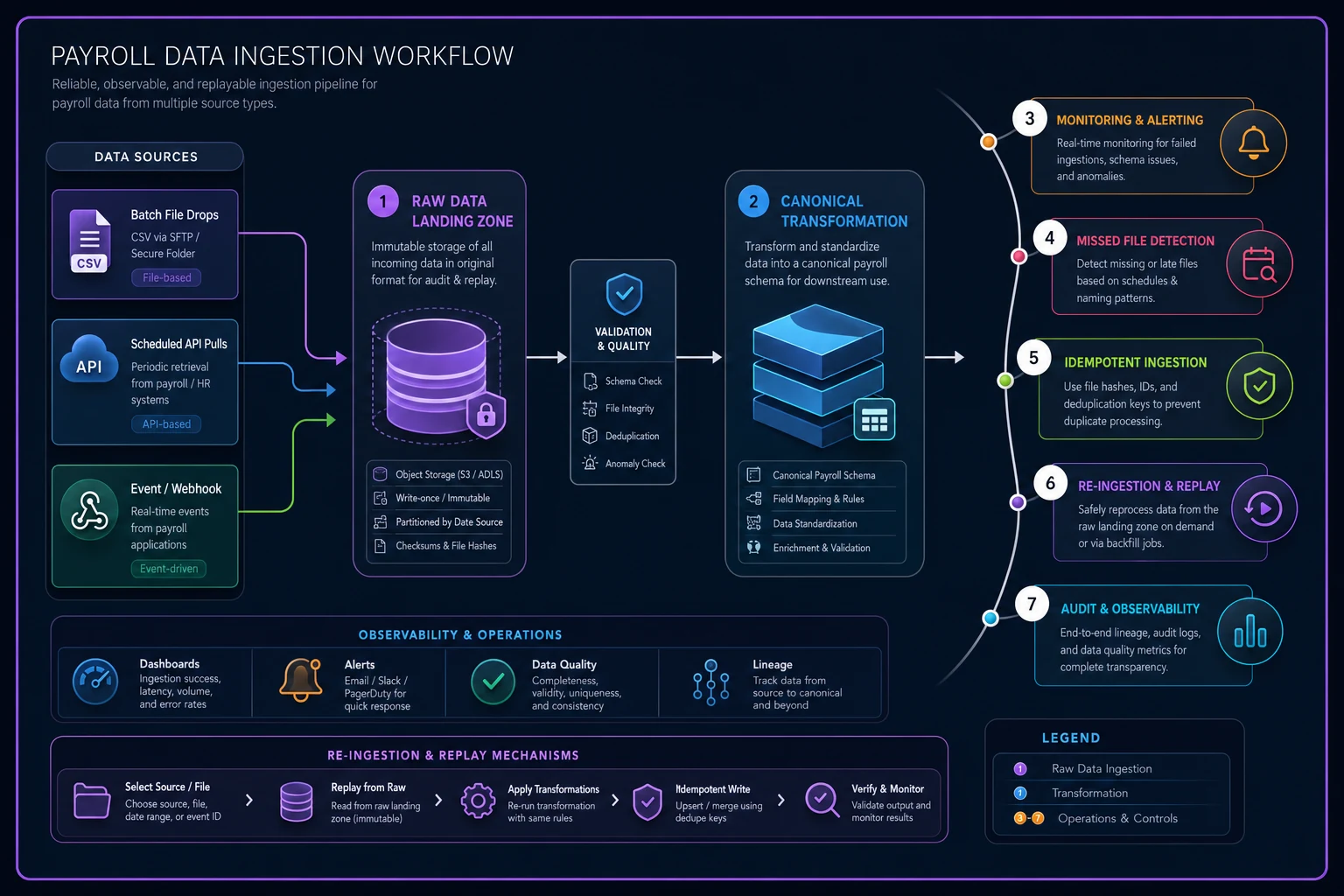
Idempotent means you can re-ingest the same file twice without doubling your numbers. In practice, this usually happens the ugly way: a vendor re-sends yesterday's file "to be safe," and now your labor cost for that day is doubled in the warehouse. If your ingestion keys every record on something stable — pay-run ID plus employee ID plus earning code — a re-send just overwrites. No harm done.
Timestamp and fingerprint raw files on arrival so you can detect re-sends and replay exactly what the source sent.
Observable means you know when a file didn't arrive. A surprising number of reporting failures are just "the Thursday file never landed and nobody noticed until Monday." A simple expected-arrival check — "we should have received the biweekly register by 6pm, alert if not" — catches more problems than any fancy validation rule.
One practical rule that saves a lot of pain: land raw data before you transform it. Keep an untouched copy of exactly what the source sent, timestamped. When someone challenges a number three weeks later, you can replay from raw instead of guessing what the source looked like back then.
A canonical schema you can actually defend
Ingestion gets data in the door. A canonical schema decides whether it means anything. The goal is a small set of stable, well-defined tables that every report reads from — so "gross pay" means one thing everywhere.
A workable canonical model for payroll analytics usually centers on a few core tables:
-
factpayrun_line— the grain everything hangs on: one row per employee, per pay run, per earning/deduction code. Amount, hours, code type, effective date, run ID. -
dim_employee— slowly-changing, so historical reports reflect the department and rate that were true at the time, not today. -
dimpaycode— the translation layer. Maps every raw earning/deduction code to a canonical category (regular, OT, bonus, pretax deduction, employer contribution, imputed income). -
facttaxdepositandfactglposting— the bridges to finance, so payroll numbers can be tied back to what actually hit the general ledger and the tax authorities.
The single highest-value piece here is dimpaycode. Almost every payroll data mess traces back to raw codes that were never mapped to consistent categories. One company can accumulate 60-plus earning codes over a decade — three of which mean "bonus" for slightly different reasons nobody remembers. Until those roll up to a canonical bonus category, no cross-department comparison is safe.
A quick note on grain: keep the fact table at the line level, not summarized. It's tempting to store "total gross per employee per run" to save space, but the moment someone asks "how much of that was overtime versus shift differential," a summarized table can't answer without a re-pull. Store detail, aggregate on read.
For teams that want the field-by-field version of these agreements — including how to version them so changes don't silently break downstream reports — the mechanics are covered in Payroll data contracts and APIs: field-level contract templates, versioning rules and automated contract tests.
Scheduled reconciliations: the part that earns trust
A number nobody reconciles is a rumor. Reconciliation is what turns your canonical tables from "probably right" into "provably right." And it has to be scheduled, not triggered by suspicion.
Think of reconciliation as a set of standing checks that run on a cadence and tie each layer to the one below it. A practical reconciliation ladder looks like this:
-
Source-to-landing. Did the row count and control totals from the vendor file match what we ingested? Catches truncated files.
-
Landing-to-canonical. After transformation, does total gross by run still equal source gross? Any pay codes that failed to map? Catches new unmapped codes.
-
Canonical-to-GL. Does payroll expense in the analytics layer tie to what posted in the general ledger for the same period?
-
Canonical-to-tax. Do taxable wages and withholdings match what was deposited and filed?
-
Period-over-period drift. Is total labor cost within an expected band versus last cycle, accounting for headcount changes?
Each check produces one of three states: clean, warning, or break. A break means a report should not be published from that period until someone signs off. That's the whole point — reconciliation isn't a report you file, it's a gate between "raw data" and "insight people are allowed to act on."
Cadence matters more than sophistication. A simple daily row-count check that actually runs beats a brilliant reconciliation script that runs "when we remember." The reconciliation nobody scheduled is the reconciliation nobody does — right up until an auditor asks for it.
One subtle failure point: reconciling against the wrong "truth." If you reconcile canonical numbers back to the same export you ingested, you've proven nothing except that your copy machine works. Reconcile against an independent source — the payroll provider's own summary report, the GL, the tax deposit confirmations. Two systems agreeing is meaningful. One system agreeing with itself is not.
Consumer SLAs: promising the right thing to the right person
This is the piece most teams skip entirely, and it's why reporting relationships turn sour. Different consumers of payroll data need wildly different things, and promising everyone "real-time accurate data" guarantees you fail everyone.
A consumer SLA is a plain-language agreement: what this consumer gets, how fresh it is, how accurate it's guaranteed to be, and what happens when something's late. Not a legal document. A shared expectation so nobody's surprised.
A few realistic consumer profiles and what they actually need:
-
The CFO / board deck. Doesn't need daily. Needs reconciled and final. SLA: "Numbers are period-close reconciled, published within 3 business days of run close, tie to GL." Accuracy over speed, every time.
-
HR ops / labor management. Needs directional and fast. SLA: "Refreshed daily, may include unreconciled off-cycle items, clearly flagged as preliminary." Speed over precision.
-
Department managers. Need their slice, consistently. SLA: "Weekly, department-scoped, with a clear 'as-of' timestamp on every view."
-
Auditors / compliance. Need traceable and frozen. SLA
"Point-in-time snapshots preserved, every figure traceable to a raw source record."
Writing these down makes conflicting needs visible. When HR wants speed and the CFO wants reconciled finality from the same underlying data, that's a design decision — you serve preliminary and final versions clearly labeled — not an argument to have every month.
Two SLA elements that get forgotten and cause the most friction:
-
The "as-of" timestamp on every view. If a number can change after publication — and payroll numbers always can — the consumer needs to know which version they're looking at. "Labor cost $412k, as of pay-run close, pre-adjustment" is trustworthy. "Labor cost $412k" is a future argument.
-
A stated correction path. When a reconciliation break gets fixed after publication, who gets notified, and how? A quiet correction erodes trust faster than an honest "we found a mapping error, here's the corrected figure."
If you want to see how these SLAs connect down to individual fields and dashboard layouts, the walkthrough in Design a stakeholder-driven payroll reporting taxonomy: SLAs, field-level source mappings and dashboard wireframes maps consumer needs to specific source fields.
How the whole thing connects as you scale
At small scale, all of this can live in one person's head and a couple of spreadsheets. Ingestion is "download the file." The schema is "the tab structure Sarah made." Reconciliation is "gross looked about right." The SLA is "ask Sarah."
That works until three things happen at once — and they always happen around the same growth stage. More data sources appear (a new time system, a benefits vendor). More consumers appear (a new controller who wants GL tie-outs, managers who want self-serve). And Sarah goes on vacation.
The transition from ad-hoc to operating model is really about moving each of those from a person to a process:
-
"Download the file" becomes an ingestion pattern with arrival monitoring.
-
"Sarah's spreadsheet tabs" become canonical tables with defined grain and pay-code mapping.
-
"Looked about right" becomes a scheduled reconciliation ladder with gates.
-
"Ask Sarah" becomes documented consumer SLAs.
The coordination cost is what people consistently underestimate. Every one of these layers touches a different owner — payroll runs ingestion timing, finance owns the GL tie-out, HR owns pay-code meaning, IT owns the pipeline. When those hand-offs are informal, a break in one layer stalls the whole chain and nobody's quite sure whose problem it is. The operating model's real job is making those hand-offs explicit so a late file doesn't become a three-day fire drill.
Modern analytics platforms help mostly by making the boring parts automatic — flagging when a file is late, catching a new unmapped pay code before it pollutes a report, running reconciliations on schedule instead of on memory. That's genuinely useful, but the tooling only matters after you've agreed on the schema, the reconciliation gates, and who gets promised what. Automating an undefined process just gets you to the wrong answer faster.
A real scenario: 220-person services company
A regional facilities-services company with around 220 employees across four states had the classic setup — payroll register exported after each biweekly run, dropped into a shared workbook, labor-cost reporting built by hand by one HR analyst. Roughly two full days every pay cycle went into building and re-checking reports.
The recurring pain: overtime numbers in the HR report never matched what finance booked to the GL. The gap was usually a few thousand dollars — enough that the CFO stopped trusting the HR dashboard and had finance rebuild labor cost independently every month. Two teams, same data, doing the work twice.
The root cause turned out to be mundane. Three overtime-related earning codes weren't being categorized consistently, and off-cycle correction runs landed after the report was built, so the report and the GL were literally looking at different data. Nothing exotic — just no canonical mapping and no reconciliation gate.
The fix wasn't a big platform rollout. They defined a canonical pay-run table, mapped every earning code once (and found five codes nobody could fully explain), and added two scheduled reconciliations — canonical-to-GL and an off-cycle catch check that held publication until late runs were included. Then they wrote two one-paragraph SLAs: preliminary daily for HR ops, reconciled-and-final within three days for the CFO.
After about two cycles: report-building time dropped from roughly two days to a few hours, the finance team stopped rebuilding labor cost independently, and the overtime discrepancy — the thing that had killed trust — closed because breaks now had to be resolved before anyone saw a number. The reports weren't fancier. They were just believed.
When this level of rigor makes sense — and when it doesn't
Not every business needs a full operating model, and building one prematurely wastes real effort.
When it makes sense:
-
You have multiple consumers who need the same numbers to agree (HR, finance, department heads).
-
Numbers feed decisions with money attached — headcount planning, GL close, board reporting.
-
You're past the point where one person can hold the whole process in their head, roughly 150-plus employees or multiple pay groups.
-
Payroll data comes from more than one source system.
When it's overkill:
-
Small, single-location team where one person owns both payroll and reporting and everyone trusts them.
-
Reports are informational, not decision-driving.
-
Your data has a single clean source and rarely gets corrected after the fact.
Who should not rush into this: teams that haven't yet agreed on definitions. If HR and finance still argue about what "labor cost" includes, building pipelines and SLAs on top of that disagreement just cements the confusion into automation. Settle the vocabulary first, then build the machinery.
Trusted payroll insight isn't a reporting feature you turn on. It's the byproduct of four things working together: data that comes in reproducibly, a canonical shape that gives numbers consistent meaning, reconciliations that run on a schedule and gate publication, and consumer SLAs that promise each audience the right version of the truth.
The teams that get this right aren't the ones with the prettiest dashboards. They're the ones where, when a number gets questioned in a meeting, someone can calmly say "that's the reconciled figure as of run close, it ties to the GL, here's the source." That sentence — not the chart — is what turns a report into something people are willing to act on.
Ready to simplify your payroll operations?
Join 2,000+ businesses using Payexly to reduce payroll overhead, ensure compliance, and enhance employee satisfaction.