
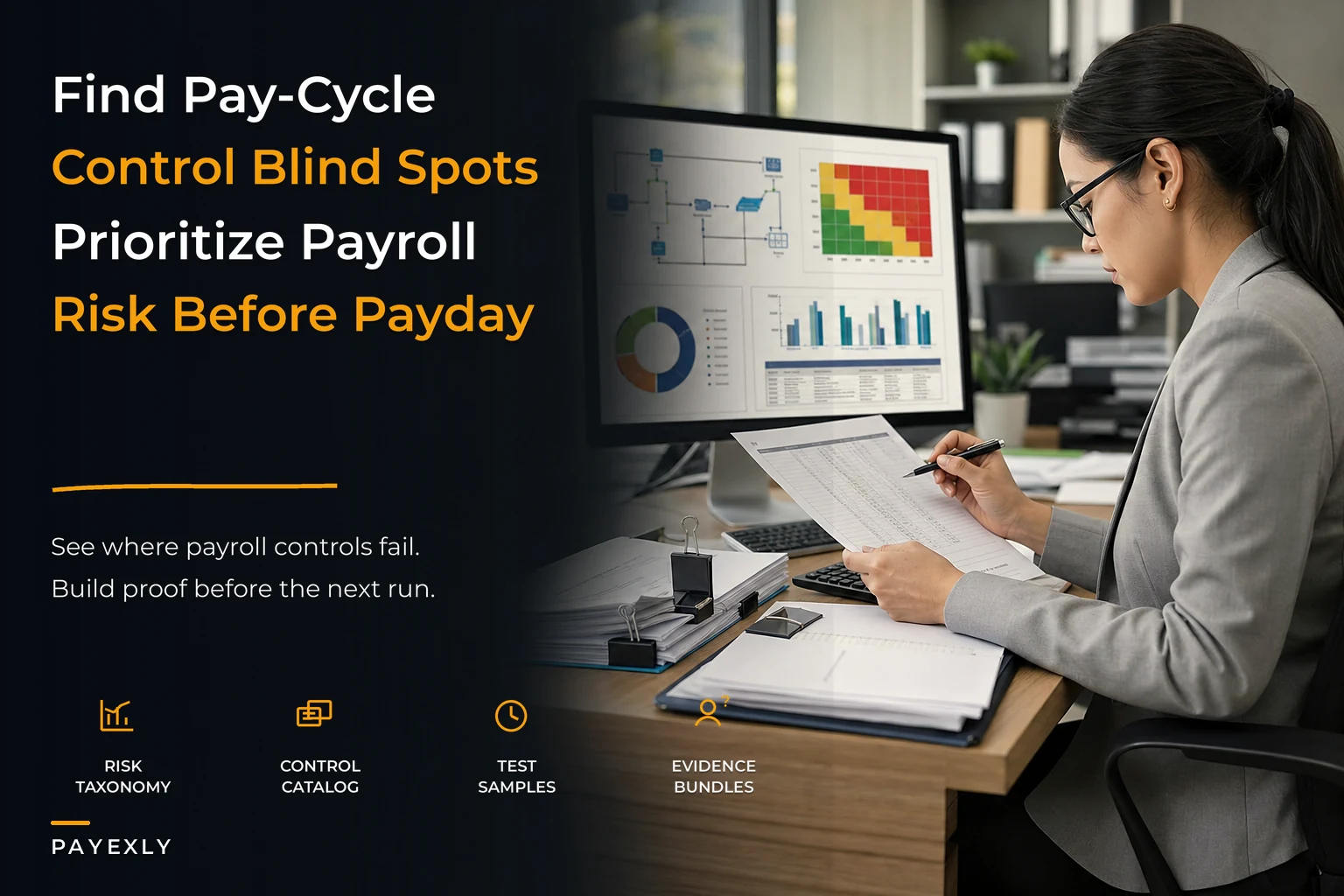

Most payroll teams don't fail because they lack controls. They fail because their controls are scattered across spreadsheets, email threads, tribal knowledge, and a vendor portal nobody actually checks — with no shared picture of what any of it is supposed to protect against. When something goes wrong, everyone points somewhere different, and nobody can say whether the miss was a design problem or an execution problem.
That's what a payroll risk taxonomy actually solves. Not compliance theater. Not a binder that comes out once a year for an audit. A taxonomy gives your team a shared language for risk, so when you're deciding where to put the next 40 hours of controls work, you're debating priorities instead of definitions.
This article walks through how to build one that's specific to payroll, tie each risk to a control, and test those controls with evidence you can actually defend. Less theory, more structure — the kind that holds up when headcount doubles and the pay cycle starts getting messy.
Why generic risk frameworks quietly fail payroll teams
Enterprise risk frameworks were mostly built for financial reporting and IT. When you bolt payroll onto them, the categories feel almost right but never quite fit. "Access control" in an IT framework means something very different from the payroll reality of a benefits admin who can also approve retro adjustments during month-end crunch.
The pattern that shows up repeatedly in midmarket teams: payroll risk gets flattened into two buckets — "compliance" and "errors." That flattening is exactly why blind spots form. A late 941 deposit and a misclassified contractor both land in the compliance bucket, but one is a timing failure in an automated process and the other is a decision-quality failure in a manual workflow. You can't fix them with the same control, and grouping them together guarantees one of them gets underfunded.
A payroll-specific taxonomy fixes this by organizing risk around the lifecycle of a pay cycle — the actual sequence of events from timecard capture to filing and reconciliation. When risks are mapped to where they occur, the connections between them get a lot more obvious. A data-entry weakness upstream shows up as a reconciliation break downstream, which becomes a tax-notice risk two months later. Seeing that chain is the whole point.
The five risk domains that cover most of the pay cycle
After enough time looking at where pay cycles actually break, the risks cluster into a handful of domains. Five covers the vast majority of what goes wrong in a midmarket environment. The goal isn't to be exhaustive — it's to be prioritized.
Eliminate payroll errors and delays.
Payexly streamlines every payroll cycle ensuring accuracy and compliance.
- Automated payroll processing
- Real-time tax compliance
- Benefits & deductions management
No credit card required
| Risk domain | What it covers | Common blind spot | Typical severity |
|---|---|---|---|
| Data integrity | Inputs feeding payroll: timecards, new hires, rate changes, deductions | No validation between HRIS and payroll system | High |
| Calculation & compliance | Gross-to-net, tax withholding, garnishments, multi-state rules | Edge cases (bonuses, retro, terminations) untested | High |
| Access & authorization | Who can change what, approval segregation, vendor access | Same person enters and approves changes | Critical |
| Disbursement & funding | Bank files, funding timing, tax deposit execution | No independent check before file release | Critical |
| Reporting & filing | Quarterly filings, W-2/1099, reconciliations, GL posting | Reconciliation done after filing, not before | Medium-High |
What makes this useful isn't the table itself — it's that each domain has a natural owner and a natural point in the cycle. Data integrity risk lives with whoever owns the inputs, usually HR. Access risk belongs to whoever administers the system. When you assign risk by domain, the accountability gaps that cause most payroll fires become visible before they burn anything.
One thing worth calling out: access and authorization is almost always the most under-controlled domain relative to its severity. Teams obsess over calculation accuracy because errors there are visible and embarrassing. Meanwhile, a broken approval workflow sits quietly until someone exploits it or a $40k off-cycle payment goes out without anyone having to approve it.
Prioritizing risks so you're not boiling the ocean
A taxonomy that treats every risk equally is useless. The whole value is deciding what to build first. The simplest prioritization approach that holds up in practice scores each risk on three things:
-
Likelihood — how often does this actually happen in a normal quarter?
-
Impact — what's the dollar, compliance, or trust cost if it goes wrong?
-
Detectability — would you catch it before it causes damage, or only after?
That third factor is what most teams skip, and it's arguably the most important. A low-likelihood, high-impact risk that you'd never catch until an employee complains is far more dangerous than a frequent error your reconciliation already flags. Detectability is what separates a risk that's genuinely exposed from one that's already contained by existing checks.
A practical scoring approach: rate each factor 1–3, multiply likelihood × impact, then bump the score if detectability is low. A garnishment misapplication might be low likelihood, high impact, and nearly invisible until the agency calls. That combination pushes it near the top of your list even though it rarely happens — because when it does, you won't see it coming.
Turning risks into a control catalog
Once risks are prioritized, each one needs at least one control mapped to it. The mistake here is writing controls that describe intentions — "payroll is reviewed for accuracy" — instead of controls that describe specific, testable actions — "the payroll register variance report is reviewed against prior period, and any line item over 15% is documented before approval."
That distinction matters a lot when you try to test the control later. Vague controls can't be tested, which means they can't be trusted, which means they're not really controls — they're hopes.
-
Risk Unauthorized rate change enters the pay run undetected
-
Control All rate changes require a second-person approval logged in the system before the pay run locks
-
Control type Preventive, segregation of duties
-
Owner Payroll manager
-
Frequency Every pay cycle
-
Evidence System approval log showing changer ≠ approver for each rate change
Notice the control specifies who, when, and how it's proven. That last piece — evidence — is where most control catalogs fall apart. If you can't name the artifact that proves the control ran, you don't have a defensible control. This is the same discipline behind a solid payroll governance framework with clear RACI and approval workflows — controls only hold up when ownership and proof are explicit.
A useful gut check: for every control you write, ask "if an auditor asked me to prove this happened last quarter, what would I hand them?" If the answer is "I'd have to go ask Sarah," it's not a control yet.
Sample control tests that actually catch things
A control catalog that's never tested drifts into fiction within a couple of quarters. People change roles, systems get reconfigured, workarounds creep in. Testing is how you keep the catalog honest.
Tests fall into two useful shapes: design tests (is this control capable of working?) and operating effectiveness tests (did it actually work over a period?). Most teams only do design tests — they confirm the approval workflow exists — and never check whether it was followed across the last several pay cycles.
-
Segregation of duties test Pull all changes from the last quarter where changer = approver. Any hit is a control failure. This is a five-minute query that catches the single most dangerous access gap.
-
Funding control test Sample three to five pay runs and confirm an independent reviewer signed off on the total dollar amount before the bank file released. Check the timestamp — sign-offs after release are a common quiet failure.
-
Calculation edge-case test Run synthetic scenarios (a mid-period termination with a bonus and a garnishment) through the system and compare against hand-calculated expected results. Building a reusable library of these pays off quickly — the mechanics are covered well in payroll regression tests and synthetic pay runs.
-
Reconciliation timing test Confirm the payroll-to-GL reconciliation was completed before the quarterly filing, not after. The date on the reconciliation versus the filing date tells the story.
Every one of these tests looks for the timestamp and the actor, not just the existence of a document. That's what separates a real test from a checkbox.
Building evidence bundles that survive an audit
Evidence scattered across email, Slack, and someone's desktop is technically evidence — but it's worthless when you need it under time pressure. The fix is bundling evidence per control, per period, in a predictable structure.
-
The control description and its risk mapping
-
The test procedure that was run
-
The population the sample was drawn from
-
The actual samples reviewed, with results
-
Any exceptions found and their remediation status
-
The reviewer's name and date
Teams that handle tax notices calmly almost always have organized evidence bundles — because a notice response is really just an evidence bundle assembled under deadline. If your bundles already exist, the triage-by-severity flow for responding to payroll tax notices becomes a retrieval exercise instead of a scramble.
One practical note: bundle evidence as controls run, not at quarter-end. The biggest time sink in payroll audits is reconstructing what happened months earlier. If evidence is captured in the moment the control executes, quarter-end review shifts from a two-week fire drill to an afternoon of work.
A real scenario: where the blind spot actually was
A regional services company with around 380 employees across four states kept getting hit with small tax-notice penalties — nothing catastrophic, but roughly $8k–$12k a year in penalties and interest, plus the internal hours to chase each one down. Everyone assumed the problem was the tax deposit process.
When they mapped their process against a proper risk taxonomy, the actual blind spot turned up in a completely different domain. Their deposits were fine. The problem was upstream: multi-state rate changes were being entered mid-quarter without a second review, and some of those changes shifted employee withholding in ways that quietly threw off quarterly filings. The penalties were a downstream symptom of a data-integrity and access-control gap, not a disbursement failure.
They added one control — mandatory second-person approval on any tax-relevant employee change — and a quarterly test to confirm it ran. Penalties dropped to nearly nothing over the next two quarters. The fix cost them maybe an hour per pay cycle.
The insight that they'd been hardening the wrong domain was worth far more than the control itself. Without the taxonomy, they'd have kept tightening a process that was already working fine.
When this level of structure makes sense — and when it doesn't
Not every team needs a formal control catalog with tested evidence bundles.
When it makes sense: You're past roughly 150–200 employees, operating in multiple states, running meaningful off-cycle volume, or heading toward a financing event or audit. At that scale, tribal knowledge stops working and the cost of a single miss exceeds the cost of building the system.
When it's overkill: A single-state company under 50 employees with one payroll person and a stable roster gets more value from a tight monthly reconciliation and clean approval habits than from a 40-control catalog. That's bureaucracy for its own sake.
Who should hold off: Teams in the middle of a payroll system migration. Building controls around a process you're about to replace is wasted effort — stabilize the platform first, then map risk against the system you'll actually run long-term.
The real judgment call is whether your pay cycle has gotten complex enough that coordination is now the bottleneck. When the problem shifts from "can we run payroll correctly" to "can everyone see who's responsible for what and prove it happened," you've probably outgrown informal controls.
How the pieces connect as you scale
The reason a taxonomy is worth building is that it turns payroll from a set of disconnected activities into a system you can reason about. Data integrity feeds calculation accuracy. Access controls protect disbursement. Reconciliation catches what upstream controls miss. Reporting is only as trustworthy as the reconciliation behind it.
Here is a simple visual of that workflow.
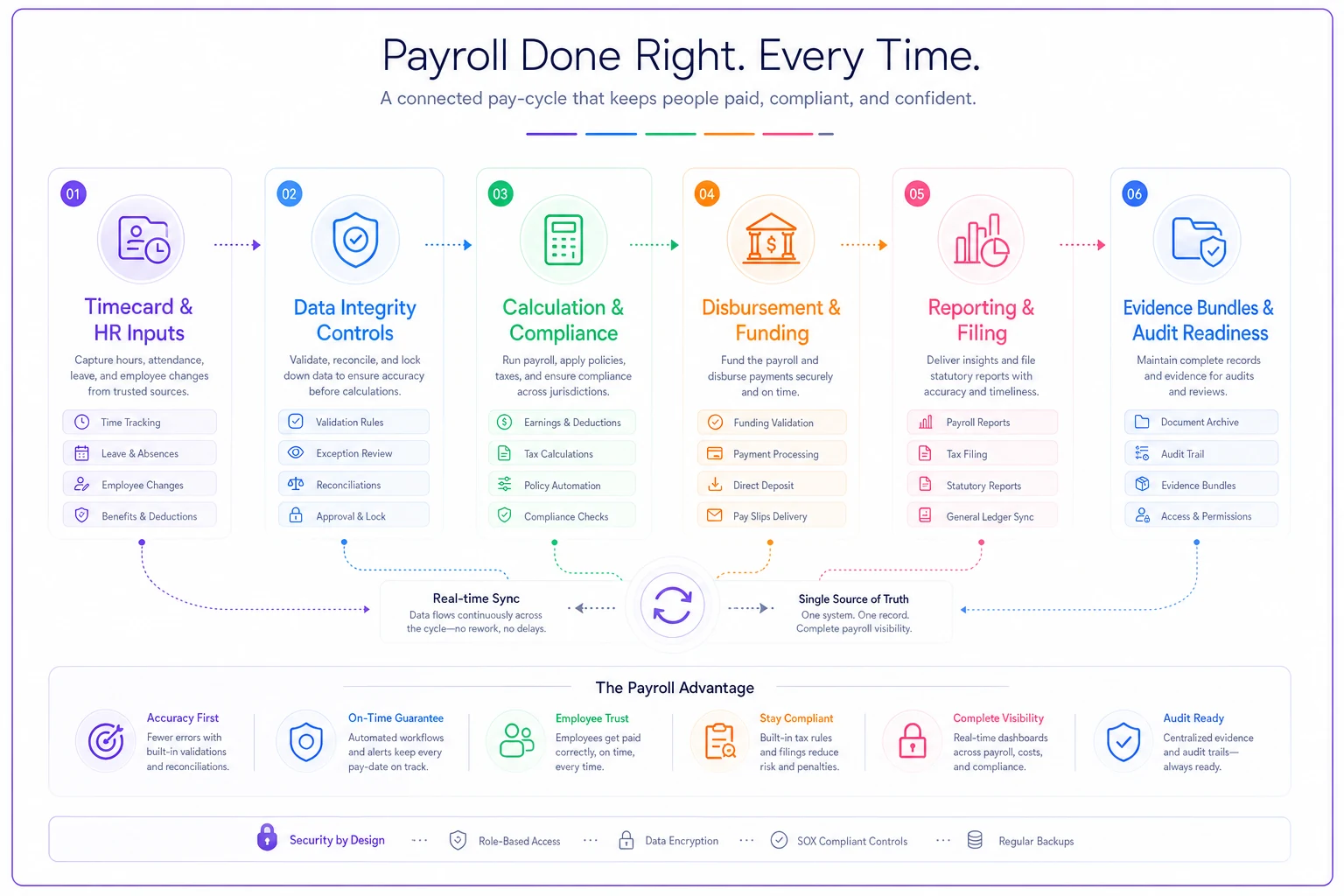
When you can see those dependencies, you stop firefighting individual errors and start fixing the domain that's actually generating them. The company chasing tax penalties was treating symptoms because they couldn't see the chain. Once the chain is visible, prioritization becomes obvious — you fix the earliest weak link, because upstream fixes carry downstream leverage.
This is also where operational tooling earns its place. A system that logs who changed what and when, enforces approval separation automatically, and captures control evidence as a byproduct of normal work removes the two hardest parts of this whole effort: remembering to run the control and reconstructing the proof later. The taxonomy tells you what to control; the right tooling makes those controls run without depending on anyone's memory.
The sequence matters though. Map the risk first, then automate the controls that survive prioritization. Automating a control you never validated just makes a bad process faster.
Closing thought
A payroll risk taxonomy isn't a compliance artifact. It's a decision-making tool that answers the question every stretched payroll team faces: of everything that could go wrong, what do we harden first?
Build it around the real pay-cycle lifecycle, prioritize by detectability as much as impact, map each risk to a control you can actually test, and capture evidence as the controls run. Do that consistently, and the next time something breaks, you'll know within minutes whether it was a design gap or an execution gap — and which domain to look in. That clarity, more than any single control, is what separates teams that get quieter every quarter from teams that keep fighting the same fires.
Ready to simplify your payroll operations?
Join 2,000+ businesses using Payexly to reduce payroll overhead, ensure compliance, and enhance employee satisfaction.