

Most pay equity work dies in a spreadsheet. Someone in HR pulls a comp analysis once a year, finds a handful of flagged employees, escalates a couple, and then the file gets buried until the next cycle or the next lawsuit. Nothing about that is operational. It's a snapshot taken under pressure, disconnected from the payroll system that actually moves the money.
The gap between "we ran an analysis" and "we have payroll pay-equity governance" is enormous, and it's where most mid-market companies get burned. The analysis lives in HR. The pay data lives in payroll. Remediation approvals sit with finance and legal. The audit trail lives nowhere. When a regulator, an acquirer, or an employee's attorney asks "show me how you found this, what you did about it, and when" — most teams can't answer without three weeks of archaeology.
This is a systems problem. Pay equity isn't a report you produce — it's a loop you run: measure, flag, remediate, adjust in payroll, document, and re-measure. Break any link and the whole thing stops being defensible. Below is how to build that loop so it survives audits, headcount growth, and the inevitable turnover of whoever originally owned the file.
Why pay equity keeps breaking across payroll operations
The core reason this stays broken is that the measurement and the fix happen in two different worlds that never reconcile.
HR runs the regression or cohort comparison in a comp tool or Excel. Payroll processes the actual rate changes. Between those two steps, someone manually translates "employee X is 6% below their comparator group midpoint" into "adjust employee X's base rate by $1.85/hour effective next pay period." That translation is where errors, delays, and lost documentation pile up.
-
The analysis groups people by job title, but payroll pays them by job code, and the two don't map cleanly. So the "comparable group" in the study isn't actually the group getting paid the same way.
-
Remediation gets approved verbally or over email, then someone keys the change into payroll with no link back to the original justification.
-
The next analysis re-flags the same person, because the last adjustment was applied to base but the disparity was actually driven by shift differentials or bonus eligibility.
-
Nobody defined what "comparable" means in writing, so every analyst draws cohort lines differently and results swing year to year.
Worker classification tangles this further. If your contractors, part-timers, and reclassified workers aren't cleanly separated, your comparator pools get contaminated. If you haven't nailed down a clean worker classification workflow with an audit-ready evidence packet, your pay equity cohorts will inherit that mess — you'll be comparing apples to a pool that's secretly half oranges.
The measurement template: define it once, run it the same way every time
The single biggest upgrade you can make is turning "the pay equity analysis" into a documented template with fixed data requirements. Not a methodology memo — an actual spec that says exactly which fields feed the model, how cohorts are built, and what thresholds trigger action.
Eliminate payroll errors and delays.
Payexly streamlines every payroll cycle ensuring accuracy and compliance.
- Automated payroll processing
- Real-time tax compliance
- Benefits & deductions management
No credit card required
Here's the minimum data contract a defensible template needs:
| Data element | Source system | Why it matters | Common failure |
|---|---|---|---|
| Base pay rate (annualized) | Payroll | Core comparison variable | Mixing hourly and salaried without normalizing |
| Job code / grade | HRIS | Defines the comparator cohort | Titles used instead of codes |
| Tenure & time-in-role | HRIS | Legitimate pay-explaining factor | Company tenure confused with role tenure |
| Location / pay zone | Payroll | Geographic differentials | Remote workers assigned to HQ zone |
| FLSA / classification status | Payroll | Keeps pools clean | Contractors leaking into employee pools |
| Shift/premium differentials | Payroll | Explains apparent gaps | Analyzed on base only, ignoring total cash |
| Bonus & variable eligibility | HRIS/Payroll | Total comp equity, not just base | Base-only analysis misses the real gap |
The template should also lock the statistical rules before you run anything: which regression controls you allow (tenure, location, performance tier), which you explicitly disallow (anything that could proxy for protected class), and what residual gap size triggers a flag. A common threshold in practice is flagging anyone whose unexplained gap exceeds roughly 5% or two-plus standard deviations from their cohort's predicted pay, but the exact number matters less than writing it down and applying it the same way every time.
Validate the inputs before you trust the output.
The reason to commit to this before you see results: once the numbers are in front of you, there's a natural pull to tweak cohort definitions until fewer people are flagged. A pre-committed template removes that temptation and — more importantly — makes the analysis reproducible. If an auditor re-runs your spec against your data, they should land on the same flagged list you did.
Getting clean inputs into this template depends on upstream data hygiene. If your comp fields are inconsistent across source systems, you're measuring noise. The same discipline behind solid pre-filing payroll validation checks applies here — validate the inputs before you trust the output.
The remediation workflow: from flagged employee to adjusted pay run
Flagging is the easy 20%. The remediation workflow is where governance actually lives, and it's the part most companies never formalize.
-
Flag generation. The template produces a list of flagged employees with their unexplained gap, cohort, and predicted-vs-actual pay. Each flag gets a unique case ID.
-
Explainability review. Before spending a dollar, a reviewer checks whether a legitimate factor explains the gap that the model didn't capture — a pending promotion, a documented performance issue, a recent hire placed below range with a written plan. Cases resolve either as "explained, no action" (with the explanation documented) or "confirmed, remediate."
-
Remediation sizing. For confirmed cases, calculate the adjustment. Decide policy up front: do you move people to the bottom of the equitable range, to the cohort midpoint, or fully close the gap? This is a policy decision, not a per-case decision — inconsistency here is its own liability.
-
Approval routing. Confirmed adjustments route through a fixed approval chain: HR business partner → finance (budget impact) → legal (privilege and risk). No verbal approvals. The case ID carries through every sign-off.
-
Payroll execution. The approved adjustment enters payroll with the case ID attached in the notes or a custom field, effective on a defined date. This is the link most teams miss — the pay change record needs to point back to why it happened.
-
Post-adjustment verification. Next pay run, confirm the change landed correctly and at the right amount. Retro adjustments in particular tend to under- or over-shoot.
-
Re-measurement. The case stays open until the next analysis cycle confirms the gap actually closed.
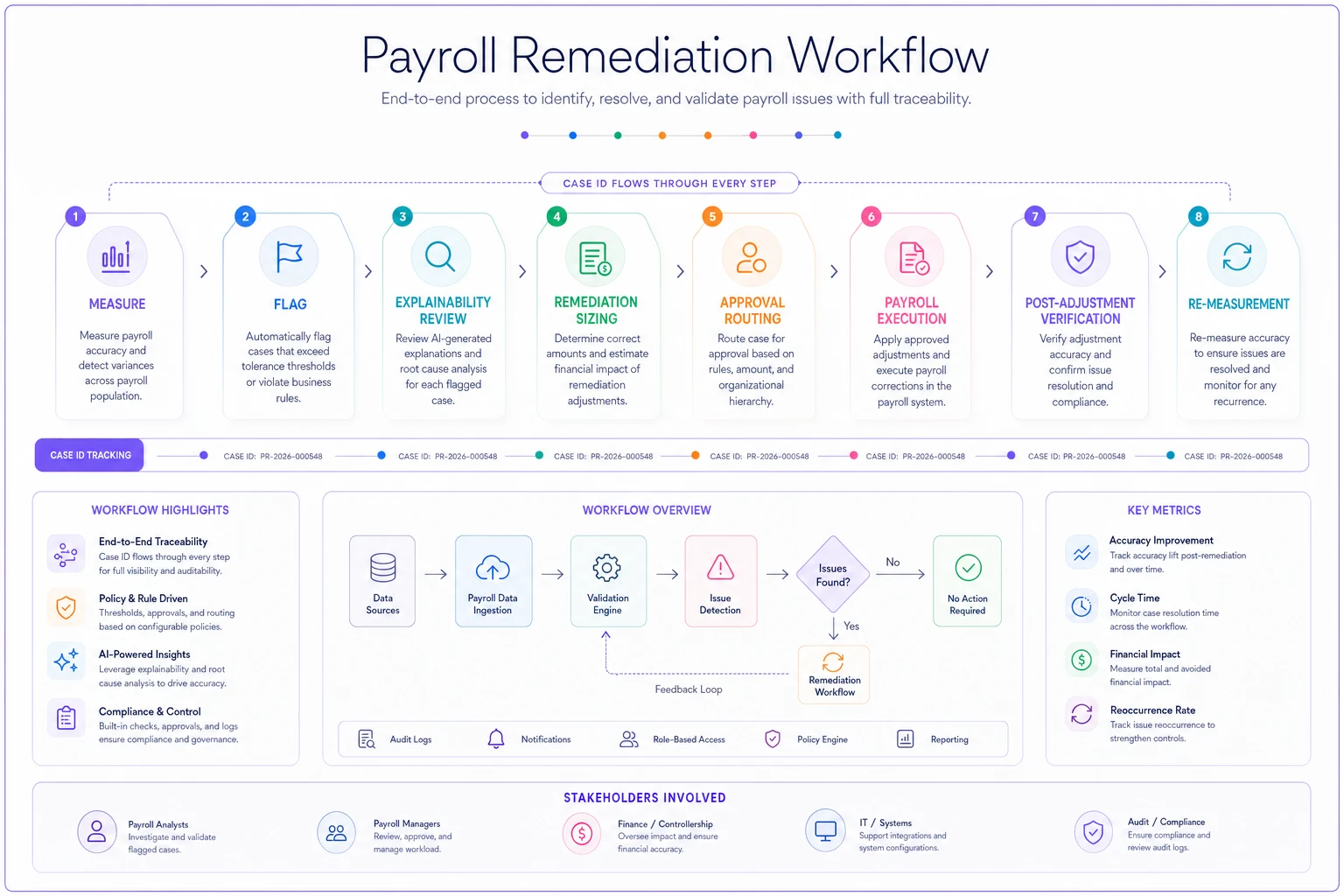
This diagram shows the flow of a case ID through each remediation step.
The failure point that quietly wrecks this: steps 5 and 7 are usually owned by different people who don't talk. Payroll executes the change and considers it done. HR re-runs the analysis months later, sees the gap "still there" because the adjustment hit the wrong pay component, and re-flags the same person. Now you've paid twice and still have a documented, unresolved disparity — probably the worst possible audit finding.
Policy language you actually need in writing
The remediation policy doesn't need to be long, but it needs to answer these unambiguously:
-
Remediation target. "Confirmed disparities are corrected to at least the cohort predicted pay" (or midpoint — pick one and stick with it).
-
Timing. "Confirmed adjustments are executed within one full pay cycle of final approval."
-
Retroactivity. Whether you pay back-pay for the disparity period, and how far back. This has real cost and legal implications — decide it as policy, not case by case.
-
No-downward rule. You never fix inequity by cutting anyone's pay. Obvious, but write it down anyway.
Documentation standard. Every case, resolved or not, retains its analysis, decision, and approval trail for a defined retention period (many teams use 5–7 years to align with EEO and litigation timelines).
Audit cadence: what to run monthly, quarterly, and annually
A once-a-year analysis means eleven months of blind spots. Between cycles, you hire, promote, adjust, and reclassify people — every one of those events can create a new gap. The fix isn't running a full regression every month; it's layering the cadence.
-
Per-pay-run (lightweight) New hires and rate changes get checked against their cohort's range at entry. A simple rule — "no new hire or adjustment lands more than X% below cohort predicted pay without a documented reason" — catches problems before they compound.
-
Quarterly (targeted) Re-run the flagged population plus any group that had significant hiring or restructuring. This confirms prior remediations held and catches drift early.
-
Annual (full) The complete cross-company analysis using the locked template, feeding your executive reporting and any regulatory obligations.
-
Event-triggered Any large reorg, acquisition, or headcount event triggers an off-cycle check on the affected population, because those events reshuffle cohorts overnight.
The insight most teams miss: pay equity gaps are created at the moment of hire and adjustment, not discovered annually. Moving even a light check to the per-pay-run level means you're preventing gaps instead of paying to close accumulated ones. It's the difference between a plumbing inspection and a flood.
When aggressive remediation makes sense — and when it doesn't
When to move fast: Clear, unexplained gaps that cluster around a protected characteristic. That's not just a fairness issue — it's live legal exposure, and every pay cycle you wait extends the back-pay clock. Move these to the front of the queue.
When to slow down and investigate first: A single flagged individual with a plausible explanation — a recent lateral hire, a role in transition, an active performance situation. Reflexively adjusting these creates a different problem: you've moved someone above their peers for reasons that won't hold up, seeding next year's disparity in the other direction.
When remediation is premature: When the gap is a measurement artifact — bad cohort mapping, contractors in the pool, base-only analysis ignoring total cash. Fix the data first. Paying real money to correct a phantom gap is completely avoidable and happens more often than it should.
Who should not run this solo: A single HR analyst owning measurement, remediation, and documentation with no separation of duties. The person defining the cohorts shouldn't be the only person approving the fixes. Split those roles even in a small team.
A realistic scenario
A regional services company with around 240 employees ran their first structured pay equity analysis after a near-miss during due diligence for a credit line. Their prior process had been a single spreadsheet an HR generalist updated when she remembered to.
The locked template flagged 18 employees with unexplained gaps above the 5% threshold. On review, seven resolved as explained — recent hires with documented ramp plans and two pending promotions already in motion. The remaining eleven were confirmed, mostly clustered in two job codes where longer-tenured women were sitting below more recently hired men. A classic pay-compression pattern nobody had caught.
Remediation to cohort predicted pay cost roughly $46k in annualized base increases, plus a back-pay decision that added a few thousand more. Not nothing, but a fraction of what a formal complaint would have cost. The bigger operational win came the following year: because every adjustment carried a case ID back into payroll, the next analysis confirmed all eleven gaps had actually closed — no re-flagging, no paying twice. The full re-measurement took about a day and a half instead of the multi-week scramble the first cycle demanded.
The difference wasn't the math. It was that the loop was closed and documented end to end.
The executive remediation tracker
Leadership doesn't need the regression output. They need to know exposure, progress, and whether the process is actually working. A one-page tracker, refreshed each cycle, should cover:
-
Open confirmed cases and their total annualized remediation cost.
-
Cases closed this period and average time from flag to resolution.
-
Recurrence rate — how many previously remediated employees re-flagged. This number should trend toward zero; if it doesn't, the execution link is broken somewhere.
-
Coverage — what percentage of headcount was in-scope for the last full analysis. New locations and acquisitions create blind spots here.
-
Residual exposure — estimated cost to fully close all confirmed open gaps, so finance can plan rather than get surprised.
The recurrence rate is the metric that separates real governance from theater. A company that flags 20 people, fixes them, and re-flags 15 of the same people next year doesn't have a pay equity problem — it has a workflow problem. That single number tells your board whether the loop between analysis and payroll actually holds.
Feeding this tracker cleanly depends on having a consistent reporting layer between your payroll and HR systems, with agreed field definitions and refresh SLAs. If your comp fields mean different things in different reports, the tracker will contradict itself in front of the board. Building this on top of a proper stakeholder-driven payroll reporting taxonomy is what makes the numbers trustworthy enough to act on.
Where operational software earns its place
You can run all of this in spreadsheets, and plenty of small teams do. It works until it doesn't — usually right when headcount crosses the point where manual cohort mapping and case tracking become a part-time job nobody has bandwidth for.
Where AI-assisted operational platforms actually add value is in the connective tissue: automatically mapping payroll job codes to comp cohorts so comparator groups stay clean, carrying case IDs from flag through approval and into the pay run so nothing gets dropped in the handoff, and surfacing when a new hire or adjustment lands below cohort range before it becomes next year's finding. The value isn't a smarter regression — it's that the measure-remediate-document-remeasure loop runs the same way every cycle without depending on one person remembering how it worked last time.
That reliability is the whole point. Pay equity governance fails not because the analysis is hard, but because the loop breaks at the seams between systems and people. Close those seams — with a locked template, a documented remediation workflow, a layered audit cadence, and a tracker that leadership can actually read — and pay equity stops being an annual fire drill and becomes just another controlled part of how payroll runs.
Ready to simplify your payroll operations?
Join 2,000+ businesses using Payexly to reduce payroll overhead, ensure compliance, and enhance employee satisfaction.