

Most classification mistakes don't happen because someone read the rules wrong. They happen because nobody wrote down why a decision was made when the person was first brought on. Two years later, a state auditor asks for documentation on a "contractor" who's been working 35 hours a week on the company laptop, and there's nothing in the file except a signed 1099 agreement and an invoice template.
That gap — between the classification decision and the evidence that supports it — is where the money leaks out. This piece walks through a workable classification workflow: a decision matrix you can actually use, the evidence bundle that holds up under scrutiny, the onboarding checks that stop bad classifications at the door, and what to do when you find one that's already wrong.
Why classification decisions fall apart later
The core problem is that classification is a judgment made at a single point in time, but the relationship keeps changing after that. Someone gets hired as a legitimate contractor to build a website. Six months later they're answering support tickets, attending the Monday standup, and using a company email address. Nobody re-evaluated anything. The 1099 stayed the same because changing it felt like admitting a mistake.
-
The decision was made by whoever needed the person fastest — usually a hiring manager, not payroll or HR.
-
There's no record of the reasoning, only the outcome (the signed agreement).
-
The "contractor" test was applied loosely to save on payroll taxes and benefits, and everyone quietly knew it.
-
Nobody owns re-checking the relationship as the scope of work drifts.
The IRS common-law rules and the state ABC tests (California's is the strictest, but many states use versions of it) both care about the actual working relationship, not what the paperwork says. An auditor doesn't care that you both signed a 1099 agreement if the person functionally operates as an employee. This is why a defensible workflow has to capture the why, not just the what.
The decision matrix
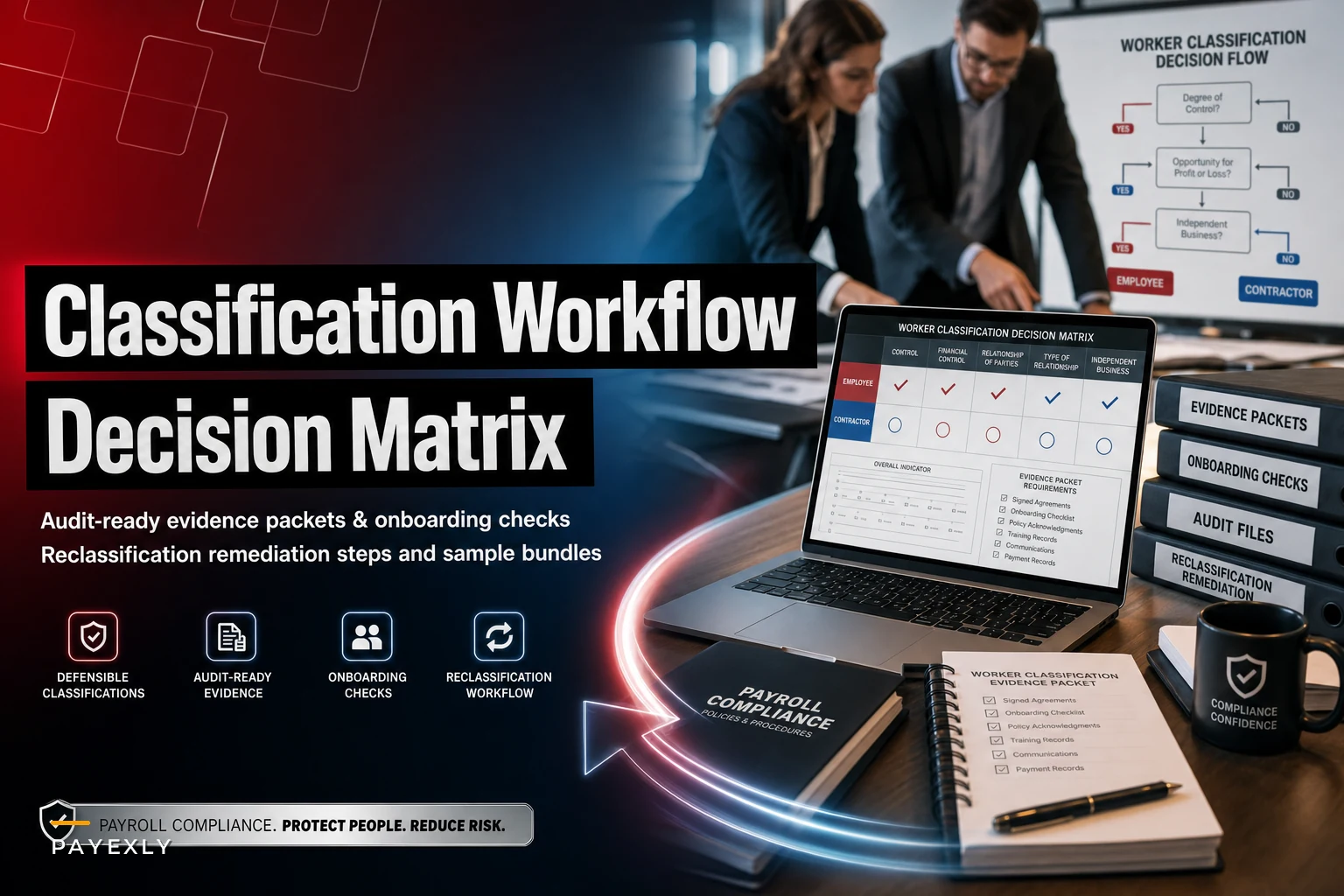
Skip the checklist that lists "20 factors" and forces you to weigh them in your head. What works better is grouping the real signals into three buckets — behavioral control, financial control, and relationship type — and scoring each one. If a person leans "employee" on two of the three buckets, that's your answer, regardless of what the hiring manager wants.
Eliminate payroll errors and delays.
Payexly streamlines every payroll cycle ensuring accuracy and compliance.
- Automated payroll processing
- Real-time tax compliance
- Benefits & deductions management
No credit card required
| Signal | Points toward W-2 (employee) | Points toward 1099 (contractor) |
|---|---|---|
| Behavioral control | ||
| Who sets the hours | Company sets schedule | Worker decides when to work |
| Who directs how work is done | Company gives detailed instructions | Worker uses own methods |
| Training provided | Company trains them | Already skilled, no training |
| Tools & equipment | Company provides laptop, software, etc. | Worker uses own equipment |
| Financial control | ||
| How they're paid | Regular salary/hourly | Per project or flat fee |
| Business expenses | Reimbursed by company | Absorbs own expenses |
| Opportunity for profit/loss | None — fixed pay | Can profit or lose on a job |
| Works for other clients | Exclusively for you | Has multiple clients |
| Relationship type | ||
| Written contract intent | Ongoing, open-ended | Defined project or term |
| Benefits | Health, PTO, retirement | None |
| Permanency | Indefinite | Ends when project ends |
| Core to the business | Does core business work | Peripheral/specialized service |
The mistake people make with any matrix is treating it like a scorecard where majority wins. It doesn't work that way. Behavioral control is the heaviest bucket in most audits. A designer who invoices you, uses her own MacBook, and has four other clients — but whom you require to be online 9 to 5 and follow your exact process — can still get reclassified because you're controlling how the work happens.
Run every ambiguous hire through the matrix and, critically, write down the reasoning in one or two sentences. "Classified as 1099 because worker sets own hours, uses own equipment, is engaged for a defined 90-day project, and serves three other clients." That sentence is the single most useful thing in your entire file.
The onboarding checks that stop the problem early
The cheapest time to fix a misclassification is before the first payment goes out. Once someone has been paid as a 1099 for a year, unwinding it is expensive and awkward. So the checks belong at onboarding, gated so a payment can't be issued until they pass.
-
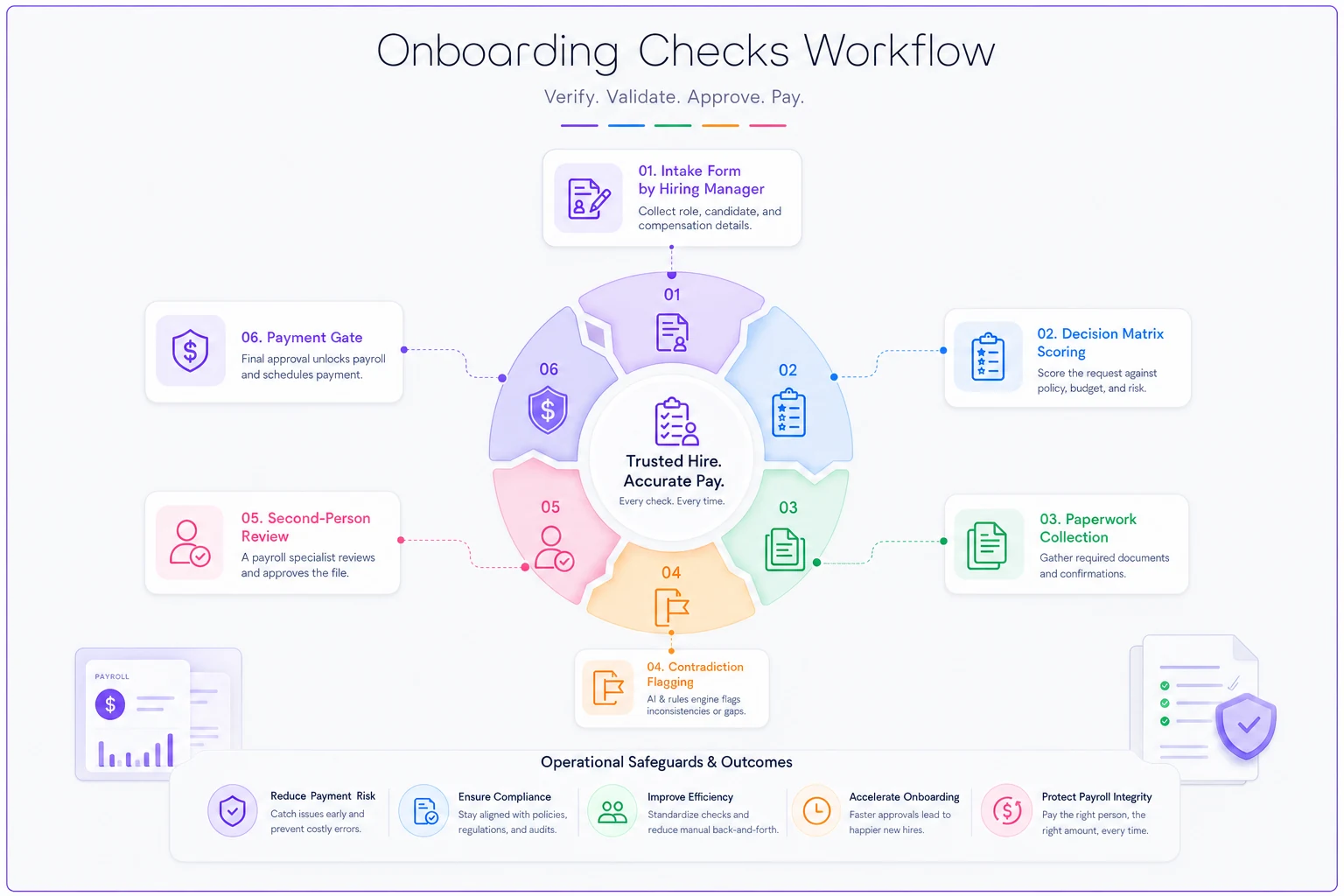
Intake form completed by the hiring manager, not HR — because the manager knows the actual working relationship. Ask direct questions: Will this person have set hours? Will you tell them how to do the work? Will they use company equipment?
-
Run the answers through the decision matrix and record the score plus the one-sentence rationale.
-
Collect the paperwork that matches the classification. For a genuine 1099: W-9, a Certificate of Insurance if relevant, evidence of a business entity (EIN, LLC docs), and a scoped statement of work with a defined deliverable and end date.
-
Flag anything that contradicts the classification. If the intake says "we'll tell them exactly how to do the work" but the paperwork says 1099, that's a stop.
-
Second-person review for any borderline case. One person's judgment on classification is a liability; two-person sign-off is a control.
Below is a simple workflow diagram of the onboarding checks.
The onboarding check that catches the most problems is also the simplest: does this person do the same work as a W-2 employee already on payroll? If your customer support team is all W-2 except for two "contractors" doing identical tickets, no amount of paperwork saves that. This is the exact scenario that gets flagged in unemployment claims — a laid-off "contractor" files for benefits, and the state starts asking why they weren't classified as an employee.
What goes in the audit-ready evidence bundle
When an auditor asks about a specific worker, you should be able to pull a single folder that tells the whole story. Scrambling to reconstruct it after the fact is where companies look guilty even when they weren't.
-
Signed W-9
-
Signed independent contractor agreement with a defined scope and term
-
Statement(s) of work tied to specific deliverables
-
Copies of invoices submitted by the contractor (their format, their letterhead)
-
Proof of business existence — EIN, business license, LLC/entity filing
-
Certificate of Insurance if applicable
-
Evidence of other clients (marketing site, other engagement references) where available
-
The classification rationale — the one-sentence "why" plus the completed matrix
-
1099-NEC copies for each year
-
Any correspondence showing the contractor controlled their own methods or schedule
For a W-2 employee, the parallel bundle is more familiar — offer letter, I-9, W-4, benefits enrollment, timekeeping records — but the same principle applies: keep the classification reasoning in the file so nobody has to guess later.
What separates companies that survive audits from ones that don't isn't the volume of documents. It's consistency between the documents and actual behavior. An invoice that arrives on the same date every two weeks for the exact same amount looks like a paycheck, not a contractor billing. Real contractor invoices vary — different amounts, different dates, tied to deliverables. If your "contractor" invoices are suspiciously regular, an auditor will notice.
Sample evidence bundle: a real scenario
Business type: A 22-person marketing agency.
The problem: They had three "1099 contractors" doing content writing. All three worked roughly 30–40 hours a week, used company Slack and project tools, had assigned editors, and had no other clients. The agency was saving somewhere around $9k–$12k a year per person by avoiding payroll taxes, workers' comp, and benefits.
One writer's engagement ended and she filed for unemployment. The state agency opened a review. The agency's file for her contained exactly one document: a two-page contractor agreement.
What the review found: All the behavioral-control signals pointed to employee. Set hours, assigned work, company tools, no other clients, ongoing indefinite relationship. Reclassified.
The cost: Back employment taxes for all three writers — the state looked at everyone doing the same role — plus penalties and interest. The total landed somewhere in the low-to-mid five figures once you factored in the years involved. The "savings" evaporated and then some.
What would have changed the outcome: Honestly, nothing on the documentation side, because these were genuinely employees. The real fix was upstream — the decision matrix would have flagged all three as W-2 at onboarding. No evidence bundle can defend a classification that's wrong on the facts. Good documentation makes correct decisions defensible. It can't rescue an incorrect one.
Remediation: fixing one you already found
When you discover a misclassification, resist the instinct to quietly flip the person to W-2 next pay period and hope nobody looks back. That leaves prior periods exposed and can look like a cover-up. Handle it as a deliberate remediation.
-
Freeze and document the finding. Note the date you identified it, who identified it, and the specific factors that make the current classification wrong. This demonstrates good faith.
-
Determine the exposure window. How many years back does the misclassification go, and across how many workers in the same role? States often expand a single case to the entire role, so scope this honestly.
-
Evaluate voluntary correction programs. The IRS Voluntary Classification Settlement Program (VCSP) lets eligible employers reclassify workers going forward with reduced back-tax liability. It's not right for everyone, and it doesn't cover state exposure, but it's worth pricing out.
-
Recalculate what should have been withheld and remitted. Employment taxes, and depending on the situation, benefits and overtime. Corrections like this touch prior periods, so treat them with the same rigor you'd bring to any retroactive pay correction workflow — the journal impacts and filing amendments are similar.
-
Reclassify going forward and rebuild the file. New W-4, I-9, benefits enrollment, timekeeping. Put the corrected classification rationale in the file.
-
Fix the process that let it through. If the person slipped past onboarding, the gate was weak. Assign ownership so someone re-checks classification when a contractor's scope drifts.
The step people skip is the last one. They fix the individual case and never address why nobody caught it. Six months later there's another one. Classification isn't a one-time decision — it needs an owner and a re-check trigger, which fits naturally inside a broader payroll governance framework with clear RACI and approval workflows.
When 1099 actually makes sense — and when it doesn't
Genuine 1099 fits when:
-
the person runs their own business, serves multiple clients, controls how and when the work gets done, is engaged for a defined project, and does specialized work that isn't your core operation.
-
A freelance photographer hired for a product shoot.
-
A CPA firm retained for tax filings.
-
A developer building a one-off integration on their own schedule.
1099 is the wrong call when:
-
the person does the same work as your employees
-
you need to control their hours and methods
-
the relationship is open-ended
-
the work is central to what your business actually sells
If you'd struggle to explain to an auditor why this person isn't an employee, they probably are one.
Who should not lean on contractors to cut costs: any business where the "contractors" fill roles identical to W-2 staff. The tax savings look good on a spreadsheet and disappear the moment one person files for unemployment or a state does a routine audit. Once you price in penalties, the math almost never works out.
Keeping it maintainable
Classification workflows fail not because they're too complicated, but because they live in someone's head and never get written down.
Three things make this durable: a decision matrix everyone runs before the first payment, a one-sentence rationale saved in every worker's file, and a named owner who re-checks classifications when scope changes. None of that is complicated. Most of it is just discipline around a step that usually gets skipped because everyone's in a hurry to get the person started.
Assign a named owner and a re-check trigger in your payroll governance so scope drift can't silently flip a classification.
Do those three things and an audit stops being a scramble. When the state asks about a specific worker, you open one folder, and the folder tells the whole story — the decision, the reasoning, the paperwork, and the behavior all pointing the same direction. That consistency is the entire game. Not the volume of documents, and not clever paperwork — just decisions that are correct on the facts and a file that proves you made them on purpose.
Do those three things and an audit stops being a scramble. When the state asks about a specific worker, you open one folder, and the folder tells the whole story — the decision, the reasoning, the paperwork, and the behavior all pointing the same direction. That consistency is the entire game. Not the volume of documents, and not clever paperwork — just decisions that are correct on the facts and a file that proves you made them on purpose.
Ready to simplify your payroll operations?
Join 2,000+ businesses using Payexly to reduce payroll overhead, ensure compliance, and enhance employee satisfaction.