

Most payroll teams can run a clean pay cycle. What they struggle with — when a regulator or an acquirer's due-diligence team shows up — is answering three fairly boring questions in a way that holds up:
That gap is what payroll data governance is really about. Not the org chart. Not the mission-statement version. The actual, written-down rules that say "this field, this long, shared this way, deleted on this date."
Almost every mid-market company I've looked at has strong operational controls and near-zero documented data-handling policy. Payroll runs great. The paper trail behind why the data exists at all is a mess. This article is about closing that gap as a system — retention schedules, redaction patterns, cross-border transfer clauses, vendor verification — with templates you can adapt without hiring a privacy lawyer for every line.
Why the data side breaks even when payroll runs fine
The core reason is that payroll data governance sits in the seam between three teams that each assume someone else owns it. HR owns the employee relationship. Finance owns the money. IT owns the storage. Data retention and cross-border handling fall into the crack, and cracks don't get budget.
-
How long do you keep each type of payroll record, and why?
-
When you share payroll data with vendors or across borders, what actually leaves the building, and in what form?
-
What legal basis and verification cadence backs those transfers?
A few patterns keep coming up:
-
"Keep everything forever" by default. Nobody wants to be the person who deleted the record an auditor later needs, so files just accumulate. A company that's ten years old is holding W-2 detail, bank routing numbers, and garnishment orders for people who left in year two.
-
Vendors get raw data because raw is easier. Sending a full census file to a benefits broker is faster than building a redacted extract. So the SSN goes out even though the broker only needs date of birth and coverage tier.
-
Cross-border transfers happen invisibly. Your payroll SaaS support desk is in another country. Your parent company consolidates reporting in another. Data crossed a border and nobody logged it as a transfer.
None of this feels like a problem until the day it is one. And by then you're reconstructing years of decisions nobody documented.
What actually breaks at scale
At 30 employees in one state, sloppy retention is survivable. The failure points compound as you add people, states, and vendors.
Eliminate payroll errors and delays.
Payexly streamlines every payroll cycle ensuring accuracy and compliance.
- Automated payroll processing
- Real-time tax compliance
- Benefits & deductions management
No credit card required
More jurisdictions, more conflicting retention rules. Federal FLSA says keep payroll records three years. Some state wage rules push to four. ERISA-adjacent benefit records reach six. If you operate across regions — and if you don't yet, you will — you inherit the longest applicable clock per record type unless you segment. The operating model side of this is worth reading separately in multi-jurisdiction payroll compliance, and retention is basically the data twin of that same problem.
More vendors, more copies of the same sensitive fields. Every integration is another place your employees' bank details live. A typical mid-market payroll stack touches a core payroll platform, a benefits admin, a 401(k) recordkeeper, a garnishment processor, and a reporting warehouse. That's five copies of SSNs before you count backups. When one of them has an incident, your exposure is defined by how much you shared, not how careful you were.
More cross-border touchpoints, more legal surface. Support teams, offshore implementation partners, consolidated group reporting — all of these move data across borders quietly. At scale, "we don't transfer data internationally" is almost never true. It's just untracked.
Retention, minimization, and transfer aren't three separate policies. They're one lifecycle: data comes in, gets used, gets shared (sometimes across borders), and eventually should die on a schedule. Break any link and the whole chain fails an audit.
A retention schedule that survives contact with an auditor
The mistake is writing one blanket retention rule. The fix is a table keyed to record type, because different records have different legal clocks and different sensitivity. Here's a starting template — adapt the periods to your actual jurisdictions and counsel.
| Record type | Contains sensitive fields | Typical minimum retention | Common driver | Deletion approach |
|---|---|---|---|---|
| Pay stubs / earnings detail | Yes (comp, deductions) | 3–4 years | FLSA + state wage law | Purge after longest applicable clock |
| Tax filings (941, W-2, state) | Yes | 4 years post-filing | IRS recordkeeping | Archive then purge |
| Direct deposit / bank details | High | Duration of employment + short tail | Operational need | Delete promptly after offboarding tail |
| Garnishment / levy orders | High | Order life + 3 years | Court/agency rules | Purge after order closes + clock |
| Benefit elections / deductions | Yes | ~6 years | ERISA-adjacent | Archive then purge |
| I-9 / eligibility | Yes | 3 years after hire or 1 year after term, whichever later | USCIS | Purge on schedule |
| Onboarding drafts / temp files | Varies | 90 days or less | None — operational | Auto-delete |
Two things people consistently miss with this table. First, the "temp files" row is where most of the risk hides — spreadsheets emailed during onboarding, screenshots in ticketing systems, exports sitting in someone's Downloads folder. Those have no retention justification and should die fast. Second, retention needs an owner per row, not one owner for the whole schedule. The garnishment row belongs to whoever manages garnishments; the tax row belongs to whoever files. Otherwise the schedule becomes a document that exists but never actually runs.
A retention schedule that isn't enforced is just a liability with formatting. The enforcement mechanism matters more than the periods themselves.
Minimization: what leaves the building, and in what form
Minimization is the cheapest risk reduction available and the most ignored. The principle is simple: a vendor or downstream system should receive the least data needed to do its job. In practice, almost nobody trims the extract because the full export already works.
-
Tokenization for identifiers. Replace SSN with an internal employee token in any file that doesn't strictly require the real SSN. The recordkeeper who needs it gets it; the reporting warehouse gets the token.
-
Truncation over masking where you can. Store and share last-four of account numbers when full numbers aren't operationally needed.
-
Field-level allowlists per vendor. Define, per integration, exactly which fields are permitted to flow. Default deny. This is the same discipline behind payroll data contracts and APIs, where each field has an explicit, versioned agreement.
-
Redaction for analytics. Pay-equity and headcount analysis rarely needs names or account numbers. Aggregate or pseudonymize before it lands in a BI tool a dozen people can query.
A quick redaction-pattern reference you can drop into a policy doc:
-
Full retain legally required record, used by system of record only.
-
Tokenize identifier needed for matching but not display (SSN → token).
-
Truncate partial value sufficient (account → last 4).
-
Aggregate analytics only, no individual grain needed.
-
Suppress field not permitted to this destination at all.
Minimization decisions made once, at integration design time, protect you continuously. Trying to claw data back after it's already spread across five vendors is a different and considerably harder problem.
Make minimization decisions once at integration design time so they protect you continuously.
Minimization decisions made once, at integration design time, protect you continuously. Trying to claw data back after it's already spread across five vendors is a different and considerably harder problem.
Cross-border transfers: SCCs and the clauses that matter
If any payroll data touches an entity, vendor, or support team in another country, you have a cross-border transfer whether you meant to or not. The tool most companies land on is Standard Contractual Clauses (SCCs) — pre-approved contract language that establishes a legal basis for the transfer. But dropping SCCs into a contract and forgetting them is exactly how companies fail the evidence test later.
What a workable cross-border clause set covers, in plain terms:
-
Scope of data and purpose. Which payroll fields transfer, to whom, and for what. Vague scope ("employee data") is a red flag; enumerate.
-
Sub-processor rules. Your vendor's vendors. If your payroll platform's support subcontracts to a third region, that has to be disclosed and controlled.
-
Data location and residency commitments. Where the data rests and is processed, not just where the company is headquartered.
-
Security and breach notification obligations. Timelines that actually match your incident-response expectations.
-
Deletion and return on termination. What happens to your data when you leave the vendor — and proof it was destroyed.
-
Audit and inspection rights. Your right to verify, not just trust.
The clause everyone underweights is the transfer impact / re-verification trigger — language that says the arrangement gets re-assessed when the legal landscape or the vendor's processing footprint changes. Cross-border rules move. A one-time SCC signed three years ago against a since-changed vendor architecture is stale, and staleness is what auditors catch.
When SCCs are the right tool — and when they aren't
-
Makes sense when you have a legitimate ongoing transfer (a foreign support desk, group consolidation) and need a durable legal basis.
-
Bad idea when you're using SCCs to paper over a transfer you could simply eliminate by keeping data in-region. If a vendor offers regional data residency, using it beats contracting around the transfer.
-
Who should not rely on this alone anyone treating SCCs as a substitute for minimization. Signing a contract about data you shouldn't have shared in the first place doesn't reduce risk — it documents it.
Signing a contract about data you shouldn't have shared in the first place doesn't reduce risk — it documents it.
Vendor verification cadence: the part policies forget
A signed contract is a snapshot. Vendor reality drifts — new sub-processors, changed data centers, staff turnover, an acquisition. Without a verification cadence, your governance decays quietly between renewals.
-
Onboarding (before first data flows) confirm field-level scope, residency, SCCs signed, sub-processor list captured.
-
Quarterly light check confirm no new sub-processors or region changes; pull current security attestation status.
-
Semi-annual evidence pull request updated SOC report or equivalent; verify deletion of any offboarded-employee data past its retention clock.
-
Annual deep review re-assess transfer basis, update the transfer impact assessment, reconcile the data map against what's actually flowing.
-
Event-triggered review any vendor incident, acquisition, or architecture change forces an immediate re-check regardless of calendar.
Verification only works if you can prove the current state of what's flowing. That's where your telemetry does double duty. The same event logging you'd build for security — covered in the payroll logging and SIEM checklist — is also your evidence that a given field left to a given vendor on a given date. Governance and logging are the same muscle, used for two purposes.
A real scenario
A regional home-services company, around 240 employees across four states, ran payroll on a mainstream platform plus a benefits broker, a 401(k) recordkeeper, and a spreadsheet-based reporting habit. During acquisition due diligence, the buyer's team asked for the retention schedule and the list of cross-border transfers.
-
Full census files (SSNs included) emailed to the broker every open enrollment, sitting in a shared inbox going back roughly six years.
-
A payroll vendor whose Tier-2 support operated overseas — an untracked cross-border transfer with no SCCs.
-
Termed-employee bank details still live in reporting spreadsheets, years past any need.
Remediation took about eight weeks. They built the retention table, tokenized SSNs in every extract that didn't strictly need them, moved the broker to a redacted file (DOB and coverage tier only), signed SCCs with the payroll vendor and captured its sub-processor list, and set the quarterly verification cadence. The number of systems holding raw SSNs dropped from five to two. The follow-up diligence request came back clean.
For a transaction that size, not having the deal stall on data risk was worth considerably more than the cleanup cost.
How the pieces connect
Here's a simple lifecycle to keep top-of-mind.
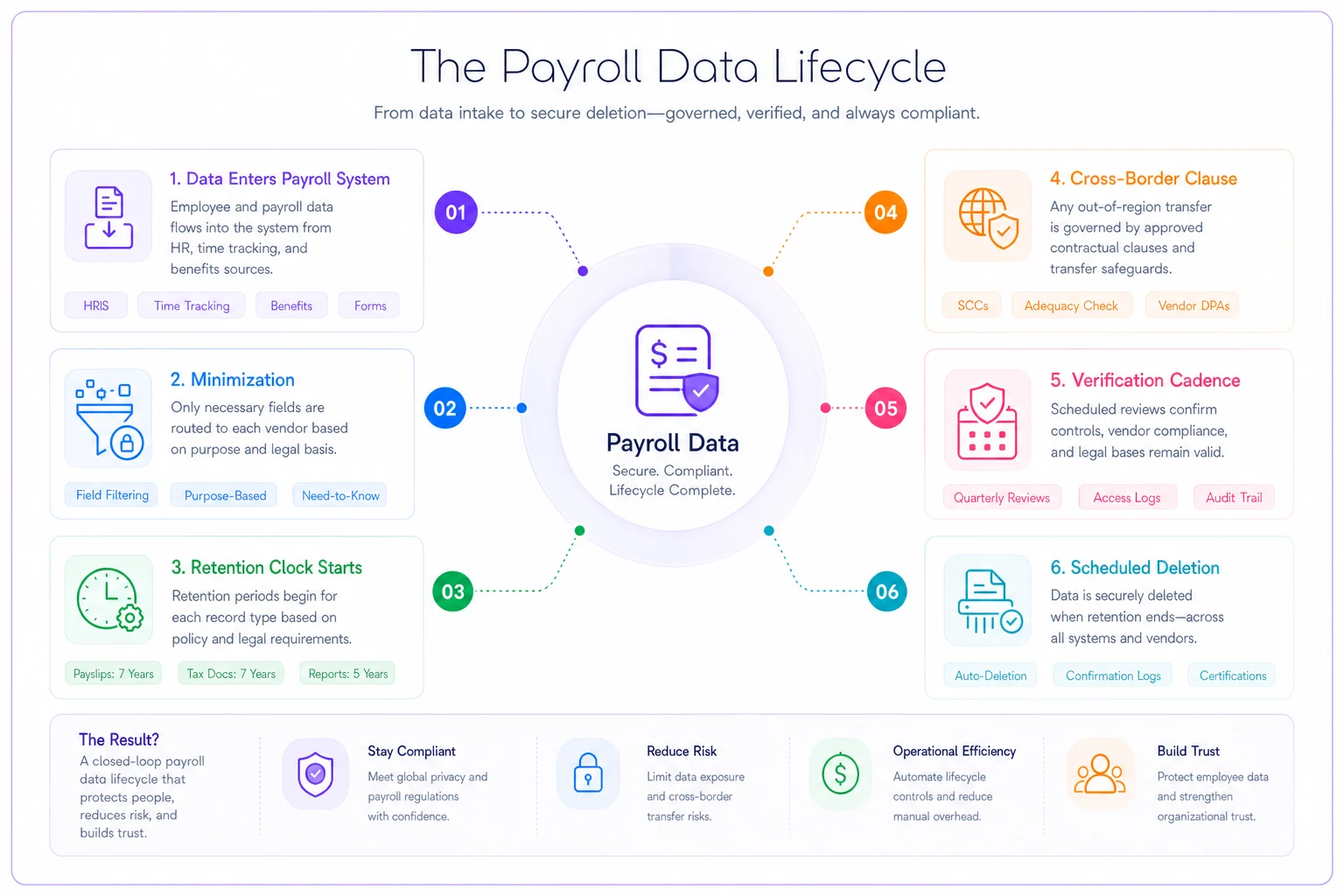
Read the four elements as one lifecycle rather than four separate policies:
-
Minimization decides how much sensitive data exists in the first place.
-
Retention decides how long each piece is allowed to live.
-
Cross-border clauses govern the legal basis when data moves out of region.
-
Verification cadence proves all of the above is still true this quarter, not just the day you signed.
Break the first and everything downstream carries more risk than it needs to. Break the last and you can't prove any of it. Most audit failures aren't because a company did something egregious — they're because nobody could demonstrate the controls existed and actually ran.
Where tooling helps without becoming the point
You can run all of this on spreadsheets and calendar reminders, and plenty of small teams do. It works until the number of record types, vendors, and jurisdictions outpaces human memory — which is usually right around the same growth stage where the stakes get real.
Operational platforms that manage payroll workflows can carry the enforcement layer: retention clocks that actually trigger deletion, field-level extract rules that default to redacted, a living data map of what flows to which vendor, a log that answers the auditor's "prove it" without a fire drill. AI-assisted checks are genuinely useful for the tedious parts — flagging when a new field starts flowing to a vendor it shouldn't, spotting records past their retention clock, or catching a sub-processor change buried in a vendor update. The value isn't automation for its own sake; it's that the boring, easy-to-skip steps stop depending on someone remembering to do them.
The tool is downstream of the decisions, though. Write the retention table, define the redaction patterns, sign the right clauses, set the cadence. Get those right on paper first, and whatever system you use to enforce them is just making sure the policy actually runs — which, at the end of the day, is the only version of governance an auditor cares about.
Ready to simplify your payroll operations?
Join 2,000+ businesses using Payexly to reduce payroll overhead, ensure compliance, and enhance employee satisfaction.