


Running payroll across multiple states shouldn't feel like playing whack-a-mole with tax deadlines, yet that's exactly what happens when companies hit around 50 employees spread across different jurisdictions. The compliance complexity doesn't scale linearly—it explodes.
Most multi-state payroll compliance frameworks are basically Excel sheets with filing deadlines that someone updates whenever they remember. They work until they don't, usually discovering gaps when a penalty notice arrives three months after a missed quarterly filing in a state where you have two remote employees.
The real problem isn't tracking deadlines. It's that every state treats payroll differently—registration thresholds, reciprocity agreements, local tax layers, unemployment insurance quirks—and your payroll vendor probably only handles about 70% of what you actually need. The other 30% sits in operational blindspots that only surface during audits or, worse, employee complaints about incorrect withholdings.
Why jurisdictional complexity breaks traditional compliance approaches
State payroll compliance operates on completely different logic than federal requirements. Federal compliance gives you clear schedules, consistent forms, straightforward deposit rules. State compliance? Pure chaos.
Take unemployment insurance rates. California might adjust your rate mid-year based on claims experience, requiring retroactive adjustments. Meanwhile, New York has its own disability insurance requirements that change based on employee count thresholds. Pennsylvania has local tax collectors who operate independently from state systems. Ohio requires school district tax withholdings based on residence, not work location.
Each state essentially runs its own payroll universe with unique:
-
Registration triggers (some at first employee, others at first dollar)
-
Filing frequencies that shift based on liability amounts
-
Reciprocity rules that change annually
-
Local tax layers that your payroll system might not even recognize
-
Special employer accounts for disability, family leave, or training taxes
Now multiply this by every state where you have employees, contractors who might be reclassified, or even traveling workers who trigger temporary withholding requirements. A sales rep working a trade show in Nevada for a week? That might create nexus. An employee who moves mid-year from Texas to California? Complete withholding overhaul plus potential tax credit complications.
The traditional approach—maintaining a spreadsheet of deadlines and hoping your payroll vendor handles the details—falls apart around 5-7 states. By 10 states, you're almost guaranteed to have gaps somewhere.
The hidden vendor coverage gaps nobody talks about
Payroll vendors don't advertise this: their "full-service" offerings usually cover basic withholding and quarterly filings, but the edge cases are where things fall apart.
Eliminate payroll errors and delays.
Payexly streamlines every payroll cycle ensuring accuracy and compliance.
- Automated payroll processing
- Real-time tax compliance
- Benefits & deductions management
No credit card required
Most vendors handle standard state income tax withholding and unemployment insurance filings reasonably well. But ask them about local tax filings for employees in Yonkers, or Pennsylvania's quarterly reconciliation requirements, or registering for Portland's transit tax—suddenly you're on your own.
Common vendor gaps that create compliance nightmares:
-
Local tax registrations and filings (especially reciprocal agreements)
-
State-specific employer accounts (disability, paid leave, training taxes)
-
Annual reconciliations beyond W-2s
-
Business tax implications of payroll (nexus, apportionment changes)
-
Multi-state worker's compensation requirements
-
Special withholding for equity compensation
-
State-specific new hire reporting timelines
A 200-person tech company found out their payroll vendor hadn't been filing Ohio municipal taxes for two years. The vendor withheld correctly but never remitted to the individual cities. Cost them $47,000 in penalties plus the administrative nightmare of late-filing two years of returns across 11 municipalities.
The vendor's response? "Local tax filing is an add-on service." Technically mentioned on page 47 of their service agreement.
Building a jurisdictional risk matrix that actually works
A functional multi-state payroll compliance framework starts with understanding your actual exposure, not theoretical requirements. Most companies build compliance matrices listing every requirement for every state—hundreds of rows that nobody maintains.
Instead, structure your risk matrix around operational reality:
Primary Risk Factors by State
| Jurisdiction | Employee Count | Contractor Risk | Unique Requirements | Vendor Coverage | Operational Load |
|---|---|---|---|---|---|
| California | 45 | High (AB5) | CalSAVERS, SDI, Local taxes | 60% | Heavy |
| Texas | 23 | Low | TWC quarterly wage | 95% | Light |
| New York | 12 | Medium | MCTMT, Yonkers, DBL | 70% | Heavy |
| Illinois | 8 | Medium | Local taxes, IDES | 80% | Medium |
| Remote (various) | 31 | High | Varies by state | 40% | Heavy |
This matrix focuses on what actually drives compliance risk:
-
Employee concentration (more employees = higher audit risk)
-
Contractor misclassification exposure
-
Unique state requirements your vendor doesn't handle
-
Actual vendor coverage percentage for that state
-
Operational burden on your team
Update this quarterly based on employee movement and vendor performance. The states with low vendor coverage and high operational load are your danger zones.
Trigger-Based Monitoring
Beyond the static matrix, you need triggers that flag jurisdiction changes:
Employee-triggered events:
-
New hire in new state
-
Employee relocation (permanent or temporary)
-
Work location changes (remote to office, or vice versa)
-
International assignments
-
Multi-state workers (sales, consultants)
Business-triggered events:
-
New office locations
-
Contractor conversions
-
Acquisition integration
-
Nexus-creating activities
Each trigger should map to specific compliance actions. Employee moves from Florida to California? That triggers California registration, PFL/SDI setup, local tax registration, and new hire reporting within 20 days.
Creating a perpetual filing calendar that updates itself
Static filing calendars fail because tax deadlines aren't actually static. States change filing frequencies based on your liability amounts, special circumstances trigger accelerated deadlines, and new requirements appear mid-year.
Build your calendar with dynamic elements:
Quarterly Filing Blocks
-
Q1 Block (January-March) - January 31: W-2/1099 delivery, state copies, annual reconciliations - February 28: State annual filings (varies by state) - March 15: First quarter estimates for pass-through entities
-
Q2 Block (April-June) - April 30: Q1 state quarterlies, UI reports - May 15: Local tax filings (Pennsylvania, Ohio) - June 15: Q2 estimates
Map each state's specific requirements to these blocks, but build in 5-day buffers before actual deadlines. Real operations need cushion for review, corrections, and vendor delays.
Automated Deadline Adjustments
Your calendar needs to automatically adjust for:
-
Deposit frequency changes (monthly to semi-weekly when you hit thresholds)
-
Weekend/holiday shifts
-
Disaster extensions (increasingly common)
-
State-specific modifications
Some states change your filing frequency mid-year based on liability. Colorado moves you from quarterly to monthly if your withholding exceeds $50,000 annually. Your calendar system needs to catch these transitions.
Here's a simple workflow visualization of the dynamic filing calendar.
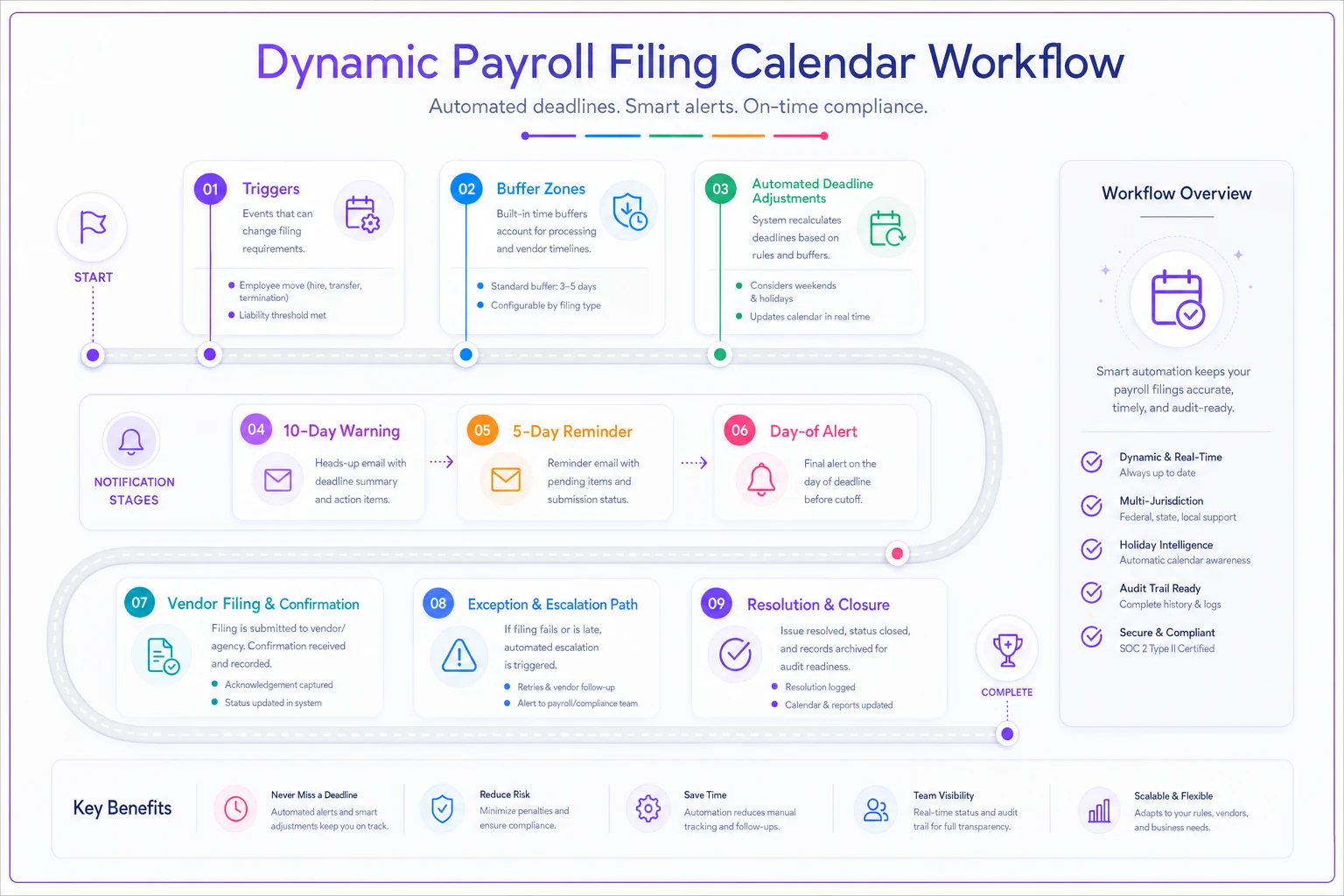
The calendar should push notifications, not wait for manual checks. Every deadline needs a 10-day warning, 5-day reminder, and day-of alert. Missing one quarterly filing can cascade into penalties across multiple periods before you even notice.
Vendor oversight framework for multi-state operations
Your payroll vendor is processing millions in wages and tax liabilities, yet most companies have less vendor oversight for payroll than they do for office supplies. This gap becomes critical with multi-state operations where vendor failures compound across jurisdictions.
Effective vendor oversight requires structured monitoring:
Monthly Vendor Health Checks
Review these metrics monthly, not quarterly:
-
Filing Confirmations
- Screenshot or confirmation number for every filing - Deposit verification from bank statements - State account transcripts (quarterly minimum)
-
Coverage Verification
- New state registrations completed - Local tax accounts activated - Special withholding programs enrolled
-
Error Tracking
- Notice response time - Amendment frequency - Penalty occurrences
A tech startup discovered their vendor had been depositing California SDI to the wrong account for six months. Monthly reconciliation would have caught it in month one. Instead, they found out when California sent a delinquency notice threatening wage garnishment.
Structured Escalation Paths
When vendor issues arise—and they will—you need clear escalation:
-
Level 1 (Operational) Day-to-day issues, missed deadlines - Primary contact: Dedicated account manager - Response SLA: 24 hours - Resolution: 72 hours
-
Level 2 (Critical) Penalties, employee impact, compliance failures - Contact: Vendor operations manager - Response SLA: 4 hours - Resolution: 24 hours
-
Level 3 (Executive) Repeated failures, material breaches - Contact: Vendor VP/Director - Response SLA: Same day - Resolution: Immediate action plan
Document every escalation. You'll need this trail when negotiating service credits or considering vendor changes.
Real-world implementation: 80-person SaaS company case study
A B2B SaaS company with 80 employees across 12 states came in after receiving penalty notices from four states totaling $18,000. Their setup: ADP for payroll, Excel for deadline tracking, hope for compliance.
Their main issues:
-
No visibility into what ADP actually filed
-
Three states where they needed registration but didn't know
-
Local taxes completely ignored for Pennsylvania employees
-
Quarterly filings missed because ADP thought they were annual filers
We built their multi-state payroll compliance framework over six weeks:
Week 1-2: Jurisdictional audit
-
Identified 31 different tax obligations across 12 states
-
Found 7 missing registrations
-
Discovered $11,000 in unfiled local taxes
Week 3-4: Risk matrix and calendar build
-
Prioritized California, New York, and Pennsylvania as high-risk
-
Created trigger-based monitoring for remote employees
-
Built perpetual calendar with 147 annual deadlines
Week 5-6: Vendor accountability structure
-
Documented ADP's actual coverage (62% of requirements)
-
Established monthly reconciliation process
-
Created escalation playbook with specific contacts
Results after six months:
-
Zero penalty notices (down from 4-6 per quarter)
-
Around 15 hours monthly saved on compliance management
-
Caught three filing errors before they became penalties
-
Clean audit from their Series B due diligence
The key wasn't adding more tools—it was building visibility into what they actually needed versus what their vendor actually provided.
Building your escalation playbook for compliance failures
Compliance failures in multi-state payroll are when, not if. Your escalation playbook determines whether a missed filing becomes a $500 fix or a $50,000 disaster.
Structure your playbook around failure types:
Missing Registration Discovered
Immediate actions (Day 1):
-
Stop payroll for that state
-
Calculate exposure period
-
Document all employees/wages affected
Resolution phase (Day 2-5):
-
File retroactive registration
-
Submit all missing returns
-
Calculate penalty/interest exposure
-
Request first-time abatement
Incorrect Withholding Discovered
Immediate actions (Day 1):
-
Correct go-forward withholding
-
Calculate under/over withholding by employee
-
Determine amendment requirements
Communication phase (Day 2-3):
-
Notify affected employees
-
Explain correction process
-
Provide tax impact estimates
Correction phase (Day 4-30):
-
File amended returns
-
Process supplemental withholding if needed
-
Issue corrected W-2s if year-end passed
Vendor Filing Failure
Discovery phase (Hour 1-4):
-
Document vendor confirmation of failure
-
Pull all affected calculations/reports
-
Calculate penalty exposure
Vendor escalation (Hour 4-8):
-
Invoke SLA breach clause
-
Demand immediate correction
-
Require written remediation plan
Protective filing (Day 1-2):
-
File returns directly if vendor delays
-
Document all costs for reimbursement
-
Consider backup vendor activation
Each scenario needs specific owners, timelines, and decision trees. The playbook should live where your team works—not in a dusty policy folder.
Technology integration and workflow automation
The manual approach to multi-state compliance—spreadsheets, calendar reminders, email chains—breaks down fast. But full automation isn't realistic either when every state has unique quirks that require human judgment.
The sweet spot is selectively automating high-frequency, low-complexity tasks while keeping human oversight on high-risk decisions. AI-powered operational software helps by centralizing your compliance data and automating the routine checks that eat up most of your team's time.
What makes sense to automate:
-
Deadline notifications and escalations
-
Registration status monitoring across states
-
Vendor filing confirmation tracking
-
Deposit reconciliation between bank and filings
-
Employee move notifications triggering compliance reviews
-
Quarterly tax liability calculations for frequency changes
What needs human oversight:
-
Reciprocity agreement interpretation
-
Nexus creation evaluation
-
Penalty response strategies
-
Vendor performance assessments
-
Complex multi-state allocations
Automate notifications and reconciliation, but require a human sign-off for new-state registrations and frequency-change decisions.
Modern platforms can connect your payroll system, tax filing software, and compliance calendars into a single operational view. Instead of checking three systems to verify a filing was completed, you get automated confirmation when your vendor files, the deposit clears, and the state accepts the return. That's the kind of visibility that actually changes how your team operates day to day.
This integration approach typically cuts compliance management time by 60% or more while actually improving accuracy. The automation handles the volume; your team handles the exceptions.
Preparing for multi-state audit defense
Multi-state payroll audits tend to arrive in waves. One state finds an issue, shares data through interstate agreements, and suddenly you're defending audits in multiple states simultaneously. Your compliance framework needs to generate audit-ready documentation continuously—not scramble when a notice arrives.
Essential audit preparation elements:
-
Quarterly packages
- All tax returns filed (with confirmations) - Deposit verification records - Employee census by state - Withholding calculation samples - Vendor correspondence log
-
Annual documentation
- State registration confirmations - Reciprocity agreement documentation - Contractor vs employee determinations - Multi-state allocation methodology - Policy change documentation
Keep three years readily accessible, seven years in archive. State auditors love testing whether your Pennsylvania employee who worked two weeks in New Jersey had proper withholding. Without documentation, you're writing checks.
The strongest audit defense isn't perfect compliance—it's showing systematic processes, regular monitoring, and quick correction of identified issues. Auditors can tell the difference between companies trying to comply and those just hoping not to get caught.
Building resilience into multi-state compliance
A functional multi-state payroll compliance framework isn't about perfection—it's about visibility, systematic monitoring, and quick response when issues arise. The companies that handle multi-state payroll well aren't necessarily the ones with the biggest compliance teams or most expensive vendors. They're the ones who built frameworks that surface problems quickly and fix them systematically.
The framework components—risk matrix, perpetual calendar, vendor oversight, escalation playbook—work together to create operational resilience. When an employee moves states, your triggers catch it. When a vendor misses a filing, your monthly reconciliation finds it. When a penalty notice arrives, your playbook handles it.
This framework also scales. The same structure handling 12 states today can handle 30 states next year. You'll add rows to your risk matrix, dates to your calendar, but the core operational model stays intact.
The difference between reactive scrambling and proactive management isn't the complexity of your tools—it's the completeness of your framework. Build it right, maintain it consistently, and multi-state payroll compliance becomes an operational process rather than a quarterly panic.
A functional multi-state payroll compliance framework isn't about perfection—it's about visibility, systematic monitoring, and quick response when issues arise. The companies that handle multi-state payroll well aren't necessarily the ones with the biggest compliance teams or most expensive vendors. They're the ones who built frameworks that surface problems quickly and fix them systematically.
The framework components—risk matrix, perpetual calendar, vendor oversight, escalation playbook—work together to create operational resilience. When an employee moves states, your triggers catch it. When a vendor misses a filing, your monthly reconciliation finds it. When a penalty notice arrives, your playbook handles it.
Ready to simplify your payroll operations?
Join 2,000+ businesses using Payexly to reduce payroll overhead, ensure compliance, and enhance employee satisfaction.