

Your HRIS says an employee worked 42.5 hours. Your timekeeping system shows 41.75. Payroll processes 42. Three systems, three different numbers, one confused employee wondering why their check is short $18.
The hidden cost of broken payroll integrations
Your HRIS says an employee worked 42.5 hours. Your timekeeping system shows 41.75. Payroll processes 42. Three systems, three different numbers, one confused employee wondering why their check is short $18.
This isn't a one-off glitch. It's happening across your workforce every pay period, quietly creating a pile of manual reconciliation work that keeps growing. The core problem is your systems speak different languages and nobody's enforcing any rules about it.
Why payroll integrations break (and keep breaking)
Most mid-sized companies run payroll through a patchwork of systems — BambooHR for employee data, ADP for timekeeping, Gusto or Paychex for actual processing. Every vendor promises seamless integration. What you actually get is data chaos.
Eliminate payroll errors and delays.
Payexly streamlines every payroll cycle ensuring accuracy and compliance.
- Automated payroll processing
- Real-time tax compliance
- Benefits & deductions management
No credit card required
The breakdown happens at the field level. Your HRIS stores employee IDs as text strings with leading zeros ("00542"), but your timekeeping system strips those zeros and treats them as integers (542). When payroll tries to match records, a chunk of your employees just disappear from the import.
Or take overtime calculations. One system rounds to the nearest quarter hour, another tracks to the minute, your payroll system expects decimal format. By the time data flows through all three, you're dealing with compounding errors that touch every overtime calculation on the roster.
These aren't edge cases. They're standard operating disasters that companies have quietly accepted as "just how payroll works."
The operational impact nobody bothers to measure
A mid-sized company with 250 employees typically burns somewhere between 8 and 12 hours per pay period just fixing integration errors. That's basically someone's entire workday, every two weeks, cleaning up data mismatches.
The hidden costs go deeper. When your HR manager manually verifies every new hire across three systems, that's around 45 minutes per employee that could've gone toward actual HR work. Reconciling timekeeping discrepancies for hourly workers piles another couple hours of manual verification on top.
Errors also compound. A field mapping issue in January becomes a tax filing headache in April. A timezone bug found in Q3 means adjusting six months of overnight shift differentials retroactively.
One manufacturing client discovered their integration had been silently dropping the second clock punch for any employee who clocked out and back in within the same hour — basically every lunch break. They'd been underpaying 40% of their workforce by roughly 2.5 hours per pay period for eight months. The back pay hit $47,000, not counting penalties.
Building payroll data contracts that actually work
A payroll data contract isn't a legal document. It's a technical specification that defines exactly how data should flow between systems — a blueprint every system is expected to follow.
Start with field-level definitions. Don't just say "employee ID." Specify that it's a 6-digit string with leading zeros, alphanumeric characters allowed, case-insensitive. Define not just what the field contains, but how it behaves under different conditions.
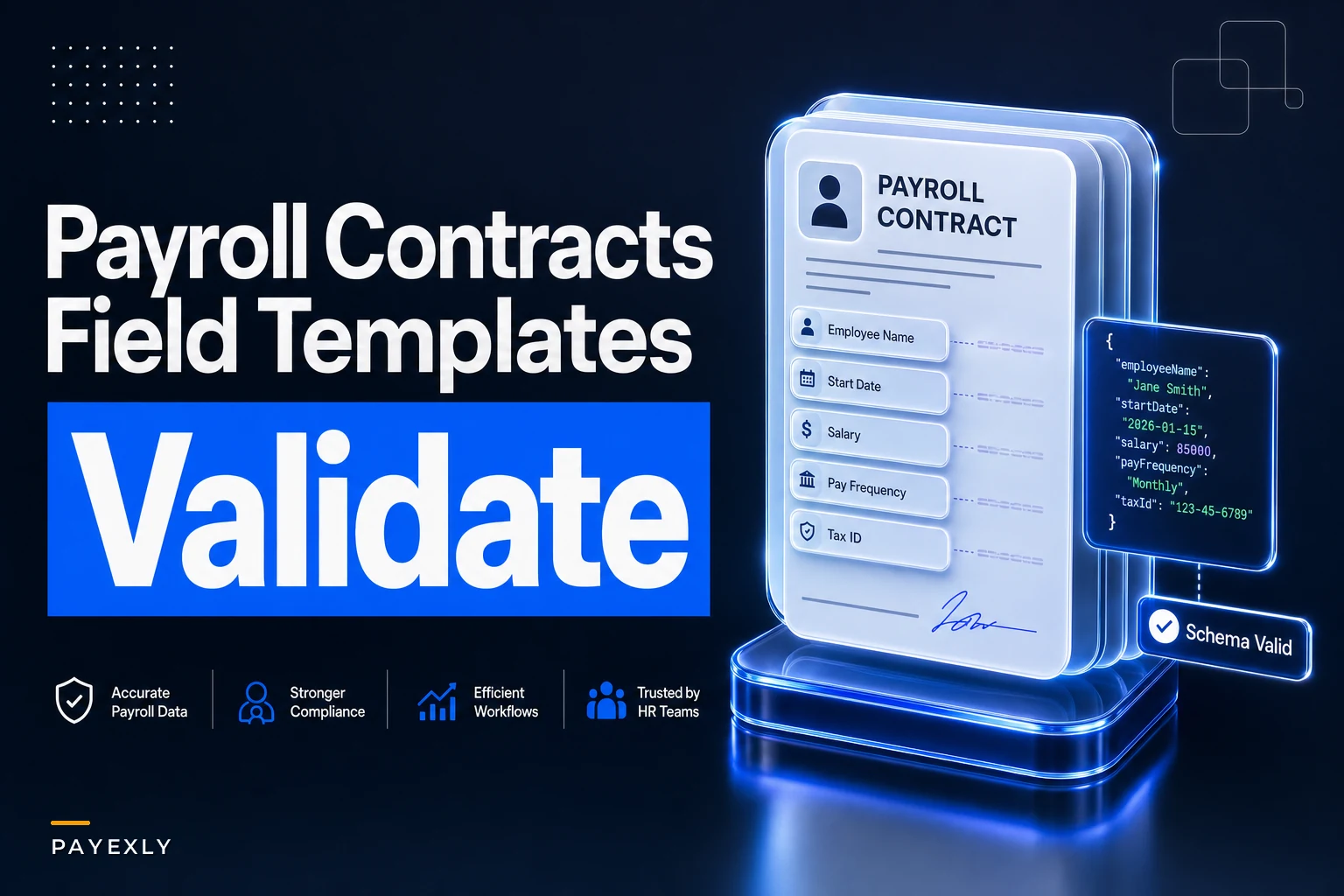
Here's what a real field contract looks like for something as basic as hours worked:
``
Field: regularhours
Type: decimal(5,2)
Range: 0.00 to 168.00
Rounding: nearest hundredth
Null handling: convert to 0.00
Timezone: employer's primary location
Update frequency: real-time
Validation: must not exceed scheduledhours by more than 20%
``
Every field needs this level of detail. Pay codes, deduction types, tax jurisdictions — all of them need explicit contracts that leave no room for interpretation.
Versioning matters too. When your timekeeping vendor adds a new field for break penalties, that's a version change. When they modify how overtime is calculated, that's a breaking change requiring a new major version.
Creating test payloads that catch problems before payroll runs
Theory is great, but you need to test these contracts against real data patterns. Build test payloads that reflect your actual employee scenarios, not just clean happy-path examples.
Your test payload library should cover:
-
Regular full-time employee, no overtime
-
Part-time with variable schedule
-
Hourly with daily overtime
-
Salaried non-exempt with weekly overtime
-
Multiple pay rates (shift differentials)
-
Split departments/cost centers
Edge cases that break things:
-
Employee with hyphenated last name
-
Negative PTO balance
-
Retroactive rate change mid-period
-
Terminated then rehired in the same pay period
-
Interstate remote worker
-
Garnishment exceeding disposable income
Data quality issues:
-
Missing middle initial
-
Apartment number in address line 1
-
International postal code
-
Phone number with extensions
-
Email with plus addressing
Each payload should document the raw input, expected transformation at each step, and the final expected output. When any system updates, you run these payloads through the full chain and compare results.
How contract testing fits into your integration workflow
Before getting into automated testing specifics, it helps to see how contract validation fits across your overall data flow. The general sequence looks something like this:
``
Source System (HRIS / Timekeeping)
        ↓
Field-Level Contract Validation
        ↓
Transformation & Mapping Layer
        ↓
Automated Contract Tests (scheduled)
        ↓
Staging Environment
        ↓
Manual Review (on failures)
        ↓
Production Payroll Processing
``
Here's a visual of the workflow.
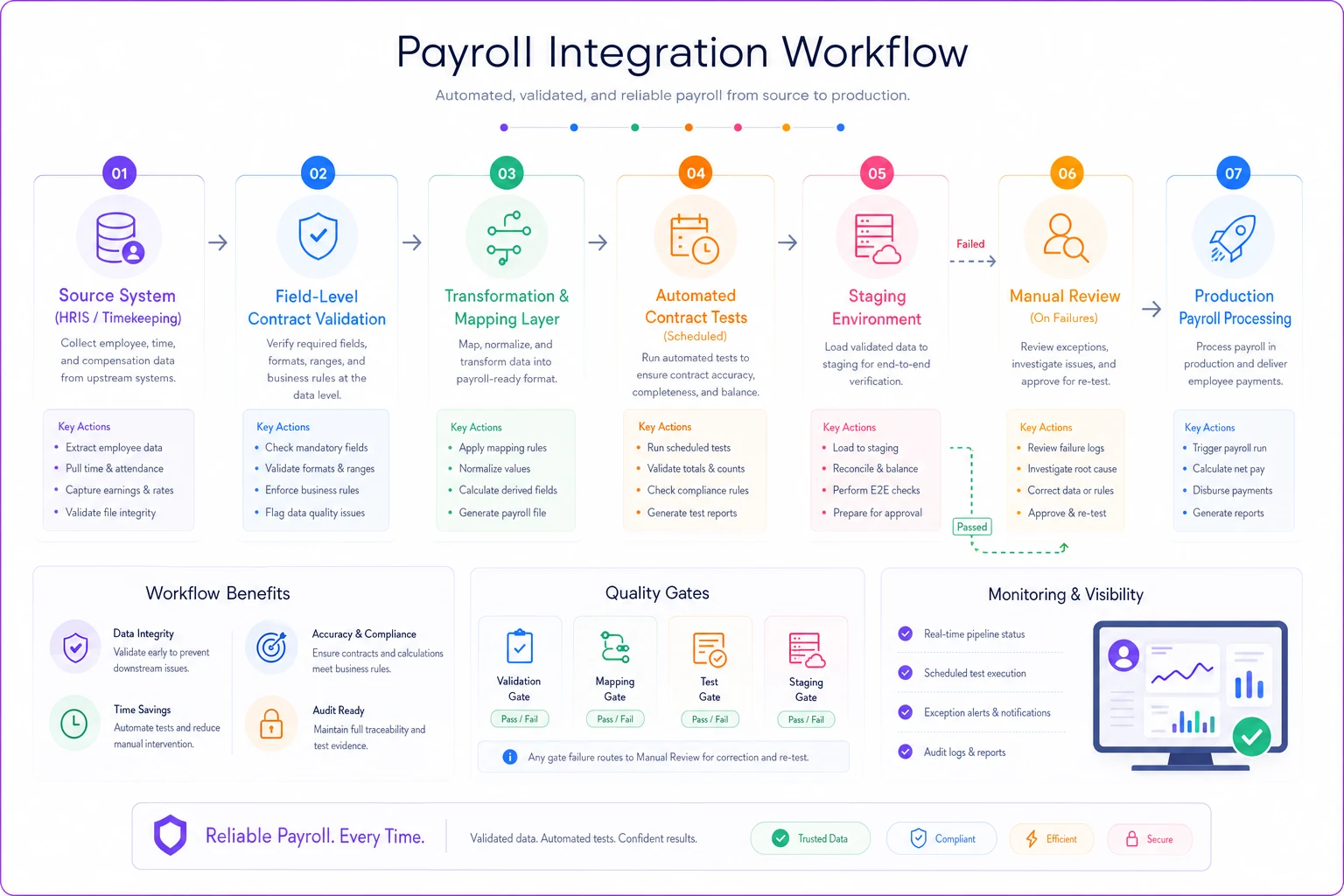
Every integration point is a place where data can silently drift. The contract validation layer and automated tests are what stop that drift from reaching payroll. Without them, you're relying on someone to catch problems manually — and that usually means catching them after employees are already affected.
Automated contract testing that runs continuously
Manual testing catches maybe 20% of integration issues. You need automated contract tests running on a schedule, not just during implementation.
Set up tests that fire every few hours, sending payloads through your integration pipeline and validating responses. These aren't full payroll runs — they're lightweight checks that confirm your systems still agree on the rules.
A basic testing matrix:
| Test Type | Frequency | Payload Count | Response Time Limit |
|---|---|---|---|
| Field validation | Every 4 hours | 10–15 | < 2 seconds |
| Calculation accuracy | Daily | 25–30 | < 5 seconds |
| Edge case handling | Daily | 40–50 | < 10 seconds |
| Full regression | Weekly | 200+ | < 60 seconds |
| Breaking change detection | On vendor update | All | < 5 minutes |
When a test fails, you want to know immediately. Not when payroll runs. Not when employees start calling HR. Right now, while there's still time to fix it without fallout.
Make these tests specific to your actual business rules. If nobody can work more than 60 hours without VP approval, your test should verify that any payload over that threshold triggers the approval workflow — not that it quietly processes through.
Versioning strategies that don't break production
Vendors love pushing updates. "Minor enhancement," they'll say, while quietly reformatting your date fields. You need versioning rules that protect production while still letting necessary changes through.
A three-tier approach works well:
Patch versions (1.2.x): Auto-accept if all contract tests pass. Should only fix bugs without changing behavior.
Minor versions (1.x.0): Manual review required, but parallel running is fine. New fields or optional features go here.
Major versions (x.0.0): Full testing cycle with a 30-day parallel running period. Breaking changes that require contract updates.
Never let vendors push directly to production. Route everything through staging first, where your contract tests run before anything goes live. If a vendor can't support that workflow, that's worth taking seriously as a vendor problem.
Track version dependencies explicitly. When your HRIS is on v2.3 and timekeeping is on v1.8, document which field mappings work and which require transformation. That version matrix becomes critical when something breaks and you're trying to trace it backward.
Building your contract testing recipe
Standing up contract testing doesn't require massive infrastructure. You need a few key components working together.
Test data generator: Build templates for common employee profiles, then use them to generate realistic test variations. Include intentional data quality issues — misspellings, formatting inconsistencies, edge cases you've actually seen in production.
Validation engine: Rules that check both structure and content. Not just whether a field exists, but whether it contains valid data in the expected format.
Comparison logic: Define acceptable variances upfront. 40.00 vs 40.0000 hours is probably fine. 40.00 vs 39.75 is a problem worth flagging.
Alert routing: Integration errors at 2 AM don't need to wake anyone up. Errors at 8 AM on payroll Monday do. Build alerting that accounts for both severity and timing.
Document your testing recipe in a runbook anyone can follow. Include the specific SQL queries or API calls, expected results, and escalation steps. When something breaks at 4 PM on payroll day, you don't want to be figuring it out from scratch under pressure.
Who should own payroll data contracts?
Most companies fumble this. IT thinks it's an HR problem. HR thinks it's a vendor problem. Vendors think it's your problem. Meanwhile errors keep flowing through unchecked.
Ownership needs to be explicit and technically competent. You need someone who understands both payroll rules and data integration — not necessarily a programmer, but someone comfortable reading API documentation and writing basic SQL.
Shared responsibility tends to work better than dumping it on a single owner:
Payroll owns the business rules: What constitutes overtime, how deductions prioritize, which codes map to which GL accounts. They define what correct looks like.
IT owns the technical implementation: Data flow, transformation logic, error handling. They keep the pipes from leaking.
Finance owns the validation: Reconciliation requirements, audit trails, compliance checks. They verify output matches expectations.
All three need visibility into the contract testing dashboard. When tests fail, everyone knows immediately and understands their role in the fix.
Preventing integration decay over time
Even solid integrations degrade. Vendors update, business rules shift, new edge cases surface. Without active maintenance, a carefully built integration turns into spaghetti within a year or two.
Schedule quarterly integration reviews. Pull error logs, look for patterns, update test payloads based on scenarios you've actually hit since the last review. That employee who works across three states? Add them to the test suite. The new shift differential policy? Build contract tests for it before it goes live.
Schedule quarterly integration reviews and update test payloads based on real incidents.
Track integration health over time:
-
Error rate per 1,000 records
-
Manual intervention hours per pay period
-
Time to detect and resolve issues
-
Percentage of automated vs manual fixes
-
Number of retroactive corrections needed
When error rates start climbing, investigate before it becomes a fire. A 0.1% error rate means 2–3 affected employees per pay period in a 250-person company — manageable. At 1%, you're looking at 25–30 problems every two weeks, and that's when employees start noticing.
Common integration patterns to avoid
Certain patterns show up again and again across implementations, and they consistently cause problems.
The "close enough" syndrome: Accepting small discrepancies because they're not material. Those 15-minute rounding differences accumulate into real wage claims over time.
The "vendor handles it" assumption: Trusting that default integration settings work for your business. They don't. The defaults are built for the average company, not yours.
The "we'll fix it in payroll" mentality: Using your payroll system to clean up upstream data problems. This hides issues until they blow up during an audit.
The "set and forget" approach: Building integrations without ongoing monitoring. By the time you notice the problem, you've got months of errors to unwind.
Real-world implementation example
A healthcare staffing company with around 400 employees across 15 locations was dealing with constant payroll errors. Their nurses worked variable shifts across different facilities, each with its own pay rules and differentials.
They started by implementing contracts for just five fields: employee ID, hours worked, facility code, shift type, and pay rate. Built test payloads for their 20 most common shift patterns. Set up automated testing every six hours.
First month: caught 47 integration errors before they hit payroll. Second month: down to 12. By month three, they were preventing roughly 95% of what used to require manual correction.
The technology wasn't sophisticated — basic SQL queries for testing, a simple Python script for validation. What made the difference was defining explicit contracts and actually testing them on a consistent schedule.
Making this work with your existing systems
You don't need to replace your current payroll setup. Start by mapping your existing integration points. What data flows where? What transformations happen along the way? Where do errors typically surface?
Pick your highest-error integration and build contracts for those fields first. Maybe it's the timesheet import. Maybe it's the benefits deduction sync. Start there, create 10–15 test payloads representing your most common scenarios, and set up basic automated testing — even if it's just a scheduled SQL query that emails results.
For teams already drowning in integration errors, AI-powered operational platforms can help enforce contracts automatically. Modern payroll operations software can monitor data flows in real-time, flag contract violations before they hit payroll, and surface fix suggestions based on patterns it's seen before. That capability becomes especially useful when managing complex validation requirements across multiple systems simultaneously.
The goal isn't a perfect setup on day one. It's building something that catches errors before they hit employee paychecks. Every prevented error saves roughly 45 minutes of manual correction time, plus whatever employee trust you would have burned in the process.
Building your testing cadence
Your testing rhythm should align with your payroll cycle but run independently. Don't wait until payroll day to find out something's broken.
Weekly contract tests should verify:
-
All active integrations respond correctly
-
Test payloads process without errors
-
Field mappings remain consistent
-
Calculation rules match specifications
Daily smoke tests should check:
-
Connection status across all systems
-
Authentication tokens are valid
-
Recent data syncs completed
-
No unusual error patterns
During payroll processing, run enhanced checks:
-
Full employee roster reconciliation
-
Total hours variance analysis
-
Deduction sum verification
-
Tax calculation spot checks
This cadence works within your existing governance framework and should become part of standard operating procedure, not something you only think about when something breaks. Teams that treat it as routine catch the quiet, slow-moving errors that are the hardest to trace later.
Moving beyond break-fix mode
Companies that handle payroll well don't just fix integration errors faster — they stop most of them from happening in the first place. They treat data contracts as critical infrastructure, not optional documentation that lives in a folder nobody opens.
Start small. One integration, five fields, ten test cases. Run them manually for a week. Then automate. Then expand. Within a few months, you'll be catching most errors before they touch payroll.
The alternative is continuing to absorb integration errors as inevitable, spending dozens of hours per month on manual corrections, and hoping employees don't notice when their paychecks are off.
Your payroll data contracts aren't just technical specs. They're what makes accurate paychecks possible at scale. When things work, nobody notices. When they don't, everyone remembers — and fixing the trust problem is a lot harder than fixing the data problem.
Your payroll data contracts aren't just technical specs. They're what makes accurate paychecks possible at scale. When things work, nobody notices. When they don't, everyone remembers — and fixing the trust problem is a lot harder than fixing the data problem.
Ready to simplify your payroll operations?
Join 2,000+ businesses using Payexly to reduce payroll overhead, ensure compliance, and enhance employee satisfaction.