
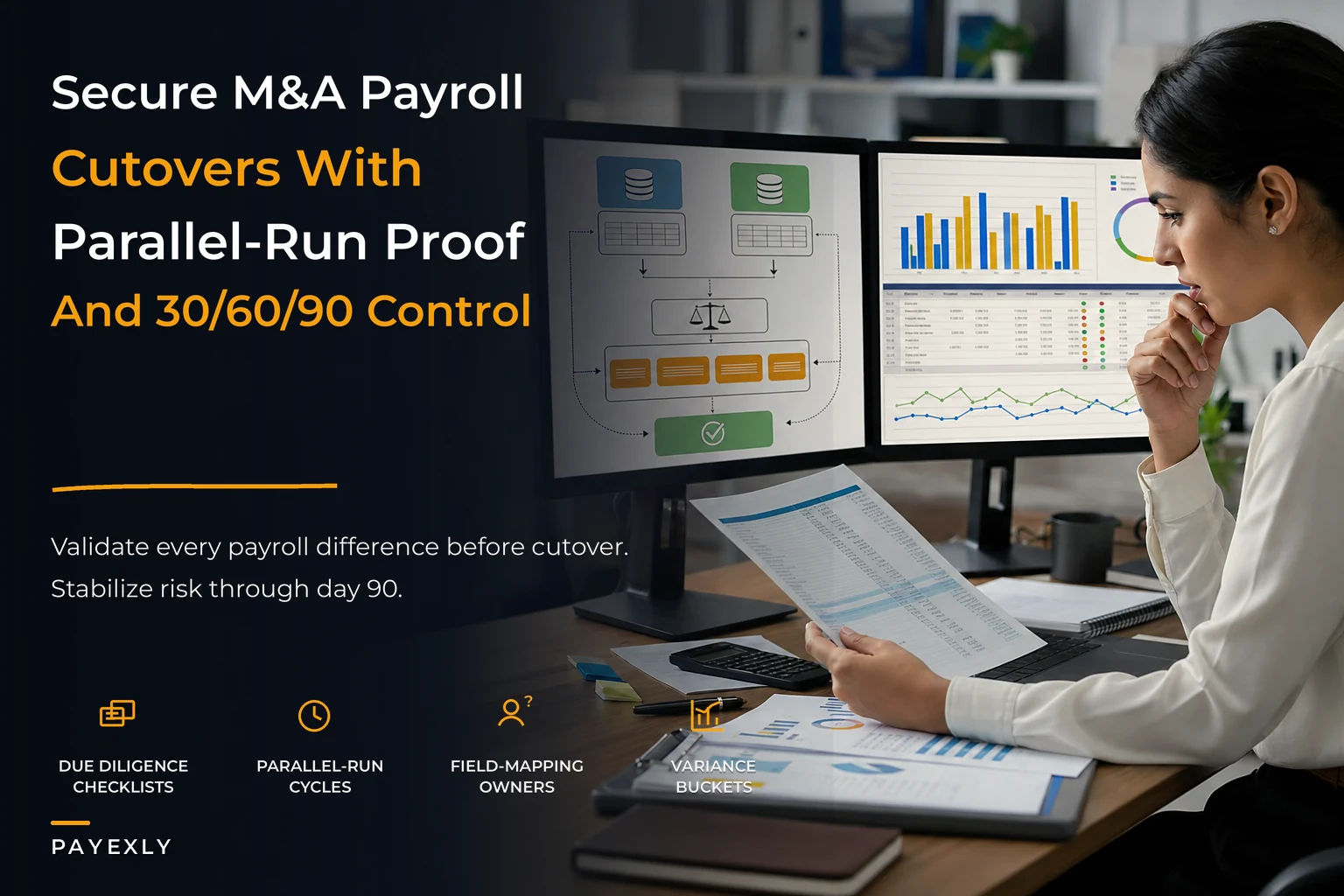

Most payroll integration failures don't happen on cutover day. They're baked in weeks earlier — during due diligence when nobody asked the target company for their garnishment order files, or when the acquiring team assumed both companies ran the same tax engine because they used the same provider brand. By the time the first combined pay run misses, the people who caused the problem have already moved on to the next workstream.
That's what makes M&A payroll different from other payroll projects. It's not one migration. It's two live payroll operations, each with their own undocumented exceptions, running against a legal timeline that doesn't care whether your field mapping is finished. A good payroll M&A integration playbook isn't a checklist you run once. It's a set of interlocking systems — diligence, field mapping, parallel validation, and stabilization gates — that each feed into the next and catch the mistakes the previous stage missed.
This article walks through how those pieces connect, where they break under deal pressure, and what actually holds together when you're merging two payrolls that were never designed to meet.
Why payroll is usually the last thing anyone checks in a deal
Deal teams spend months on financials, customer contracts, IP, and real estate. Payroll shows up late — often after the LOI, sometimes after signing. The logic is understandable. Payroll feels like a back-office utility. You pay people, it works, move on.
The problem is that payroll sits on top of almost every liability a deal cares about. Misclassified contractors become tax exposure. Unremitted garnishments become legal exposure. Accrued PTO that never made it onto the balance sheet becomes a cash surprise. Open tax notices in three states become a successor-liability headache that lands squarely on the acquirer.
What comes up repeatedly in these integrations is a predictable gap: the finance side of diligence reconciles payroll expense, but nobody reconciles payroll mechanics. The expense number can be perfectly accurate while the underlying operation is held together with spreadsheets, one person's tribal knowledge, and a quarterly manual fix that nobody documented. You inherit all of it.
The deeper issue is timing. Payroll liabilities compound on a schedule — deposit deadlines, filing deadlines, benefit true-ups. If diligence surfaces a problem two weeks before close, you don't have the runway to fix it before it becomes your problem. That's why the diligence phase has to be structured to find the operational stuff, not just the numbers.
The due diligence checklist that actually finds problems
A real payroll diligence request goes well past "send us your last four quarterly filings." You're trying to reconstruct how the target's payroll actually runs — including the parts they've stopped thinking about because they're automatic to them.
Eliminate payroll errors and delays.
Payexly streamlines every payroll cycle ensuring accuracy and compliance.
- Automated payroll processing
- Real-time tax compliance
- Benefits & deductions management
No credit card required
Here's the core request list worth pushing for in any deal:
-
Full tax registration inventory — every federal, state, and local jurisdiction where the target is registered to withhold or remit, including dormant registrations they forgot to close
-
Open and recent tax notices — anything from the last 24–36 months, resolved or not, because unresolved notices transfer
-
Garnishment and levy orders — active orders, the withholding logic applied, and proof of remittance to each agency
-
Benefit deduction and carrier reconciliation — the last two cycles of deductions matched against carrier invoices, which is where ghost enrollments show up
-
Contractor/1099 population — with classification rationale, because this is the single most common inherited liability
-
Off-cycle and manual payment history — every correction, bonus run, and manual check for the last year, which reveals how often "normal" payroll actually breaks
-
Accrued liability detail — PTO, deferred comp, commission, anything owed but not yet paid
-
System and vendor contracts — provider agreements, data ownership terms, and termination clauses
The items that create the biggest post-close surprises are almost never in the financials. They're in the off-cycle history and the deduction reconciliation. A company running 40 manual checks a month isn't a company with occasional exceptions — it's a company whose payroll has structural gaps you're about to absorb.
One thing diligence should capture that teams routinely skip: who actually runs the payroll. If the entire operation depends on one person who knows which spreadsheet feeds which upload, that person is a diligence finding. Retention agreements for payroll staff through the stabilization period are cheap insurance.
Field mapping: where two payrolls either reconcile or collide
Once a deal is moving, the technical heart of the integration is field mapping — translating the target's payroll data model into yours. This sounds mechanical. It isn't. Field mapping is where you discover that "regular pay" in their system includes shift differential that your system treats as a separate earning code, or that their 401(k) deduction is pre-tax for some populations and post-tax for others and nothing in the data tells you which is which.
A field-mapping template needs three columns most teams forget: the source field, the target field, and the transformation logic in between. The transformation column is where the real work lives. It's where you document that their "Bonus" code maps to your "Supplemental Wages" code and triggers a different withholding method. Skip that column and you've built a mapping that looks complete and produces wrong paychecks.
| Mapping element | What breaks when it's wrong | Where to catch it |
|---|---|---|
| Earning codes | Over/underpaid wages, wrong tax treatment | Parallel run, gross-to-net comparison |
| Deduction codes | Benefit gaps, incorrect pre/post-tax split | Carrier invoice reconciliation |
| Tax jurisdictions | Wrong withholding, missed local taxes | Jurisdiction-level tax recon |
| Garnishment logic | Missed or over-withheld orders, agency penalties | Order-by-order remittance check |
| PTO/accrual balances | Lost balances, employee disputes | Balance reconciliation at cutover |
| Employee IDs/keys | Duplicate records, broken history | Pre-migration record dedup |
The mistake that shows up repeatedly: mapping at the field level but not at the population level. Two companies can have identical earning codes that mean different things for different employee groups. Hourly staff might have overtime baked into one code while salaried exempt staff use the same code for something else entirely. If your mapping assumes one code means one thing, you'll be fine for 80% of the population and quietly wrong for the rest — and the wrong 20% are the ones who notice.
Good mapping also means deciding, deliberately, what history you carry over. Year-to-date tax totals have to move or your W-2s at year-end will be a mess. This connects directly to the year-end close and W-2 packaging process — a mid-year cutover that doesn't preserve YTD figures turns into a tax-form crisis six months later, long after the integration team has declared victory.
Parallel-run validation: proving it works before it matters
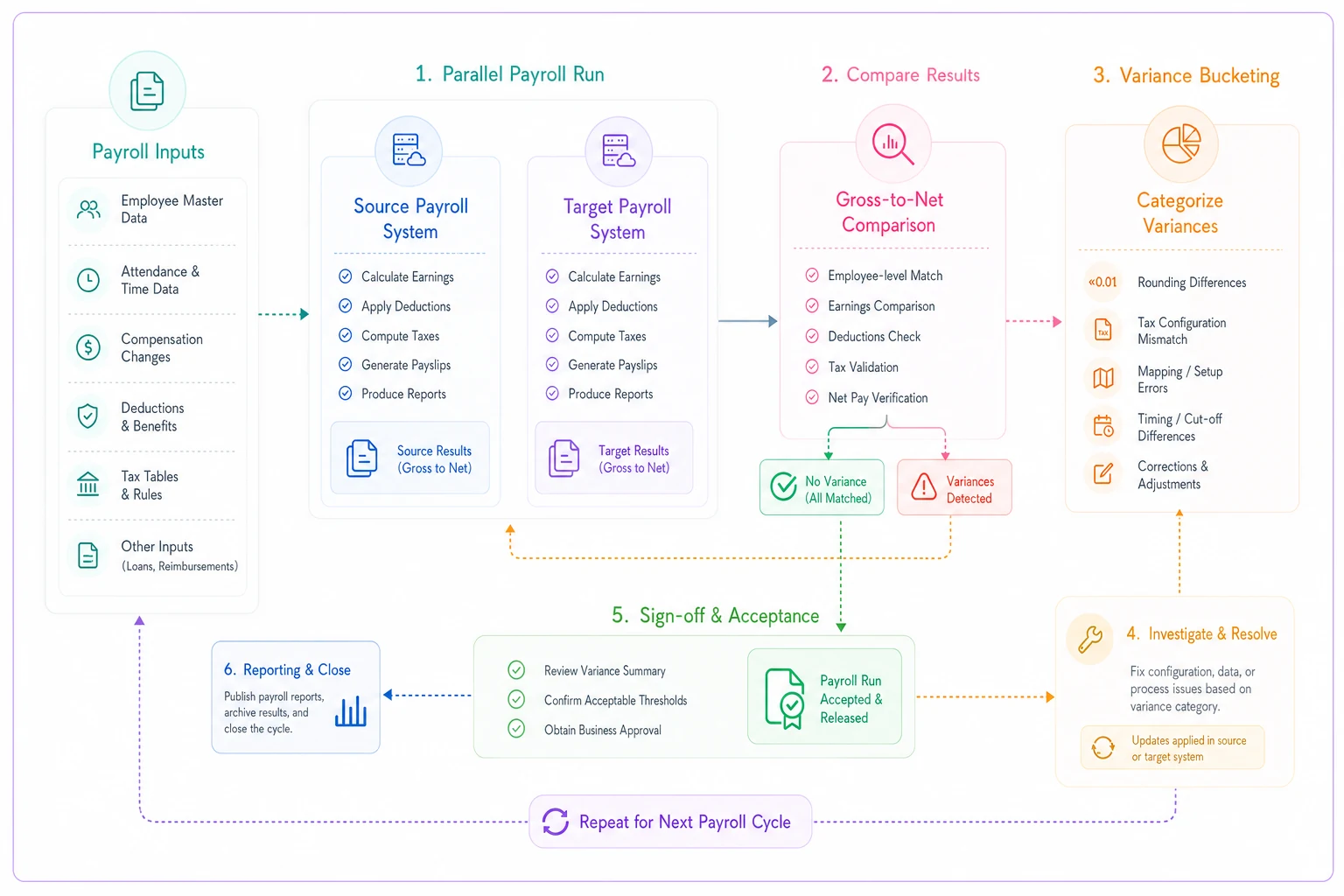
A parallel run means processing the acquired population through the new system alongside the old system for one or more live cycles — without actually paying from the new one — then comparing results line by line. It's the single most valuable control in the entire integration, and it's the one most often cut when the timeline tightens.
Field mapping is a theory about how the data should translate. A parallel run is the experiment that tests the theory against real paychecks for real people. You're not checking whether the system runs — you're checking whether it produces the same net pay the employee would have received in the old system, and where it doesn't, whether the difference is correct or a bug.
A disciplined parallel run follows a repeatable sequence:
-
Freeze a representative cycle — pick a normal pay period, not one with a bonus run or quarter-end noise, so differences are easy to interpret
-
Process both systems against identical inputs — same hours, same deductions, same elections, so any gap is a mapping or configuration issue, not a data issue
-
Compare gross-to-net at the employee level — not totals, individual records, because offsetting errors hide in totals
-
Bucket every variance by cause — rounding, tax config, mapping error, timing, or genuine correction
-
Set a tolerance and a sign-off rule — define what variance is acceptable (often literally zero for net pay) and who signs off that it's met
-
Run it again — one clean parallel cycle isn't proof; two or three consecutive clean cycles is
The tolerance conversation is where discipline matters most. There's always pressure to wave through "small" differences to hit the cutover date. A $3 variance on one person's check usually isn't random — it's a tax or deduction configuration that's wrong for a whole category of people and just happens to be small this cycle. Chase the $3. It's never really $3.
One underused tactic: run your parallel comparison across at least one cycle that includes a correction or retro adjustment.
The workflows behind retroactive pay corrections are complex enough in a stable system — validating them during an integration, before you're live, is far better than discovering the problem in production.
Visualizing the parallel-run workflow can help teams follow the sequence and ensure each step is executed consistently.
The tolerance conversation is where discipline matters most. There's always pressure to wave through "small" differences to hit the cutover date. A $3 variance on one person's check usually isn't random — it's a tax or deduction configuration that's wrong for a whole category of people and just happens to be small this cycle. Chase the $3. It's never really $3.
When a hard cutover is fine, and when it absolutely isn't
Not every integration needs the same cutover approach. Matching the approach to the situation is a real decision, not a default.
A clean, single-date cutover makes sense when the acquired population is small, pay structures are genuinely simple, both companies are already on the same platform, and you've completed at least two clean parallel cycles. In that case, dragging out a phased transition just adds coordination overhead for no real risk reduction.
A phased or dual-run approach makes sense when you're merging materially different pay structures, operating across many tax jurisdictions, carrying a large garnishment population, or dealing with union agreements that each have their own rules. Trying to move everyone on one date in those situations is how you end up with several hundred wrong paychecks and a legal timeline you can't pause.
A hard cutover is the wrong call — regardless of deal pressure — when you haven't reconciled garnishments order-by-order, when YTD tax figures haven't been validated, or when the one person who understands the target's payroll is already gone. Those aren't timeline problems you can push through. They're setups for the kind of failure that generates agency penalties and employee complaints that don't go away quietly.
The scenario that should never attempt a compressed cutover: a lean acquirer absorbing a company with messy, manual payroll and no documentation, on a timeline that doesn't allow parallel runs. In that situation, the honest move is to keep the target's payroll running on its existing system through at least one quarter-end and integrate afterward — even if it feels inefficient. The efficiency you'd gain isn't worth the liability you'd inherit.
The 30/60/90 stabilization structure
Cutover isn't the finish line. It's the start of the window where inherited problems surface under live conditions. A 30/60/90 stabilization plan exists to catch them while you still have the team, context, and budget to fix them. After day 90, the integration budget closes, people reassign, and whatever's broken becomes permanent operational cost.
First 30 days — prove the basics. Every pay run completes on time. Net pay matches expectations. Tax deposits go out on schedule. Garnishments withhold and remit correctly. This is the stability-of-mechanics phase. You're not optimizing — you're confirming nothing is actively breaking. Run a full reconciliation after each cycle, not monthly, because a deposit problem caught in week one is fixable and the same problem caught at month-end is a penalty.
Days 31–60 — validate the edges. This is where exceptions you couldn't fully test in parallel show up live: the first off-cycle correction, the first new hire processed end-to-end in the new system, the first benefit change, the first termination with final pay. Each of these is a workflow, and each is a place where a mapping gap becomes a visible error. The 60-day window is about confirming the exception paths work, not just the happy path.
A stabilization checklist worth keeping visible through all three windows:
-
[ ] Every pay cycle completed on time with sign-off
-
[ ] Gross-to-net reconciled per cycle, zero unexplained net variance
-
[ ] All tax deposits made on schedule, confirmations filed
-
[ ] Garnishment withholdings and remittances reconciled order-by-order
-
[ ] Benefit deductions matched to carrier invoices
-
[ ] First off-cycle, termination, and new-hire processed and validated
-
[ ] YTD and QTD tax figures reconciled against prior system
-
[ ] Access controls and approval workflows locked and documented
-
[ ] Open issues logged with owners and target dates before day 90
Days 61–90 — reconcile and harden. Now you reconcile cumulative figures: quarter-to-date tax, benefit deductions against carrier invoices across the full period, garnishment remittances against agency records. You also lock down governance — who approves changes, who has access, what the audit trail looks like. Standing up a clear payroll governance framework with defined RACI and approval workflows during this window is what turns a temporary integration team's knowledge into a durable operating model. Skip it, and all that context walks out the door at day 91.
A realistic scenario
A regional services company — roughly 220 employees — acquired a smaller competitor with about 90 employees across four states. Both used the same payroll provider brand, so the integration was initially scoped as a simple consolidation. The target's expense numbers were clean, diligence on financials signed off, and the plan was a single cutover at the next quarter boundary.
The parallel run changed the plan. Two things surfaced in the first comparison cycle: around 11 employees had shift-differential pay mapped into a code that triggered the wrong withholding method, and the target's garnishment population — seven active orders — used withholding logic that didn't translate cleanly, with two orders that had been under-remitted for months before the deal. Neither showed up in the expense reconciliation. Both were live legal exposure.
Because it surfaced in parallel rather than production, the team kept the acquired payroll on its existing setup through quarter-end, fixed the mapping and the garnishment logic, ran two more clean parallel cycles, and cut over in the following period. The under-remitted garnishments were corrected and brought current before they triggered an agency action. The timeline slipped roughly five to six weeks — against a liability that, had it gone live wrong, would have meant corrected filings across four states plus potential penalties on the garnishment orders.
The outcome wasn't dramatic. That's the point. A good integration is boring. The value was entirely in catching the two problems before they hit real paychecks, and the only reason they were caught was that the parallel run wasn't cut when the timeline got tight.
How the system holds together
These four phases work because each one is designed to catch what the previous one missed. Diligence finds the structural liabilities before you own them. Field mapping translates the mechanics and surfaces population-level collisions. Parallel runs test the mapping against real pay before anyone's check depends on it. Stabilization gates catch the exceptions that only appear under live conditions, while the team that understands the context is still around.
Break any one link and the others can't fully compensate. Skip diligence and your mapping is built on assumptions. Skip the parallel run and your cutover is the first real test, with live paychecks as the test data. Skip stabilization and every edge case becomes a permanent workaround.
The deal timeline will push on all of these — it always does. But the phases exist precisely because that timeline doesn't account for how payroll liabilities compound. The teams that come through M&A payroll cutovers cleanly aren't the ones with the most sophisticated tooling. They're the ones who treated the integration as a connected system with real gates, refused to wave through variances they couldn't explain, and kept enough runway to leave the acquired payroll running untouched when the right answer was simply "not yet."
Ready to simplify your payroll operations?
Join 2,000+ businesses using Payexly to reduce payroll overhead, ensure compliance, and enhance employee satisfaction.