


Most finance teams don't realize their global payroll is broken until the consolidation doesn't tie out. The individual countries look fine. UK payroll ran clean. Germany reconciled. Brazil closed on time. Then everything lands in the group ledger and there's a $340k variance nobody can explain, and three people are rebuilding a spreadsheet at 11pm trying to figure out whether it's an FX timing issue, a mapping mismatch, or a genuine error.
Harmonization failures rarely come from the payroll itself. They come from the translation layer — the invisible machinery that takes 14 different local payrolls, each with its own pay components, tax logic, and currency, and tries to turn them into one consistent story the group can report on. When that layer isn't designed deliberately, it improvises. And improvised translation is where consolidated accounting goes to die.
This article is about building that layer on purpose — layered translation architecture, a practical harmonize-vs-localize decision matrix, how multi-currency posting rules behave at scale, what translation journals actually look like, and the tolerance tables that keep your reconciliation from becoming a continental treasure hunt.
Why the translation layer is the real problem
The mental model that trips up most teams: they think global payroll harmonization means "make every country do payroll the same way." It doesn't. You can't. German works councils, Brazilian 13th-month pay, UK pension auto-enrolment, and US multi-state withholding are not going to collapse into one universal process, and trying to force them to is how harmonization projects die after 18 months and several million dollars.
Harmonization isn't about identical local processing. It's about identical representation at the group level. The locals stay weird. The translation layer makes them legible.
What breaks across organizations is that the translation logic gets scattered. Part of it lives in the local payroll vendor's export mapping. Part lives in a middleware tool someone configured four years ago. Part lives in the Excel macro the consolidation accountant guards like a family heirloom. Nobody owns the whole chain, so when a German pay component gets renamed, the break surfaces three steps downstream as an unbalanced journal — and the person who finds it has no idea where it originated.
This usually happens when a company grows by acquisition. Each acquired entity brings its own chart of accounts, its own vendor, its own idea of what "overtime" means in the ledger. The group inherits a federation of translation logic that was never designed to coexist. For that kind of cleanup, the post-merger stabilization gates and GL templates approach to canonical mapping is the foundation everything else sits on.
A layered translation architecture
The fix is to stop treating translation as one step and treat it as four distinct layers, each with a single job and a clear owner. When you separate them, breaks become traceable. When they're fused together, every error looks the same.
Eliminate payroll errors and delays.
Payexly streamlines every payroll cycle ensuring accuracy and compliance.
- Automated payroll processing
- Real-time tax compliance
- Benefits & deductions management
No credit card required
Capture raw local exports exactly as produced to preserve audit trails.
Layer 1 — Local capture. Raw local payroll output in its native form: local pay components, local currency, local tax codes. Nothing gets transformed here. The rule is simple — capture exactly what the local system produced, including the stuff that looks redundant. The instinct to "clean it up early" is what destroys audit trails later.
Layer 2 — Canonical mapping. Every local component maps to a canonical pay element. Local "Überstundenzuschlag" and US "OT premium" both map to EARNOTPREMIUM. This is where the harmonize-vs-localize decisions actually get encoded. The canonical layer is still in local currency — you're standardizing meaning, not money yet.
Layer 3 — Currency translation. FX gets applied here. Each canonical amount converts to group currency using a defined rate type and timing rule. This layer produces translation differences, and those differences need their own accounts — which is where most consolidations quietly go wrong.
Layer 4 — Posting and consolidation. Canonical, translated amounts post to the group ledger against the consolidated chart of accounts. Tolerances get applied here. Exceptions route here.
The discipline that matters: a value should only ever be transformed by the layer responsible for that transformation. If someone's doing currency conversion inside the canonical mapping layer, or renaming components during posting, you've recreated the scattered-logic problem inside a fancier diagram.
A typical failure looks like this — a team applies FX at Layer 2 to "simplify" the mapping tables. Six months later, finance changes the rate convention from month-end spot to average rate. Because the conversion is baked into the mapping layer, the change requires rewriting 40 mapping tables instead of one currency rule. That's a two-week project that should have been a two-hour config change.
How the four layers connect in practice
[Local Payroll Systems] ↓ (raw export, no transformation) [Layer 1 — Local Capture] ↓ (component mapping, local currency preserved) [Layer 2 — Canonical Mapping] ↓ (FX applied using declared rate type) [Layer 3 — Currency Translation] ↓ (translated amounts + tolerance checks) [Layer 4 — Posting & Consolidation] ↓ [Group Ledger]
Here's a simple visual of that flow to keep the owners and hand-offs clear.
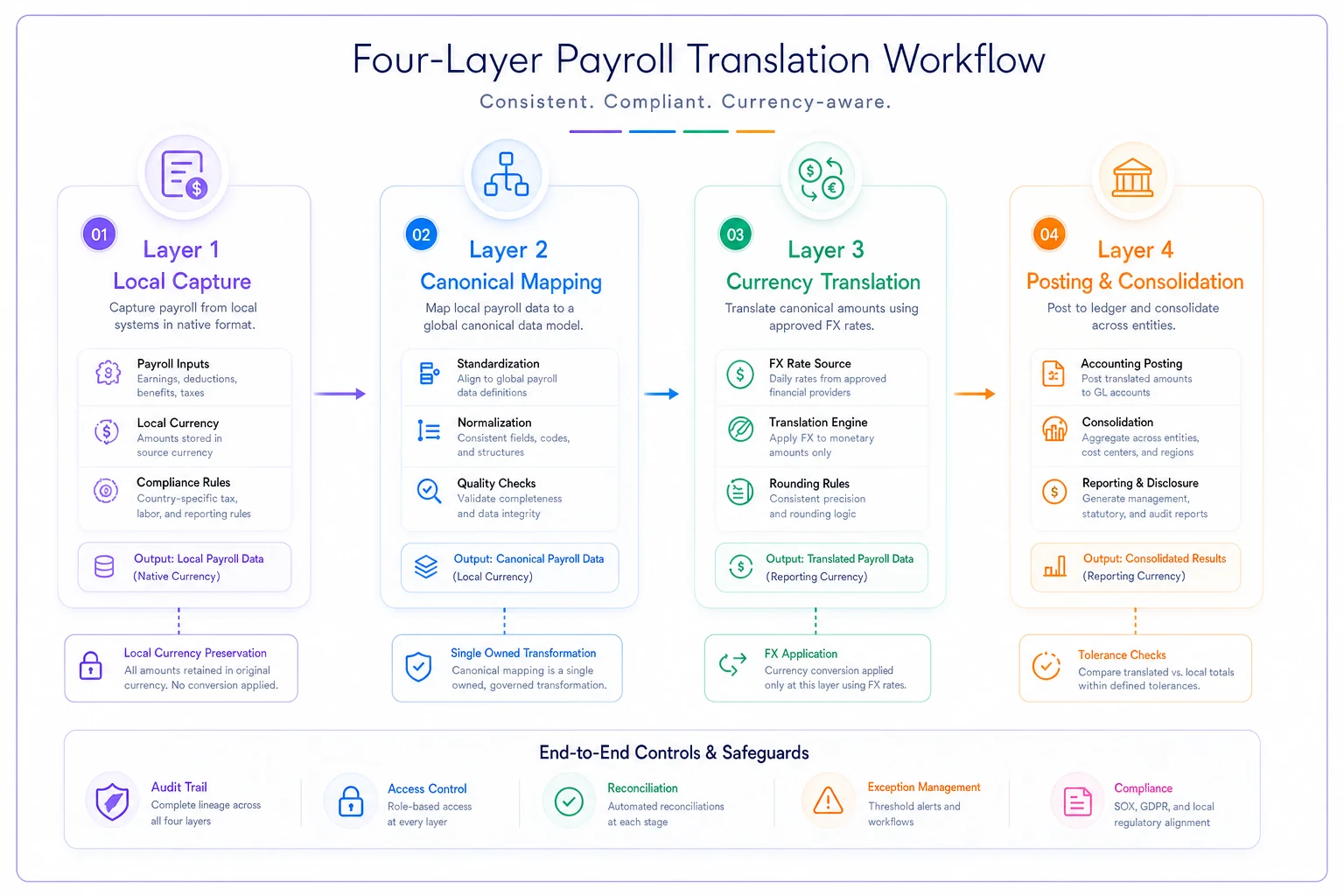
Each arrow represents a single, owned transformation. When a break occurs, you trace it to exactly one layer rather than hunting across the whole chain.
The harmonize-vs-localize decision matrix
Not everything should be harmonized. Over-harmonizing is as damaging as under-harmonizing — you end up jamming local nuance into canonical buckets that lose the detail regulators and local finance teams actually need. The decision comes down to a few questions, and it's worth making them explicit rather than deciding ad hoc per component.
| Dimension | Lean Harmonize | Lean Localize |
|---|---|---|
| Group reporting relevance | High — rolls into KPIs, labour cost analytics | Low — purely local statutory detail |
| Statutory specificity | Generic concept exists everywhere | Legally defined, country-unique |
| Audit traceability need | Group audit cares | Only local audit cares |
| Volatility of local rules | Stable definition | Changes frequently per jurisdiction |
| Downstream GL impact | Hits consolidated accounts directly | Stays in local sub-ledger detail |
A component that's high on group-reporting relevance and has a generic equivalent everywhere — base salary, employer social cost, overtime premium — should harmonize to a canonical element. A component that's legally unique and only matters to the local tax authority — a specific Italian severance accrual (TFR) or a French CSG/CRDS split — should localize, carried through as detail but not forced into a group-wide bucket.
The mistake that comes up constantly: teams harmonize everything because it feels cleaner, then discover during a local statutory audit that they've destroyed the granularity needed to defend a filing. Harmonize the group story. Preserve the local detail underneath it. The canonical layer can hold both — a parent canonical element with localized child attributes — if you design it that way from the start.
A quick decision walk-through
Take "meal allowance." In one country it's fully taxable, in another partly exempt, in a third it's a non-cash benefit. Does it harmonize?
Group reporting probably cares about total allowance cost — harmonize signal. But the tax treatment is wildly jurisdiction-specific — localize signal. The answer isn't binary. You harmonize the cost to a canonical allowance element for labour-cost reporting, and you localize the tax treatment as attributes attached to it. One number rolls up cleanly; the local tax nuance stays intact for statutory defense. That dual treatment is the whole point of a layered design.
Multi-currency posting rules that actually hold
Currency is where harmonization projects produce their most expensive surprises, because FX errors compound silently and only reveal themselves at consolidation.
Define rate type per transaction class, not per transaction. Payroll liabilities, cash settlements, and accruals should each have a declared rate convention — month-end spot, period-average, or transaction-date — and that convention should live in the currency layer, not be decided case by case. When the convention is implicit, two accountants will choose differently and your intercompany won't net.
Separate the posting currency from the functional and group currencies explicitly. A Polish entity might pay in PLN, report functionally in EUR, and consolidate in USD. That's three conversions, and each one can introduce a difference. Collapsing them into "just convert to USD" hides where the difference was born.
Give translation differences their own accounts. This is the single most common gap. When you convert payroll liabilities at one rate and settle them at another, the difference has to land somewhere. If it lands in a wage expense account, your labour cost is now polluted by FX noise and your variance analysis is meaningless. Route it to a defined FX translation difference account so it's visible and explainable.
Here's the pattern that bites people: a company books the payroll liability at month-end spot, then pays it three days later at a different rate. The settlement doesn't match the liability. Multiply that across 12 countries and a few million in payroll, and you've got a five-figure "unexplained" variance every single month — not because anything is wrong, but because nobody designed where the realized FX difference should post. The deeper mechanics of conversion timing and remittance handling connect directly to how your broader multi-jurisdiction compliance operating model handles cross-border payments.
Translation journal examples
Abstract rules don't stick, so here's what the journals actually look like. Imagine a UK entity, functional currency GBP, consolidating to USD. Gross pay for the period is £500,000. Month-end spot rate is 1.27.
Local accrual (Layer 1, GBP): Dr Wage Expense (EARN_BASE) £500,000 Cr Payroll Liability £500,000
Canonical mapping (Layer 2) — no amount change, just the component now carries the canonical code EARN_BASE and the local code as an attribute. Nothing posts; this is representation.
Currency translation (Layer 3, to USD at 1.27): Dr Wage Expense (USD) $635,000 Cr Payroll Liability (USD) $635,000
Now settlement happens two days later at 1.29: Dr Payroll Liability (USD) $635,000 Cr Cash (USD) $645,000 Dr FX Translation Difference $10,000
That $10,000 is not an error. It's the realized FX difference, posted where it belongs, fully explainable. Showing the journals in sequence makes visible that the difference was created by a timing and rate reality, not by a mistake in the payroll. Teams that can't produce this sequence end up treating every FX difference as a defect to investigate, which burns the close team's time on non-problems while real errors hide in the noise.
Tolerance tables: deciding what's worth chasing
The second half of a sane consolidation is knowing what not to investigate. Without tolerance thresholds, teams treat a $12 rounding difference with the same urgency as a $40,000 mapping break. That's how a close takes ten days instead of four.
Tolerances should vary by account materiality and by the nature of the difference. Rounding differences on converted amounts are expected and small; mapping or liability differences are not. Here's a workable starting structure:
| Difference type | Auto-accept threshold | Review threshold | Hard stop |
|---|---|---|---|
| FX rounding (per entity) | < $50 | $50–$500 | > $500 |
| Liability-to-settlement FX | < 0.5% of liability | 0.5%–2% | > 2% |
| Canonical mapping variance | $0 (should be zero) | any non-zero | > $1,000 |
| Accrual-to-actual (per component) | < 1% | 1%–3% | > 3% |
Mapping variance should have a zero tolerance. If a canonical mapping produces a difference, it means a local component didn't map to anything — the money fell through a gap. That's never acceptable regardless of size, because a $3 unmapped component today is the symptom of a mapping rule that will drop a $30,000 component next quarter when volume changes. Tolerance tables protect your attention; they shouldn't excuse structural gaps.
For the detailed field-level reconciliation mechanics that sit underneath these tolerances, the month-end payroll-to-GL reconciliation SOP covers the mapping and exception-routing side in depth.
A process for standing this up
If you're building the translation layer rather than inheriting a working one, sequence matters. Doing currency before canonical mapping guarantees rework.
-
Inventory every local pay component across all entities. Not a sample — all of them. The components you skip are the ones that break consolidation later.
-
Define the canonical element set. Keep it deliberately small. If you have 400 local components mapping to 180 canonical elements, your canonical set is too granular and you've just recreated the mess.
-
Make harmonize-vs-localize calls per component using the matrix. Document the reasoning, not just the decision. Six months later nobody remembers why meal allowance was localized.
-
Define rate conventions per transaction class. Lock these down before any FX runs.
-
Set up translation difference accounts. Explicitly, in the group chart, before the first consolidated close.
-
Build tolerance tables and exception routing. Decide where each hard-stop goes and who owns it.
-
Run a parallel close. Old method and new method side by side, at least one full cycle, reconciled line by line.
The parallel run is non-negotiable. Teams that skip it to "save time" spend that time tenfold explaining variances to auditors who don't trust a translation layer that was never validated against the old numbers.
When heavy harmonization makes sense — and when it doesn't
When it makes sense: You're consolidating five or more entities, group leadership wants cross-country labour-cost analytics, you're heading toward an audit or IPO that demands consistent representation, or you've grown by acquisition and inherited incompatible mappings. At that scale, the cost of not harmonizing — manual reconciliation every close, unexplainable variances, audit findings — dwarfs the project cost.
When it's a bad idea: You have two or three entities in similar jurisdictions and a close that already ties out. Building a four-layer architecture for that is over-engineering; you'll spend more maintaining the layer than you ever lose to the current process.
Who should not do this yet: Companies mid-acquisition with the target's payroll still unstable. Harmonizing onto a moving target means rebuilding your canonical mapping the moment the acquired entity's processing settles. Stabilize local processing first, then translate. Trying to do both at once is how you get a translation layer that's wrong in ways nobody can see until the numbers don't tie.
A real scenario
A mid-market manufacturer, roughly 2,100 employees across seven countries, grew through three acquisitions in four years. Each entity used a different local payroll provider, and consolidation ran through a chain of Excel workbooks that one senior accountant maintained. Month-end close for the group payroll piece took about nine business days, and there was almost always a residual variance somewhere in the $20k–$50k range that got written to a suspense account and "investigated later" — which usually meant never.
The core issues were textbook: FX was being applied inside the mapping workbooks, so rate convention changes meant rewriting everything; translation differences were landing in wage expense, polluting labour-cost reporting; and three local components had quietly stopped mapping to anything after a vendor renamed them, dropping roughly $8k a month into a gap nobody had noticed.
They rebuilt around a layered architecture — raw capture, a canonical set of about 150 elements, a dedicated currency layer with declared rate conventions, and tolerance tables with zero tolerance on mapping variance. The first parallel close surfaced the dropped-component problem immediately, because the mapping layer flagged non-zero variance where there should have been none.
After two full cycles, the close dropped to around four days, the recurring suspense variance effectively disappeared, and FX differences became a single explainable line rather than noise smeared across expense accounts. Nothing about the local payrolls changed — the locals stayed exactly as weird as they always were. What changed was that the translation between local reality and group representation finally had a design instead of a tradition.
Bringing it together
Global payroll harmonization doesn't fail because countries are different — it's supposed to deal with countries being different. It fails when the translation between local and group is scattered, implicit, and owned by nobody.
The four-layer architecture makes every transformation traceable: capture stays raw, mapping standardizes meaning, currency handles money, posting handles consolidation, and each break can be located instead of hunted. The harmonize-vs-localize matrix keeps you from flattening the local detail you'll need later. Multi-currency posting rules keep FX differences visible and explainable instead of silently polluting your cost analytics. Tolerance tables keep your close team's attention on differences that actually matter — while treating mapping gaps, correctly, as never acceptable at any size.
Build the layer on purpose. The entities will keep doing what local law requires. Your job is to make them speak one language at the group level without pretending they're all the same underneath.
Global payroll harmonization doesn't fail because countries are different — it's supposed to deal with countries being different. It fails when the translation between local and group is scattered, implicit, and owned by nobody.
Build the layer on purpose. The entities will keep doing what local law requires. Your job is to make them speak one language at the group level without pretending they're all the same underneath.
Ready to simplify your payroll operations?
Join 2,000+ businesses using Payexly to reduce payroll overhead, ensure compliance, and enhance employee satisfaction.