

Most payroll upgrade requests die in the same place: a conference room where finance asks "what's the return?" and the HR or payroll lead gives an honest but unconvincing answer about saved hours and fewer errors. The problem isn't the idea. It's that the request was built as a feature wishlist instead of an investment case tied to outcomes someone on the executive team actually cares about.
A real payroll modernization playbook isn't a pitch deck. It's a system — a way to rank what you fix first, defend the spend with numbers that hold up, and then track whether the money you got actually moved the needle. The teams that get funded year after year aren't the ones with the slickest demos. They're the ones who closed the loop on the last investment they asked for.
This article walks through how those pieces fit together: the prioritization matrix that decides what goes first, the investment-case structure that survives scrutiny, the benefits-tracking dashboard that proves realized value, and the governance checklist that keeps the whole thing honest for the executive sponsor who signed off.
Why payroll investments get rejected (and it's rarely the money)
Payroll sits in a weird spot. It's mission-critical — miss a pay run and you've got a staff revolt and possibly a regulator — but it's invisible when it works. Nobody gets promoted for "payroll ran fine again this month." So when you ask for budget, you're competing against revenue-generating projects with cleaner stories.
A consistent pattern shows up in these funding conversations: the request describes the solution in detail and the problem vaguely. "We need a new integration layer and an automated reconciliation tool" lands with a thud because the decision-maker can't connect it to anything they're measured on. Flip it around — "we're carrying roughly 40 hours of manual rework every cycle and two of those cycles last quarter had corrections that hit the GL" — and now you're describing a cost and a risk, not a shopping list.
The second failure mode is scope creep disguised as ambition. A team asks for a full platform replacement when 70% of the pain comes from three broken handoffs. Executives smell the risk in a big-bang project, and the whole thing stalls. The modernization playbook exists precisely to break that instinct — to force a ranked, staged view instead of an all-or-nothing ask.
The prioritization matrix: deciding what actually goes first
Before you write a single investment case, you need a defensible way to rank the candidate projects. Not by who complained loudest, and not by what's technically interesting. The matrix below tends to hold up in front of finance because it weighs the two things sponsors care about — impact and risk reduction — against the two things that kill projects: effort and dependency.
Eliminate payroll errors and delays.
Payexly streamlines every payroll cycle ensuring accuracy and compliance.
- Automated payroll processing
- Real-time tax compliance
- Benefits & deductions management
No credit card required
| Factor | What you're measuring | Weight |
|---|---|---|
| Financial impact | Rework hours, error costs, penalty exposure, overpayments | High |
| Risk / compliance | Likelihood and severity of a filing or control failure | High |
| Effort to deliver | Build time, integration complexity, testing burden | Medium |
| Dependency | Does this unblock other projects or sit alone? | Medium |
| Adoption difficulty | Will the team actually use it, or route around it? | Medium |
A simple workflow shows how projects move from scoring to staged funding and governance gates.
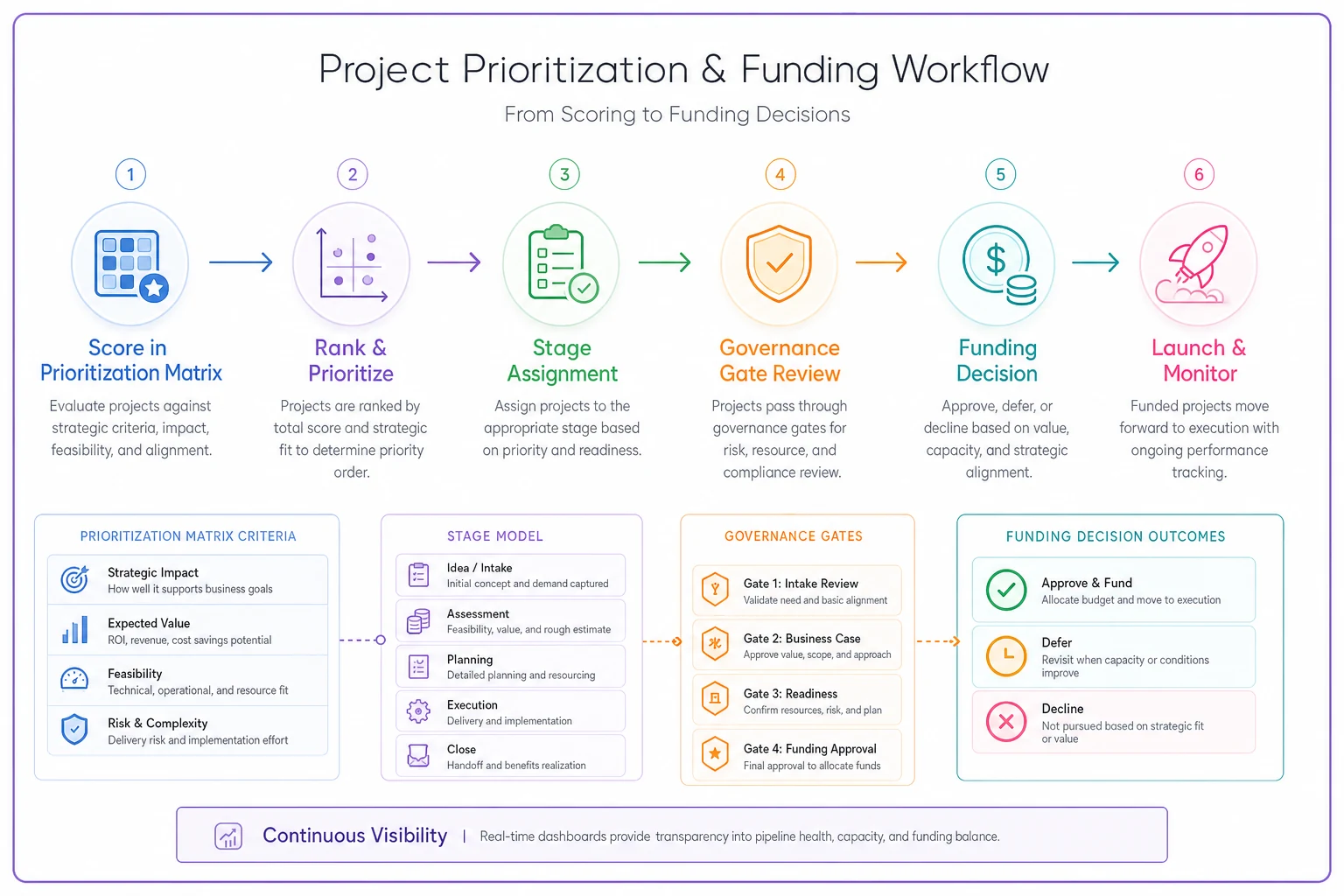
Score each candidate 1–5 on every factor, apply the weights, and you get a ranked list that isn't based on politics. The useful part isn't the math — it's the conversation it forces. When someone insists their pet project should jump the queue, you point at the matrix and ask which score they're disputing.
One factor most teams underweight: dependency. A mid-sized employer once ranked a self-service deductions portal as their top project because employees kept emailing about pay discrepancies. But every one of those discrepancies traced back to inconsistent data definitions upstream. Fixing the portal first would've just put a nicer window on a broken foundation. The matrix surfaced that the data cleanup — boring, invisible, unglamorous — had to go first because three other projects depended on it. This is exactly the kind of foundational work covered in why a canonical payroll data strategy matters for HR and finance reporting, and it's almost always ranked lower than it should be.
When the matrix says "do nothing"
Sometimes the honest output is that a project scores low on everything. That's actually a win. A self-service feature that saves maybe two hours a month and carries integration risk isn't worth a funding fight. Killing weak candidates early is what gives your strong candidates credibility — nobody trusts a team that says everything is a priority.
Building an investment case that survives finance
Once you know what's first, the investment case has to translate operational pain into the language finance uses. The structure isn't complicated, but each piece has to hold up under questioning.
-
State the current cost in concrete terms. Not "payroll is inefficient." Instead: "Each cycle absorbs roughly 35–45 hours of manual correction and reconciliation across two FTEs. At a loaded rate, that's somewhere around $60k–$75k a year in effort that doesn't need to exist."
-
Quantify the risk you're buying down. Pull from your own incident history. "Over the last four quarters we had three off-cycle corrections and one near-miss on a tax deposit deadline. Each correction runs us a few thousand in rework plus the exposure if we'd missed."
-
Define the target state in outcomes, not features. "Reduce manual touch per cycle by half, eliminate the two most common error types, and give the controller a reconciliation sign-off that takes minutes instead of a day."
-
Lay out the staged spend. Phase it. A pilot, then a rollout, then a scale phase — each with its own go/no-go gate. Executives fund stages far more readily than monoliths.
-
Name the sponsor and the measure. Who owns this outcome, and what single number proves it worked? If you can't name both, the case isn't ready.
The step people skip most often is #2. Pulling real incident history is tedious, but it's the difference between "trust me, this is risky" and a number the audit committee recognizes. If you don't already have that history catalogued, that's its own small project — and worth doing before you ask for anything.
A note on honest numbers
Resist the urge to make the ROI look spotless. A case that claims an 18-month payback with a tidy round figure reads as invented. A case that says "we expect to recover most of the manual cost within two to three cycles, with the compliance benefit harder to quantify but real" reads as credible. Finance people have seen a thousand too-good-to-be-true business cases. Rough, honest ranges beat polished fiction every time.
The benefits-tracking dashboard: proving it actually worked
This is the part almost everyone neglects, and it's the single biggest reason payroll teams struggle to get their next investment approved. You got the money, you did the project, and then nobody ever confirmed whether the promised benefits showed up. So the next time you ask, you're starting from zero credibility.
A benefits-tracking dashboard closes that loop. It doesn't need to be elaborate — it needs to directly mirror the outcomes you promised in the investment case. If you said you'd cut manual correction hours in half, the dashboard tracks correction hours per cycle, with the baseline clearly marked.
-
Effort realized — manual hours per cycle, number of off-cycle corrections, reconciliation close time
-
Risk realized — control exceptions caught, near-misses, deadline adherence on deposits and filings
-
Adoption realized — percentage of transactions flowing through the new process vs. the old workarounds
That last bucket catches the quiet failures. A new automated process can look successful on paper while half the team keeps using the old spreadsheet because the new flow is awkward. If adoption is at 55% six months in, you didn't realize the benefit — you just added a tool. Tracking it keeps you honest.
One thing worth building in: tie every dashboard metric back to a specific line in the original investment case. If a metric doesn't map to something you promised, question whether it belongs. Dashboards that track everything end up telling you nothing. Keeping it to "only measure what we committed to" makes it readable for the sponsor who has four minutes to look at it.
Governance that ties projects to realized outcomes
The governance layer is what keeps the whole system credible over multiple budget cycles. Without it, the prioritization matrix gets quietly overridden, investment cases get approved on vibes, and benefits never get verified. It's the connective tissue — and where most mid-market teams are weakest, usually because they've never formalized who owns what.
A workable governance rhythm: candidate projects get scored on the matrix at a quarterly review. Funded projects get a named executive sponsor who signs off on the expected outcome. At defined gates — not just at the end — the sponsor reviews the benefits dashboard against the original case. If the numbers aren't tracking, the project gets adjusted or stopped, not quietly continued.
That stop-or-adjust gate is the whole point. Most organizations never kill a payroll project once it's funded, even when it's clearly underdelivering. Sunk-cost momentum carries it to completion regardless. Governance gates give the sponsor explicit permission — and an explicit moment — to pull the plug. For the deeper structure around roles, approvals, and ownership, the payroll governance framework for mid-market companies lays out the RACI and approval workflows that make these gates actually function instead of being a rubber stamp.
Governance checklist for executive sponsors
-
[ ] The project ranks where the prioritization matrix says it ranks — no queue-jumping without a documented reason
-
[ ] The investment case states current cost and risk in numbers pulled from real history
-
[ ] Target outcomes are defined as measurable results, not feature deliverables
-
[ ] A single named sponsor owns the outcome and will review the dashboard at each gate
-
[ ] Spend is staged with go/no-go gates, not approved as a lump sum
-
[ ] Baseline metrics are captured before the project starts (you can't prove improvement without a starting line)
-
[ ] The benefits dashboard maps every metric back to a specific promise in the case
-
[ ] Adoption is being measured, not assumed
-
[ ] There's an explicit condition under which the project gets stopped or reshaped
The item teams forget most often is capturing the baseline before they start. You cannot prove you cut correction hours from 40 to 20 if you never measured that it was 40 to begin with. Even a rough two-cycle sample beats nothing.
A real scenario: staged modernization at a 600-person employer
A regional services company with around 600 employees across a few states had the classic symptom — payroll "worked," but it consumed enormous hidden effort. Two payroll specialists were spending close to a full week each cycle on manual reconciliation and correcting the same recurring errors, mostly tied to inconsistent data coming from their time and benefits systems.
Their first instinct was to ask for a full platform replacement. Finance balked at the scope and cost, and the request sat for two budget cycles with no decision.
The reset was running everything through the prioritization matrix. The replacement project scored poorly on effort and dependency. A narrower project — standardizing upstream data definitions and automating the most error-prone reconciliation step — scored high on impact and low on risk. They built the investment case around that single phase: a baseline of roughly 70–80 combined hours per cycle on correction and reconciliation, a target to cut it by about half, and a compliance benefit from eliminating the two most frequent error types.
They got funded for the phase, not the platform. Within three cycles the dashboard showed correction hours down to the low 30s, and the off-cycle corrections that had been happening most quarters dropped to near zero. Adoption held above 90% because the new flow was genuinely easier than the spreadsheet it replaced.
The part that mattered most came after: because they'd tracked realized benefits against the original promise, their next request — automating a second category of exceptions — got approved in one meeting. The track record did the selling. This kind of exception-based staging is explored in depth in automate payroll by exception, which pairs naturally with the prioritization logic here.
When this playbook makes sense — and when it doesn't
This whole system is built for organizations with enough payroll complexity that investments are genuinely competing for limited budget. If you're running payroll for 30 people on a single clean system, a formal prioritization matrix and governance gates are overkill. Just fix the obvious thing.
It starts earning its keep somewhere around the point where you have multiple systems feeding payroll, more than one jurisdiction, and a finance function that scrutinizes spend. That's when the ad-hoc "squeakiest wheel" approach starts producing a pile of half-finished tools and no clear story about whether any of them paid off.
Who should not adopt the heavier version of this: teams in the middle of an active crisis. If you're currently missing deadlines or firefighting a control failure, you don't need a benefits dashboard — you need the fire out first. Stabilize, then build the investment discipline once you can think past the next cycle.
The underlying principle holds regardless of size, though. Rank honestly, fund in stages, measure what you promised, and close the loop before you ask for more. A payroll modernization playbook built that way doesn't just get this investment approved — it makes every investment after it easier to approve, because you've proven you can be trusted with the budget you already got.
Bringing it together
The teams that consistently get payroll investments funded aren't the ones with the most compelling slides. They're the ones who've turned funding into a repeatable, evidence-based system: a matrix that ranks without politics, investment cases grounded in real cost and risk, dashboards that confirm the benefit actually landed, and governance that gives the sponsor a real decision at every gate.
Start with the baseline. Rank what's in front of you. Fund one honest phase, prove it worked, and let the track record build. That's the whole game — and it's a lot more durable than hoping the next budget meeting goes your way.
Ready to simplify your payroll operations?
Join 2,000+ businesses using Payexly to reduce payroll overhead, ensure compliance, and enhance employee satisfaction.