

Most payroll teams don't fail their controls. They fail the gaps between their controls. A hire gets entered clean. Timecards look fine. The tax deposit clears. Every individual step passes, and then a $4,200 overpayment slips through because nobody owned the handoff between onboarding and the first pay run.
Control gaps rarely live inside a single process. They live in the seams. And when you map controls the way most teams do — one checklist per task, reviewed once a quarter — you end up with strong walls and no roof.
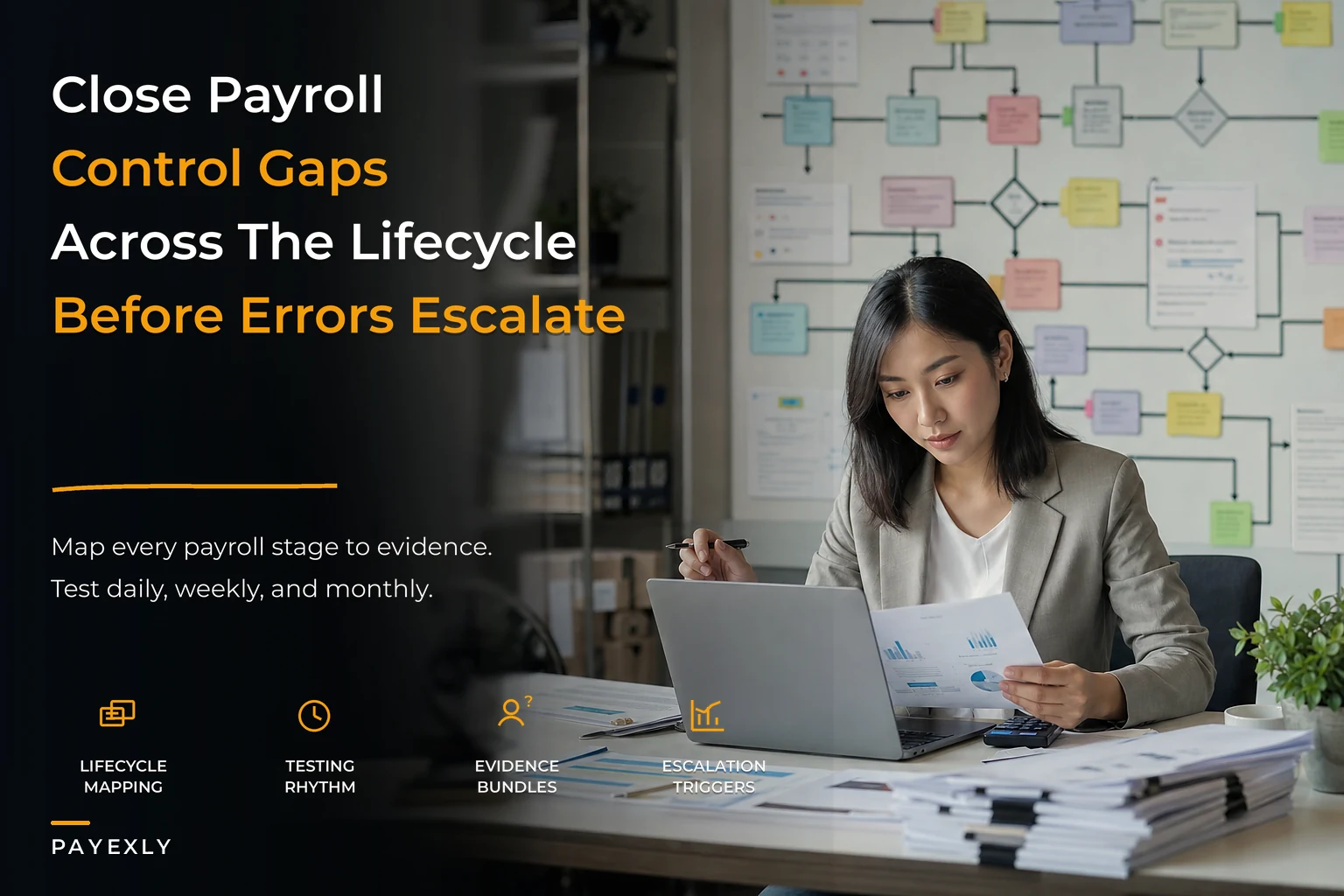
This is a systems piece. The goal is to show how the payroll lifecycle connects end-to-end, where control objectives should sit, what evidence you need to prove a control ran, and how to build a testing rhythm that catches drift before it hits a paycheck. If you're running end-to-end payroll controls and still feel surprised on payday, the problem is almost always structural.
Why control frameworks fall apart the moment payroll scales
At 30 employees, payroll runs on human memory. Someone knows the new sales hire started mid-cycle, so they eyeball the proration. That memory is the control. Undocumented, but it works because one person sees the whole picture.
At 300 employees across three states, that same approach quietly collapses. The person entering new hires isn't the person running the pay calc, who isn't the person filing taxes, who isn't the person reconciling to the GL. Each of them trusts that the upstream step was clean. That trust is the gap.
What breaks at scale isn't the individual tasks — it's coordination. A typical pattern:
-
Onboarding enters a bonus as recurring instead of one-time
-
The pay calc runs it correctly (garbage in, garbage out — but technically "correct")
-
The reviewer approves because the numbers reconcile to the input
-
Three cycles later, someone notices an employee got paid a $2,500 bonus twice more
Every control "passed." No single control was designed to catch a bad handoff. Bolting more checklists onto a broken lifecycle map rarely helps.
Start by mapping lifecycle stages to control objectives
Here's a working structure for the core payroll lifecycle. Most control objectives sit at transitions, not inside stages.
Eliminate payroll errors and delays.
Payexly streamlines every payroll cycle ensuring accuracy and compliance.
- Automated payroll processing
- Real-time tax compliance
- Benefits & deductions management
No credit card required
| Lifecycle Stage | What Can Break | Control Objective | Owner |
|---|---|---|---|
| Hire / status change | Wrong classification, wrong pay rate, duplicate record | New/changed records match source HR approval before first pay | HR + Payroll |
| Time & attendance | Missing punches, unapproved overtime, timecard held open | All hours approved by manager before cutoff | Managers |
| Pay calculation | Bad proration, one-time vs recurring errors, retro miscalc | Calc inputs traced to an approved source document | Payroll |
| Review & approval | Rubber-stamp approvals, no variance check | Reviewer confirms variance against prior cycle, not just internal math | Payroll lead |
| Disbursement | Duplicate payments, wrong bank details | Payment file matches approved register, dual control on changes | Payroll + Finance |
| Tax deposit & filing | Late deposit, wrong jurisdiction, wrong rate | Deposits reconciled to liability before submission | Finance |
| GL posting | Misclassified accounts, unbalanced entries | Payroll register ties to GL within tolerance | Accounting |
The mistake most teams make is writing control objectives that describe the task ("run the pay calc") instead of the risk ("no calc input exists without an approved source document"). A control objective should be phrased so a stranger could tell you whether it was met.
Worth calling out: the transition rows — hire→pay, calc→approval, disbursement→GL — are where the majority of real errors live, but they're almost never assigned a named owner. If a control objective doesn't have one person accountable for it, it isn't really a control. It's a hope.
Evidence bundles: proving the control actually ran
A control you can't prove ran didn't run. This is the part teams resist most, and it's also where audits, tax notices, and internal disputes get won or lost.
An evidence bundle is a small, pre-defined set of artifacts that proves a specific control operated for a specific cycle. Not a folder of everything — a curated package tied to one control objective. When you get a payroll tax notice and need to respond fast, the difference between a two-hour reply and a two-week scramble is whether these bundles already exist.
Here's what a solid bundle looks like for the disbursement control ("payment file matches approved register"):
-
The approved payroll register (with approver name and timestamp)
-
The generated bank/ACH file
-
A reconciliation showing register total = file total, with any variance explained
-
A log of any post-approval changes to the file, and who made them
-
Sign-off confirming dual control was applied to bank detail changes
Build the bundle definition once, per control, and make collecting it part of the workflow — not a month-end archaeology project. Teams that assemble evidence after the fact always find one artifact missing, and it's always the one the auditor asks for first.
When you get a payroll tax notice and need to respond fast, the difference between a two-hour reply and a two-week scramble is whether these bundles already exist.
On scope: you don't need evidence bundles for every micro-step. Prioritize controls tied to money leaving the building (disbursement, tax deposits), controls tied to compliance filings, and controls that have actually failed before. Your incident history is your best prioritization signal. Trying to bundle everything is how teams burn out and quietly stop doing it at all.
The testing calendar: daily, weekly, monthly, tied to escalation
A control map tells you what should be true. Testing tells you whether it actually is. Most teams test controls quarterly — which means a broken control can run wrong for up to 90 days before anyone checks. That's a lot of paychecks.
PAYROLL CONTROL TESTING RHYTHM Daily ────────────────────────────────────────────── [Access & change review] → flag → approval match? ↓ yes: log ↓ no: escalate (L2) [Open timecard exceptions] → past cutoff? ↓ no: continue ↓ yes: manager alert [Bank detail change queue] → any changes in 24hrs? ↓ no: log ↓ yes: second review Weekly ───────────────────────────────────────────── [Variance scan] → outside tolerance? ↓ no: document ↓ yes: explain or flag [Duplicate detection] → match found? ↓ no: clear ↓ yes: hold + review [Correction backlog] → aging past SLA? ↓ no: monitor ↓ yes: escalate (L2) Monthly ──────────────────────────────────────────── [GL tie-out] → within tolerance? ↓ yes: sign off ↓ no: stop + resolve (L3) [Tax liability vs deposits] → matched? ↓ yes: document ↓ no: escalate (L3) [Control sampling] → evidence bundles complete? ↓ yes: archive ↓ no: gap log + fix
A simple visual of this rhythm can clarify responsibilities and escalation.
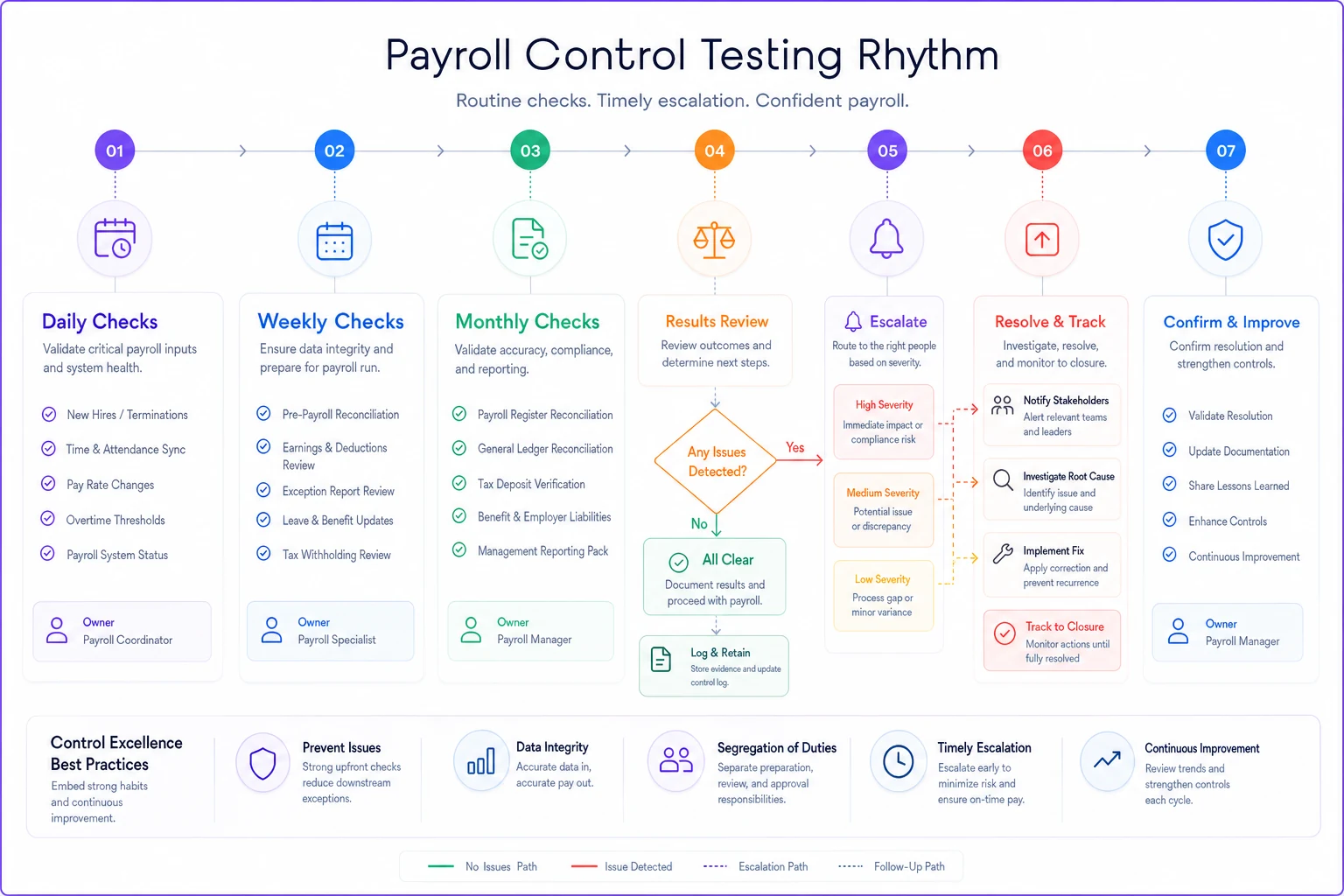
Daily checks (fast-failing, high-impact)
-
Access & change review — any new payroll changes since yesterday, flagged against approvals. Unauthorized changes are the fastest path to fraud and error, which is why role-based access and audit-trail cadence belongs at the daily layer, not the quarterly one.
-
Open timecard exceptions — anything unapproved past cutoff gets escalated to the manager before it hardens into a pay error.
-
Bank detail change queue — any employee banking change in the last 24 hours gets a second set of eyes.
Weekly checks (trend and drift)
-
Variance scan — compare this cycle's totals by department against the prior cycle. Anything outside tolerance needs a note explaining why.
-
Duplicate detection — same name, same amount, same account flagged for review.
-
Pending correction backlog — how many retro items are unresolved, and are any aging past SLA?
Monthly checks (structural)
-
Payroll-to-GL tie-out — register totals reconciled to posted GL, within a defined tolerance.
-
Tax liability vs deposits — confirm every deposit matched the calculated liability.
-
Control sampling — pull 5–10 transactions and walk them through the full lifecycle, checking that each control's evidence bundle exists and is complete.
The piece most calendars skip entirely: synthetic test runs. Before a rate change, a new state, or a major system update, run a fake pay cycle with known inputs and confirm the outputs match expectations. If you're not already doing this, the approach in payroll regression tests and synthetic pay runs is the cleanest way to catch a broken control before it touches a real employee.
Escalation triggers
-
Level 1 (log and monitor) minor variance within tolerance, documented and moved on
-
Level 2 (same-day review) unauthorized change, duplicate flag, timecard past cutoff
-
Level 3 (stop-the-run) disbursement file doesn't match register, tax deposit mismatch, GL out of tolerance beyond threshold
Level 3 triggers pause the cycle. Not "we'll fix it next time." If the payment file doesn't tie to the register, the run doesn't go out. Teams that treat Level 3 as advisory eventually end up explaining a large mispayment to a very unhappy executive.
A real scenario: where the gaps actually show up
A regional home-services company — roughly 240 employees, four states, bi-weekly payroll — kept catching errors after pay ran. Nothing catastrophic individually. A missed overtime rate here, a bonus coded recurring there, a state deposit sent to the wrong jurisdiction once.
When they mapped it out, the pattern was obvious in hindsight: controls were all inside stages, none at the transitions. The pay calc always ran correctly on whatever it received. The reviewer always confirmed the internal math. Nobody owned "does the input match the approved source."
They didn't add more people. They added a variance scan at the weekly layer, a daily access-change review, and pre-defined evidence bundles for disbursement and tax deposits. Post-payroll corrections dropped from somewhere in the low double digits per cycle to two or three. The bigger win was quieter — the payroll lead stopped spending the two days after each run hunting for what went wrong.
Somewhere in the range of $6k–$9k a year in recovered overpayments and correction labor. But honestly, the real return was the team no longer running payroll on adrenaline.
When this level of structure makes sense — and when it doesn't
Worth building out when:
-
You're past roughly 75 employees, or operating across multiple states
-
Payroll ownership is split across more than one person
-
You've had a tax notice, an audit finding, or a mispayment dispute in the past year
-
You're heading toward a financing event, acquisition, or serious growth
Probably overkill when:
-
Small single-state team where one person genuinely sees the whole cycle
-
Very stable headcount with few status changes
-
You'd be building elaborate evidence bundles for controls that have never once failed
One thing worth saying directly: if your underlying payroll data is a mess — inconsistent codes, no clean source of truth for pay rates — fix that first. A testing calendar built on unreliable inputs just tests unreliable inputs faster. Get the data trustworthy, then layer controls on top of it.
Where software quietly earns its keep
None of this requires sophisticated tooling to design. You can build the control map, evidence bundle definitions, and testing calendar in a spreadsheet. The problem is sustaining it. Manual variance scans get skipped during busy weeks. Evidence collection slides. The calendar becomes aspirational.
That's the honest case for AI-assisted payroll operations software: not to replace judgment, but to make the repetitive parts of a control system actually happen every cycle. Automation that flags daily access changes, surfaces variance outliers, and assembles evidence bundles as the workflow runs means the artifacts exist when you need them — instead of being reconstructed under pressure. The controls are still yours. The system just keeps them from quietly decaying the moment the team gets stretched thin, which is exactly when errors slip through.
Bringing it together
Payroll errors that survive to payday almost never come from a single broken step. They come from unowned handoffs, controls tested too infrequently to matter, and evidence that only gets assembled after something's already gone wrong.
Map the lifecycle to real control objectives — especially at the transitions. Define lean evidence bundles for the controls tied to money and compliance. Layer your testing across daily, weekly, and monthly rhythms, and wire in escalation triggers that can actually stop a bad run. Do that consistently, and end-to-end payroll controls stop being a binder you show auditors once a year and start being the thing that catches the $4,200 overpayment before it ever goes out the door.
Map the lifecycle to real control objectives — especially at the transitions. Define lean evidence bundles for the controls tied to money and compliance. Layer your testing across daily, weekly, and monthly rhythms, and wire in escalation triggers that can actually stop a bad run. Do that consistently, and end-to-end payroll controls stop being a binder you show auditors once a year and start being the thing that catches the $4,200 overpayment before it ever goes out the door.
Ready to simplify your payroll operations?
Join 2,000+ businesses using Payexly to reduce payroll overhead, ensure compliance, and enhance employee satisfaction.