

Most payroll "transformation" projects fail in a predictable way. Someone signs a big contract, sets a go-live date twelve months out, and the whole thing becomes a migration project instead of an improvement project. The team spends a year moving old problems into a new system, hits the deadline exhausted, and realizes the same reconciliation headaches, the same manual corrections, and the same "why did this employee get paid wrong again" conversations followed them right over.
The reason is almost never the software. It's sequencing. Payroll touches HR, finance, IT, tax, and every manager who approves a timecard. When you try to fix all of it at once, nothing gets fixed. A real payroll transformation roadmap breaks the mess into quarters, ties each quarter to a specific dataset and a specific dollar figure, and proves ROI before spending the next dollar.
This is how to build one that survives contact with a real budget cycle.
Why payroll transformation gets stuck
The core problem isn't complexity — it's that payroll data lives in too many places and nobody agrees on which copy is correct.
A mid-sized company usually has employee records in the HRIS, hours in a time system (sometimes two or three, if they acquired anyone), deductions in a benefits portal, tax setup inside the payroll engine, and cost center mappings living in a finance spreadsheet that one person maintains and everyone quietly depends on. When those sources disagree, payroll becomes a reconciliation job before it's a payment job.
What you see across a lot of finance teams is that the "transformation" they think they need — a new payroll platform — is actually downstream of a data problem they've never named. If you can't answer "what is the single correct value for this employee's department, pay rate, and deduction set right now," a new system won't help. It'll just give you a nicer interface on top of the same disagreement.
That's why the first move in any serious roadmap is establishing canonical data. It's not glamorous, and it doesn't show up in a demo, but it's the thing that makes everything after it possible. If you haven't thought about this layer yet, it's worth understanding why a canonical payroll data strategy matters for HR and finance reporting before you scope anything else.
What breaks when you skip the sequencing
Companies that jump straight to implementation tend to break in the same three spots.
Eliminate payroll errors and delays.
Payexly streamlines every payroll cycle ensuring accuracy and compliance.
- Automated payroll processing
- Real-time tax compliance
- Benefits & deductions management
No credit card required
First, the pilot is too big. They pick their most complex population — union employees, multi-state remote workers, a division with weird shift differentials — because "if it works there, it works everywhere." It never works there, because that's exactly where all the undocumented rules live. The pilot stalls, confidence drops, and the project gets a bad reputation before it's proven anything.
Second, there's no baseline. Six months in, someone asks "is this actually saving us money?" and nobody can answer, because they never measured what payroll cost before. Manual correction hours, off-cycle check volume, reconciliation time, penalty notices — none of it was tracked. You can't show ROI against a number you never captured.
Third, the integrations are assumed, not tested. Two systems "talk to each other" until the day a field changes shape and a batch silently drops records. If your source systems don't have enforced contracts, every quarter you'll be firefighting a new breakage. Formalizing payroll data contracts and APIs with field-level templates and versioning rules turns "we think the feed works" into something you can actually test.
The pattern underneath all three: teams treat transformation as an event instead of a sequence of provable stages.
The roadmap structure: four quarters, four proof points
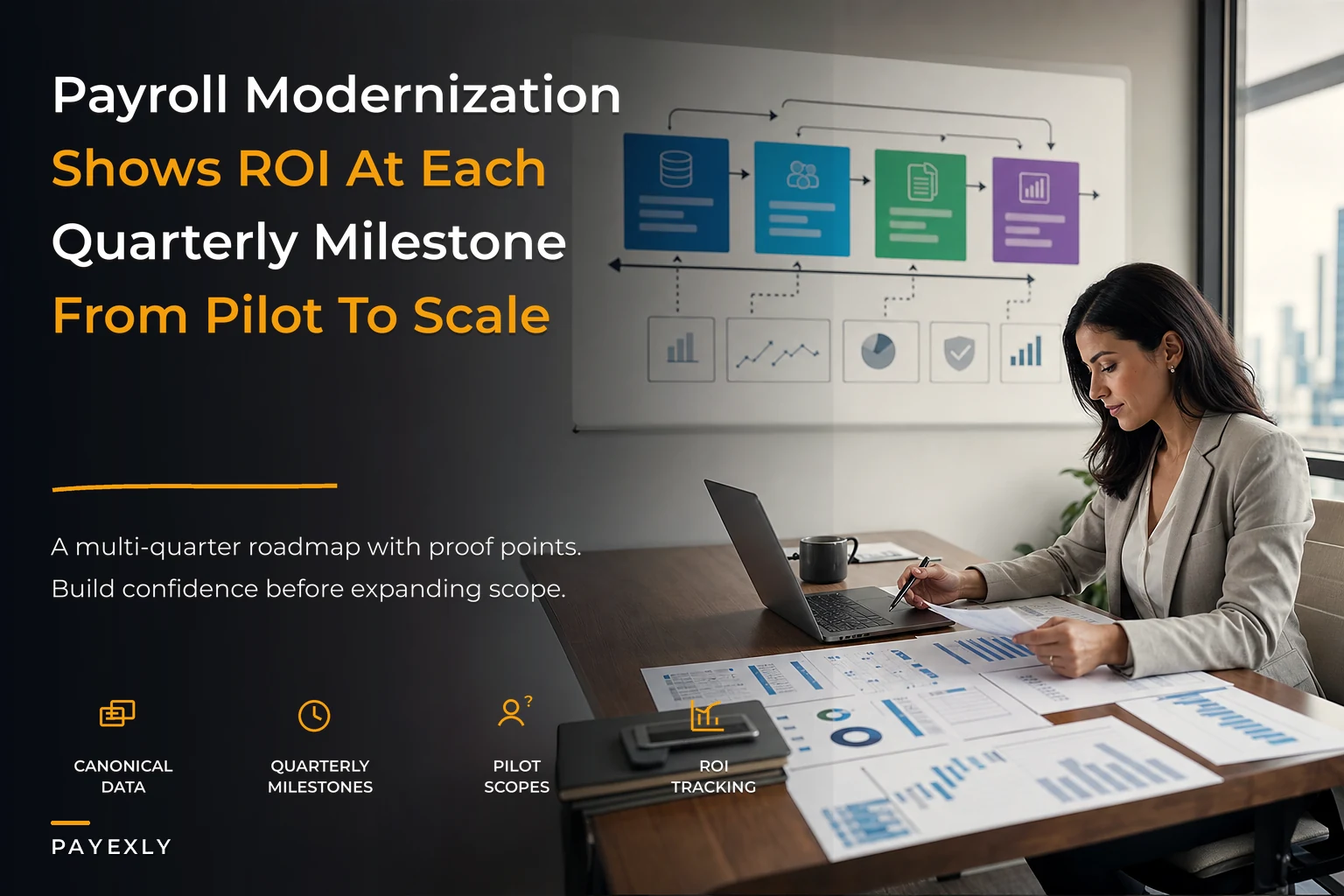
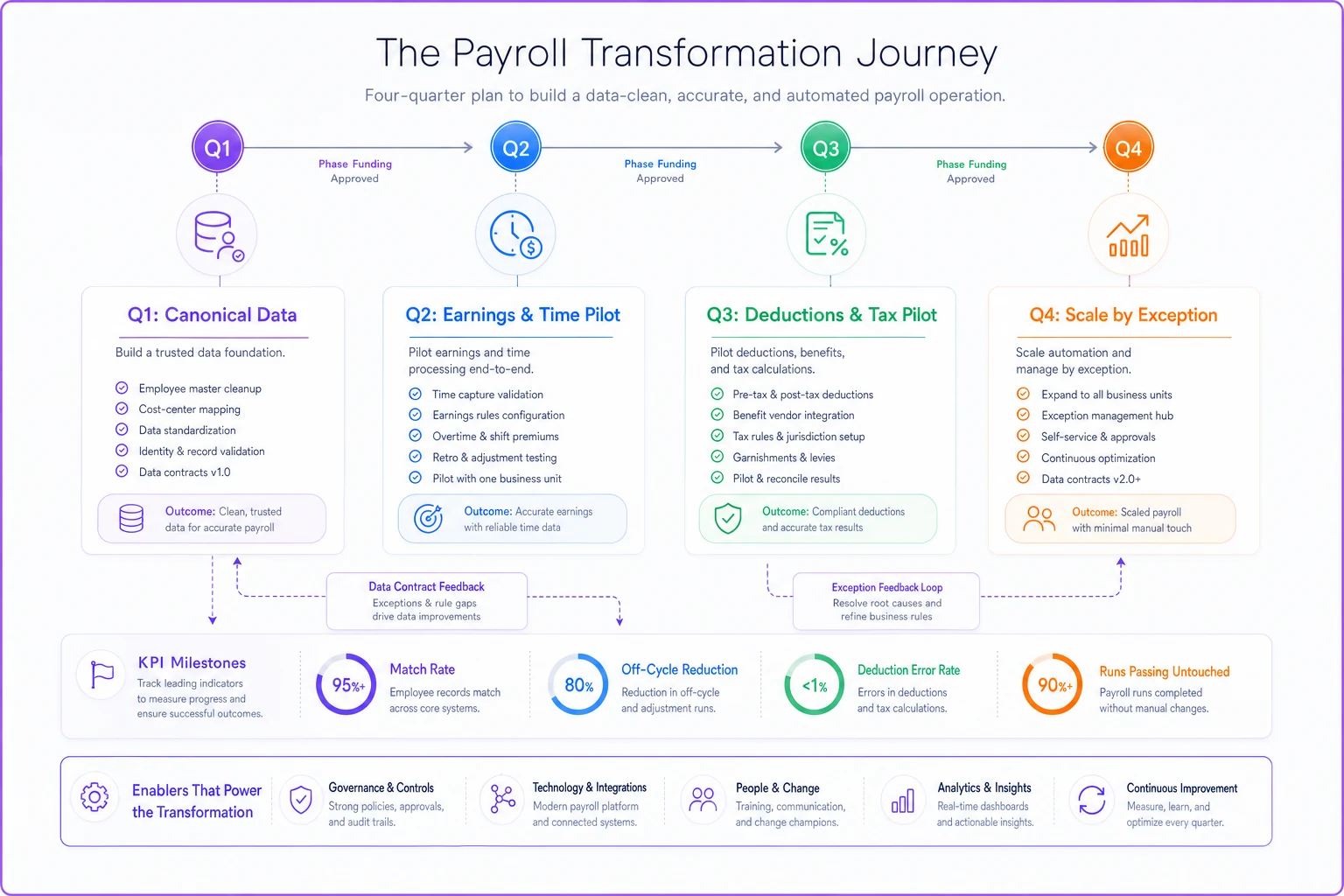
Think of the roadmap as four connected phases, each with its own dataset, its own narrow pilot, and its own KPI you can put in a business case. Each phase funds the next.
| Quarter | Primary focus | Canonical data locked | Pilot scope | KPI milestone | Typical realized ROI |
|---|---|---|---|---|---|
| Q1 | Foundation | Employee master + org/cost center mapping | One clean, mid-complexity department | Data match rate across sources hits ~98% | Fewer manual corrections; reduced reconciliation hours |
| Q2 | Earnings & time | Hours, rates, differentials | Two departments incl. one with variable pay | Off-cycle checks down 30–40% | Reduced rework and banking fees |
| Q3 | Deductions & tax | Benefits deductions, tax setup | Multi-state or multi-benefit group | Deduction error rate under 1% | Fewer notices, cleaner filings |
| Q4 | Scale & exception handling | Full population canonical layer | Company-wide, exception-based review | 60–70% of runs pass with no manual touch | Time savings compound; audit prep shrinks |
The table looks tidy, but the real work is messier. Each quarter uncovers something you didn't plan for. That's fine — the point of sequencing is that a surprise in Q2 costs you weeks, not a whole failed rollout.
This diagram shows the four-phase workflow and how each phase funds the next.
Each quarter uncovers something you didn't plan for. That's fine — the point of sequencing is that a surprise in Q2 costs you weeks, not a whole failed rollout.
Quarter 1 — Foundation before features
Quarter 1 — Foundation before features
Don't touch the payroll engine yet. Q1 is entirely about building one trusted employee master and one agreed cost-center map.
The work is unglamorous: pull the same 200-record sample from every source and reconcile it by hand the first time so you understand why they disagree. Usually you'll find terminated employees still active in one feed, department codes renamed in finance but not HR, or rate fields rounded differently across two systems.
Your KPI is a match rate — the percentage of records where every source agrees on the fields that matter. Getting from a starting point of maybe 88–90% up to around 98% is the whole game in Q1. That gap is where your manual corrections and your surprise reconciliations come from.
A realistic Q1 checklist:
-
Identify the authoritative source for each core field (rate, department, status, tax profile)
-
Pull a matched sample across all systems and quantify disagreements
-
Document the reason for each mismatch type, not just the count
-
Set the match-rate baseline and the target
-
Agree, in writing, on who owns each field going forward
That last point causes more arguments than anything technical. When HR and finance both think they own "department," you get drift. Naming one owner per field is half the fix.
Name one owner per field to prevent drift between HR and finance.
That last point causes more arguments than anything technical. When HR and finance both think they own "department," you get drift. Naming one owner per field is half the fix.
Quarter 2 — Earnings and time, on a narrow pilot
Quarter 2 — Earnings and time, on a narrow pilot
Now you run a real pilot, but keep it small. Two departments — one straightforward salaried group and one with variable pay (overtime, shift differentials, whatever your version of "messy hours" is).
The reason you include one messy group is that variable pay is where your undocumented rules are hiding. A common example: a company discovers during the Q2 pilot that their overtime calculation for one shift pattern had been quietly wrong for years, corrected manually each cycle by a payroll admin who "just knew" to fix it. That knowledge was never written down anywhere. The pilot forces it into the open.
Your milestone is off-cycle check volume. Off-cycle runs are the clearest signal of payroll going wrong the first time — every one of them is a mistake caught late, plus banking fees, plus someone's afternoon. Cutting them by a third in the pilot group is a very defensible number to bring to a CFO.
Quarter 3 — Deductions and tax, where compliance risk lives
Quarter 3 — Deductions and tax, where compliance risk lives
Deductions and tax setup are the phase most likely to generate penalties, so this is where the canonical work pays back in avoided pain rather than pure efficiency.
Pick a pilot group with real complexity — multi-state employees, or a population with layered benefit deductions and pro-rations. The goal is a deduction error rate under about 1%, because deduction errors are the ones that generate employee complaints and tax notices simultaneously.
The pattern to watch: mid-period benefit changes. When someone changes coverage mid-cycle, the pro-ration logic is where errors cluster. If your canonical layer from Q1 didn't nail down effective dates cleanly, this quarter is where that shortcut comes back around.
Quarter 4 — Scale by exception, not by headcount
Quarter 4 — Scale by exception, not by headcount
By Q4 the canonical layer covers the full population and the pilots have proven the rules. Scaling now isn't about processing more people — it's about processing them without touching each one individually.
The shift is from reviewing every pay run to reviewing only the ones that break a rule. Instead of a payroll admin eyeballing every record, they look only at the exceptions the system flags — the record that jumped 40% from last cycle, the new hire missing a tax profile, the deduction that doesn't reconcile. This exception-based model is where the time savings finally compound. For the mechanics of building that prioritization, the approach in automating payroll by exception, including the ROI calculator and acceptance tests maps directly onto this quarter.
Your milestone: the share of runs that clear with zero manual intervention. Getting 60–70% of routine pay events to pass untouched frees your team for the genuinely hard cases instead of grinding through the routine ones.
Building the business case at each stage
The reason to phase this way isn't just risk management — it's that each phase gives you a fresh, funded business case for the next one.
A simple business-case template for each quarter has five lines:
-
Baseline cost — hours, off-cycle volume, notices, or error rate before this phase
-
Intervention — the specific canonical work and pilot scope
-
Measured result — the KPI movement you actually observed
-
Dollarized impact — result translated into money (hours × loaded rate, fees avoided, penalties avoided)
-
Ask for next phase — what the next quarter needs, justified by what this one returned
The discipline here is that line 3 is measured, not projected. Projected savings get argued with. Measured savings from a real pilot get approved. A team that walks into a budget meeting saying "we cut off-cycle checks 35% in the pilot, here's the fee reduction, here's what Q3 needs" is in a completely different position than one asking for faith.
A real scenario
A regional healthcare group — roughly 600 employees across three states, a mix of salaried admin staff and hourly clinical workers on rotating shifts — had been through two payroll vendors in four years and still ran 15–20 off-cycle checks a month.
Their instinct was a third vendor. Instead they ran the sequenced roadmap. Q1 reconciliation surfaced that their cost-center map hadn't been updated after a small acquisition, so about 40 employees were being charged to a department that no longer existed — which was quietly breaking finance reporting every month. Fixing the canonical layer resolved that before any new software touched it.
By the end of Q2, off-cycle checks were down to around 8–10 a month. By Q4, most routine runs cleared without manual review, and their year-end close — which used to eat most of January — was mostly done by the second week. The interesting part: they never switched vendors. The problem was never the engine. It was the data feeding it and the order in which they tried to fix things.
When this approach makes sense — and when it doesn't
This makes sense when you have multiple source systems that disagree, a payroll team spending real hours on corrections, and a finance leader who wants proof before spend. The phased, measured approach is built exactly for that situation.
This is a bad fit when you're a small business with one clean payroll system and 20 employees. You don't need four quarters of transformation — you need to close your one gap and move on. Sequencing overhead only pays off when the mess is genuinely distributed across systems and teams.
Who should not run this: a team without an executive sponsor who'll protect the quarterly cadence. The single biggest killer of these roadmaps is pressure to skip the foundation quarter and "just go live." If leadership can't hold the line on Q1, the whole sequence collapses into a normal, doomed migration.
The thing most teams get backwards
The mistake underneath almost every failed payroll project is treating data cleanup as a task you do during implementation — squeezed in alongside configuration and testing. It never gets the attention it needs there, so it gets deferred, and the new system inherits the old disagreements.
Flip it. Canonical data is the foundation, not a subtask. The pilots prove the rules. The KPIs turn the work into a business case. The ROI at each stage buys you the credibility — and the budget — for the next one. Done in that order, payroll stops being the thing everyone dreads at cutoff and starts being something that mostly runs itself, with your team spending their time on the handful of cases that genuinely need a human.
That's the whole point of sequencing it: you're not trying to fix payroll in one heroic push. You're trying to make it a little more provable, a little more trusted, every quarter — until one day you realize the fires stopped.
Ready to simplify your payroll operations?
Join 2,000+ businesses using Payexly to reduce payroll overhead, ensure compliance, and enhance employee satisfaction.