



Pretax benefits look simple on a pay stub. You see a deduction, taxable wages go down, and everyone moves on. But underneath that clean-looking line item is a payables account that has to zero out, a tax basis that has to match what actually hit the W-2, and a remittance timing gap that almost nobody watches until an auditor or a benefits vendor starts asking questions.
The problem isn't that pretax benefits payroll mapping is hard. It's that the errors don't show up in the current period. A 401(k) deferral posted to the wrong liability account, or an HSA employer contribution booked as expense instead of a payable, sits there looking fine for months. Then the funding file to the HSA custodian is short, or the Section 125 account carries a growing balance nobody can explain, and now you're reconstructing eight pay periods to figure out where $2,300 went.
This piece is narrow on purpose — it's about the ledger side of payrolled benefits, specifically pretax plans and HSAs, and how to keep the GL clean enough that month-end close doesn't turn into forensic accounting.
Where the balance sheet actually breaks
Most pretax deduction problems trace back to one of three places, and they're all boring in isolation.
The first is the liability account never clearing to zero. Every pretax deduction — medical premium, dependent care FSA, 401(k), HSA employee contribution — should hit a payables account when withheld, and that account should drain to zero when the money is remitted to the plan or carrier. When the deduction amount and the remittance amount don't match, the account carries a residual. A few dollars here, a rounding issue there, and within a quarter you've got a Section 125 payable with a $600 balance and no idea whether it's owed to the carrier, owed back to an employee, or just a mapping mistake.
The second is employer contributions booked on the wrong side. Employer HSA contributions and employer 401(k) match are expenses AND liabilities until funded. The common mistake is expensing them and skipping the payable, so the P&L looks right but the funding obligation never sits on the balance sheet. When the funding file runs, cash goes out against nothing. Now you've got a reconciling item.
The third is tax treatment mismatches between the deduction code and the wage base. This one is sneaky. A deduction can be mapped correctly in the GL and still be wrong for tax purposes. HSA contributions through a cafeteria plan are exempt from federal income tax, Social Security, and Medicare. But if the deduction code is flagged pretax-federal-only and not exempt from FICA, the employee overpays Social Security and Medicare, the employer overpays its match, and the W-2 Box 1/3/5 relationships don't tie out at year-end.
A field-by-field mapping that actually holds up
The mapping most payroll systems ship with is close enough to look right and wrong enough to cause problems. Here's how the common pretax items should sit, with the tax treatment attached — because the GL account and the tax flag have to be decided together, not separately.
Eliminate payroll errors and delays.
Payexly streamlines every payroll cycle ensuring accuracy and compliance.
- Automated payroll processing
- Real-time tax compliance
- Benefits & deductions management
No credit card required
| Benefit item | GL account (debit/credit at withholding) | Fed income tax | FICA (SS/Med) | State (typical) | Notes |
|---|---|---|---|---|---|
| 401(k) employee deferral | Cr: 401(k) Payable | Exempt | Taxable | Exempt | FICA still applies — common miss |
| Roth 401(k) | Cr: Roth 401(k) Payable | Taxable | Taxable | Taxable | Not pretax; keep separate account |
| Section 125 medical premium | Cr: Cafeteria Plan Payable | Exempt | Exempt | Usually exempt | Fully pretax under 125 |
| Dependent care FSA | Cr: DCFSA Payable | Exempt | Exempt | Exempt | $5,000 annual cap matters for W-2 Box 10 |
| Health FSA | Cr: Health FSA Payable | Exempt | Exempt | Exempt | Uniform coverage rule affects funding timing |
| HSA — employee (via 125) | Cr: HSA Payable | Exempt | Exempt | Most states exempt (CA/NJ differ) | Reports in W-2 Box 12 code W |
| HSA — employer contribution | Dr: Benefit Expense / Cr: HSA Payable | Exempt | Exempt | Most states exempt | Also Box 12 code W |
| Commuter (transit/parking) | Cr: Commuter Payable | Exempt to limit | Exempt to limit | Varies | Monthly IRS limits; excess is taxable |
Two things worth calling out. State treatment isn't uniform — California and New Jersey treat HSA contributions as taxable for state income tax even though they're federally exempt. If you run payroll across those states with a single deduction code and no state override, your state wage bases will be understated. And Roth deferrals get lumped into the same "retirement" bucket constantly. They're after-tax. They need their own payable and their own tax flags, or your 401(k) reconciliation will never tie to the recordkeeper file.
What the journal entries actually look like
Abstract mappings don't help much until you see them run through a period. Take a single semi-monthly pay run for a small employer — say 40 employees — with the following pretax activity:
-
401(k) employee deferrals
$6,400
-
Section 125 medical premiums (employee share)
$3,100
-
HSA employee contributions
$1,800
-
HSA employer contributions
$1,200
-
Employer 401(k) match
$3,200
At the pay run (recording the withholding and employer obligations):
Dr Salaries & Wages Expense (gross wages) Dr Benefit Expense — HSA ER 1,200 Dr Benefit Expense — 401(k) Match 3,200 Cr 401(k) Payable 9,600 (6,400 EE + 3,200 match) Cr Cafeteria Plan Payable 3,100 Cr HSA Payable 3,000 (1,800 EE + 1,200 ER) Cr Cash / Net Pay Clearing (net pay) Cr Payroll Tax Liabilities (ER + EE taxes)
The deferral and the match land in the same 401(k) payable because they fund together to the same recordkeeper. The HSA payable combines employee and employer for the same reason — the custodian file is one number. That's deliberate. The account structure should mirror how money actually leaves the building.
When you fund the HSA custodian ($3,000):
Dr HSA Payable 3,000 Cr Cash 3,000
That payable should now read zero for the period. If it doesn't, something upstream is off — either a deduction didn't post, or the funding file included a correction from a prior period. Either way, the residual is your early warning.
The mistake that shows up constantly: the employer HSA contribution gets booked straight as Dr Benefit Expense / Cr Cash at funding, skipping the payable entirely. It nets to the same cash outcome, so nobody notices. But the obligation never appeared on the balance sheet between accrual and funding, and if the pay run and the funding cross a month-end, the accrual is simply missing. Your benefit expense for the month is understated by whatever hadn't funded yet.
The tax-treatment checklist that prevents W-2 surprises
Ledger accuracy and tax accuracy are different problems that happen to share a deduction code. You can reconcile every payable to zero and still hand out wrong W-2s. Run this against every pretax code — ideally at setup, and again before year-end:
-
Is the FICA flag correct? 401(k) and Roth deferrals are FICA-taxable. Section 125 items and HSA (via 125) are FICA-exempt. Getting this backward is the single most common cause of Box 3/5 not matching Box 1.
-
Does the code map to the right W-2 box? HSA contributions (employee and employer combined) go in Box 12, code W. DCFSA goes in Box 10. Missing these means corrected W-2s later.
-
Are state overrides in place where treatment differs? Check the states where you actually pay people, not a generic default. HSA and sometimes commuter treatment vary.
-
Are commuter and DCFSA limits enforced? Amounts over the IRS monthly transit/parking limit or the $5,000 DCFSA cap become taxable. If the deduction code doesn't cap, you're under-taxing the excess.
-
Is Roth separated from traditional? After-tax deferrals in a pretax code corrupt both the tax base and the recordkeeper reconciliation.
-
Does the taxable wage base recompute after the deduction, not before? Order of operations matters — a pretax deduction has to reduce the applicable wage base in the same run, not the next one.
The reason this checklist matters more than it looks: tax errors compound silently across every pay period but only surface at year-end when the totals are locked. A FICA-flag mistake caught in January costs a few minutes to fix. The same mistake caught during W-2 prep in January of the next year means corrected returns, amended 941s, and refunding overwithheld Social Security to employees who've since left.
A real scenario
A regional home-services company — around 55 employees, payroll run in-house on a mid-tier system — offered HSAs through a cafeteria plan with both employee and employer contributions. Their HSA deduction code was set up as pretax for federal income tax but was never flagged FICA-exempt.
For about seven months, every HSA dollar was hit with Social Security and Medicare it shouldn't have been. On the employee side, roughly $1,800 per period in contributions across the group meant a small per-person overwithholding — a few dollars each, easy to miss on a stub. On the employer side, the company overpaid its FICA match on those same contributions. The combined over-remittance ran somewhere in the $2,600–$3,100 range by the time it surfaced during a benefits reconciliation, when the HSA custodian's funded totals didn't line up with the taxable-wage math.
The fix wasn't complicated once found: correct the deduction code's FICA flag, recompute the affected wage bases, adjust the quarterly 941, and refund the overwithheld employee amounts. But it took the better part of a week to reconstruct, because nobody had a month-end check confirming that the pretax payable and the tax treatment agreed. The ledger side had actually been fine — the payable cleared every period. It was purely a tax-flag problem hiding behind a clean-looking GL.
Month-end sign-off checkpoints
The whole point of a close checklist here is to catch the silent errors while they're still small. These are the specific pretax/HSA checks worth building into your monthly sign-off, separate from the general payroll-to-GL reconciliation:
-
Every pretax payable clears to zero (or a known, documented residual). 401(k), Section 125, FSA, HSA, DCFSA, commuter. A residual is fine only if you can name what it is and when it funds.
-
Employer contribution accruals exist for anything not yet funded at cutoff. If the pay run posted but the HSA or 401(k) funding runs next month, the payable should still be sitting on the balance sheet.
-
Funding files reconcile to the deduction totals. The amount sent to the custodian or recordkeeper equals the amount withheld plus employer contributions for the period. Any variance gets explained before sign-off.
-
YTD taxable wage bases tie to the deduction activity. Spot-check that pretax deductions actually reduced Box 1 wages and that FICA-taxable items (deferrals) didn't.
-
State wage bases reflect state-specific treatment. Especially for HSA in states that tax it.
For the fuller reconciliation discipline that this sits inside — field mappings, tolerances, and exception handling when something doesn't tie — the month-end payroll-to-GL reconciliation SOP covers the surrounding process. And when a pretax mapping error requires reaching back into prior periods to correct wages and filings, the mechanics of doing that cleanly are worth reviewing in retroactive pay corrections, because a botched correction on a pretax item creates a second reconciling mess on top of the first.
Visualizing the month-end sign-off as a short workflow helps teams own the checkpoints without redoing the whole reconciliation.
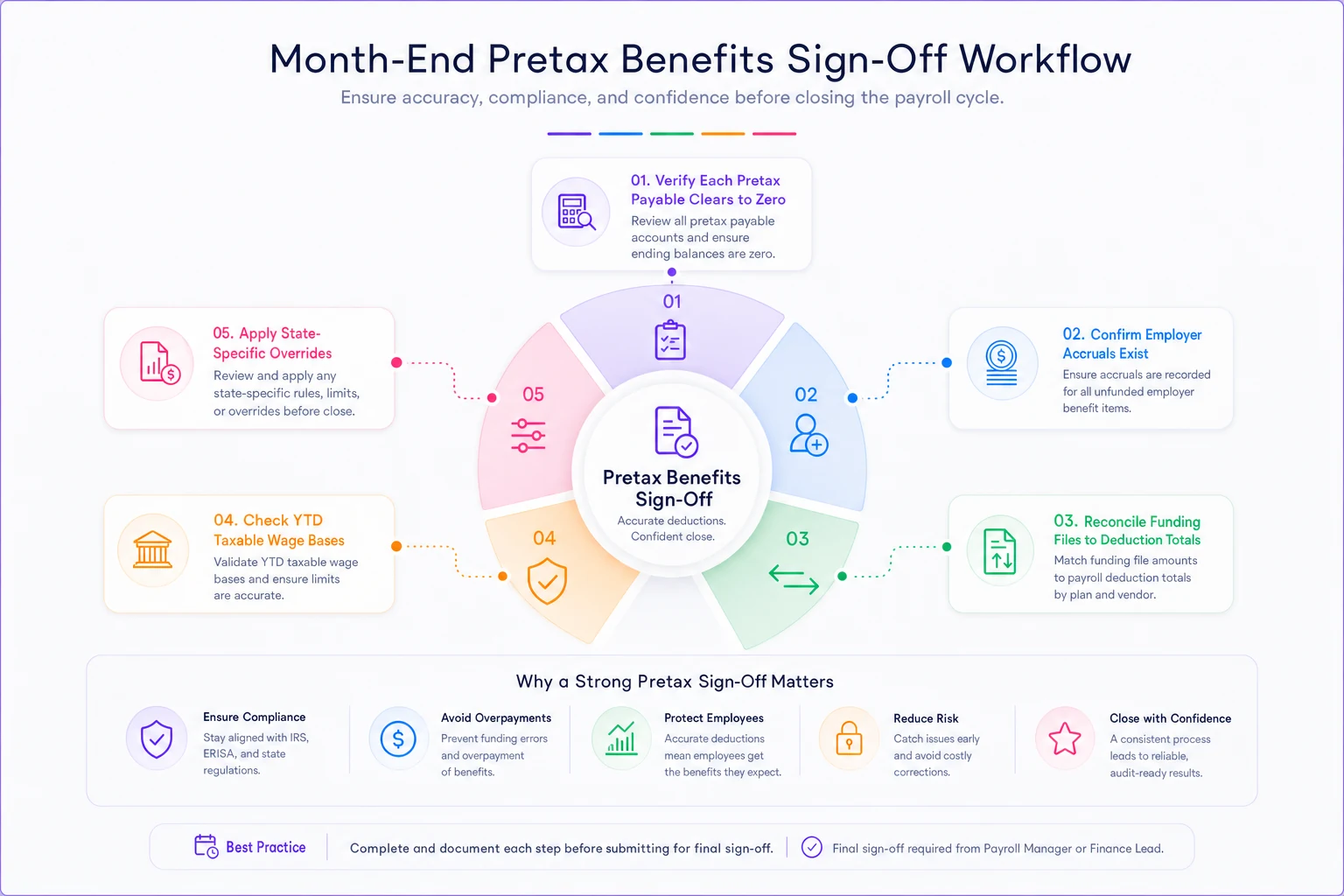
When you document a residual, include the funding date or expected correction so the next month’s reviewer can close it out quickly.
A concise, repeatable checklist that sits in the monthly close package prevents these issues from growing silently into costly reconstructions.
Where automation earns its place — and where it doesn't
There's a natural point where doing these checks by hand stops scaling. Once you're past a handful of pretax codes across multiple states, the tax-flag-versus-GL-account matrix has too many cells to eyeball every month. Operational payroll software that validates the mapping continuously — flagging a payable that didn't clear, or a deduction code whose FICA flag disagrees with its plan type — actually pays for itself here. Not by replacing the reconciliation, but by turning it from a monthly reconstruction into an exception review: instead of checking every account, you're only looking at the two or three the system flagged.
That said, automation doesn't fix a bad initial setup. If the HSA code was flagged wrong at configuration, an automated check will faithfully reconcile a wrong number to a wrong number all year. The tax-treatment checklist above is a setup and periodic-audit task that a human still has to own. Tooling catches drift; it doesn't catch a mapping that was wrong from day one.
The part worth remembering
Pretax benefits break the ledger in slow motion. The deduction posts, the stub looks right, the P&L looks reasonable, and the errors accumulate in payables and tax bases that nobody looks at until close forces the question. Two things keep this clean, and both are necessary: the GL account has to mirror how money actually funds out, and the tax flags have to match the plan type — and those two decisions get made at the same time, for the same deduction code, or they drift apart.
Get the mapping right once, build the payable-clears-to-zero check and the FICA-flag audit into your monthly rhythm, and pretax benefits become the boring line item they're supposed to be instead of the thing you're reconstructing during a year-end scramble.
Ready to simplify your payroll operations?
Join 2,000+ businesses using Payexly to reduce payroll overhead, ensure compliance, and enhance employee satisfaction.