



The most expensive 401(k) mistakes don't happen at the plan level. They happen in the 15 minutes between a pay run finalizing and the deferral file getting pushed to the recordkeeper. By then the money is committed, the employee's W‑2 math is locked for that period, and anyone who catches the error is now in correction territory — which means Form 5330, lost earnings calculations, and a conversation with your TPA that nobody enjoys.
This is a narrow problem, and it deserves a narrow playbook. Not plan design, not fiduciary strategy — just the mechanical pipeline between payroll and the recordkeeper, where deferrals get validated, matches get calculated, remittances get packaged, and reconciliation either happens or quietly doesn't.
Where the pipeline actually breaks
Most teams assume the retirement file is "clean" because payroll ran clean. Those are two different things. Payroll can be perfectly accurate on gross-to-net and still produce a garbage deferral file.
Here's a pattern that keeps showing up:
An employee hits the annual 402(g) limit mid-year. Say they're a high earner who front-loads contributions. Payroll keeps withholding because nobody set the catch-up flag correctly, or the limit tracking resets on a plan-year basis when it should track the calendar year. The deferral file goes out with a $900 contribution in December that pushes them $340 over the limit. Nobody notices until the recordkeeper flags it in Q1, and now you're issuing a corrective distribution with earnings — for an error that a single pre-run check would have caught.
Another common one: a comp change that doesn't flow to the deferral base. Someone gets a bonus coded as "supplemental," the plan document says bonuses are eligible compensation, but the payroll system was configured to exclude supplemental from the deferral calculation. Every bonus period, deferrals are understated. Multiply that across 40 people over a full year and you've got a systemic plan failure, not a one-off.
The root cause is almost always the same: the deferral and match logic lives in payroll configuration that nobody reconciles against the actual plan document. The plan says one thing, the config does another, and the gap only becomes visible when money moves.
Pre-run validation: the checks that matter before money commits
Pre-run validation is where you win or lose this. Once the ACH pulls, your options get expensive fast. The goal is a hard gate between "pay run finalized" and "deferral file transmitted" where a specific set of rules runs against the file.
Eliminate payroll errors and delays.
Payexly streamlines every payroll cycle ensuring accuracy and compliance.
- Automated payroll processing
- Real-time tax compliance
- Benefits & deductions management
No credit card required
These are the checks worth building, roughly in order of how much pain they prevent:
-
402(g) limit proximity. Flag any participant within $500 of the annual deferral limit, and hard-stop anyone who would cross it this period without a valid catch-up flag (age 50+). Don't just check the limit — check the trajectory.
-
Catch-up eligibility and sequencing. Confirm anyone over the regular limit actually qualifies for catch-up, and that the system reclassifies the excess as catch-up rather than rejecting it.
-
Compensation base agreement. Compare the compensation used for deferral calculation against the plan's definition of eligible comp. This is where bonus/supplemental/commission exclusions silently diverge from the plan document.
-
Deferral election vs. withheld amount. For every participant, the withheld percentage or dollar amount should match their current on-file election. Mismatches usually mean a mid-period election change didn't propagate.
-
New-hire eligibility timing. Deferrals shouldn't start before an employee's entry date, and auto-enrollment deferrals shouldn't start late. Both are failures.
-
Loan repayment presence. If a participant has an active plan loan, the repayment deduction should be in the file. Missing loan repayments trigger deemed distributions — a nasty, taxable mess.
-
Match formula recalculation. Independently recompute the employer match from the deferral and the plan formula, then compare to what payroll calculated. Don't trust the payroll number; recompute it.
That last point is the one teams skip most often, and it's the one that matters most on the match side.
A simple workflow for the pre-run gate looks like this.
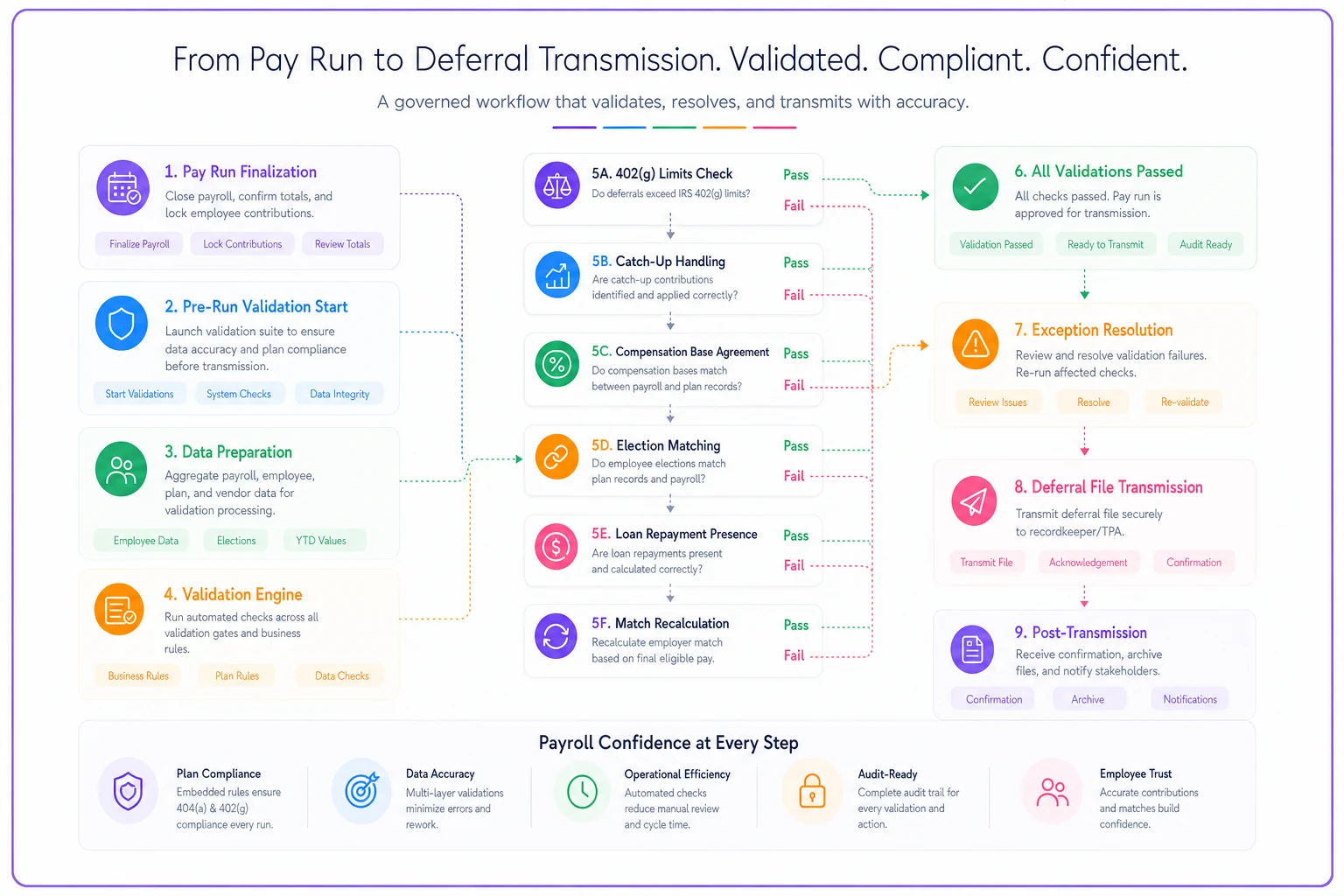
The goal is a hard gate between "pay run finalized" and "deferral file transmitted" where a specific set of rules runs against the file.
Employer-match reconciliation: recompute, don't trust
The match is where errors hide longest because nobody feels them immediately. A deferral error affects the employee's paycheck — someone notices. A match error affects only the employer contribution going into the plan, which nobody checks until an audit or a true-up.
The core discipline is simple: recompute the match independently and reconcile the two numbers every cycle. Your payroll system calculates a match. Your reconciliation should calculate the match from scratch using the plan formula, then diff the results. Any participant where the two don't agree gets investigated before the file goes out.
A realistic example of why this matters. A company runs a "100% on the first 3%, 50% on the next 2%" match. A participant earning around $5,800 per pay period defers 6%. Correct per-period match is 4% of comp — roughly $232. But the payroll config was set to a flat 50% of deferrals, which computes $174. The $58 gap per period doesn't look like much. Across 26 pay periods it's about $1,500 for one person. Across a department, the plan is materially underfunded and the company has a qualification problem.
The reconciliation structure that holds up looks like this:
| Reconciliation layer | What it compares | Frequency | Catches |
|---|---|---|---|
| Per-participant match | Payroll-calculated match vs. independently recomputed match | Every pay run | Formula config errors, comp base errors |
| File-to-remittance total | Sum of deferral file vs. ACH amount transmitted | Every remittance | Transmission truncation, dropped records |
| Remittance-to-recordkeeper | ACH amount vs. recordkeeper posted amount | Each cycle, once confirmation posts | Rejected records, posting delays, timing failures |
| Period-to-plan-year true-up | Cumulative match paid vs. match owed on annualized comp | Quarterly + year-end | Pay-timing distortions, missed true-up obligations |
That last layer — the true-up — is where plans with per-pay-period matching but an annual match definition get burned. Someone who front-loads deferrals early in the year can end up with less total match than the plan formula owes on their full-year comp, unless you run a true-up. If your plan document promises an annual match, per-period matching alone will systematically shortchange front-loaders.
Remittance packaging that survives scrutiny
The remittance itself is deceptively simple — it's a file and an ACH — but the packaging around it is what makes corrections survivable later. A remittance isn't just the money; it's the evidence that the money matched the deferrals, which matched the elections, which matched the plan.
Timing is also a hard compliance line. For plans subject to DOL rules, participant deferrals need to be deposited as soon as they can reasonably be segregated from general assets — small plans have a 7-business-day safe harbor. Blowing the deposit window is one of the most common findings in plan audits, and it's entirely a packaging-and-process failure, not a money failure.
-
The transmitted deferral/contribution file (the exact file, not a regenerated copy)
-
The ACH confirmation with date and amount
-
The pre-run validation report showing all checks passed (or exceptions documented)
-
The per-participant match reconciliation with any diffs explained
-
A deposit-timing stamp
pay date, segregation date, deposit date, and business days elapsed
-
The recordkeeper posting confirmation once it comes back
Bundle the exact transmitted file, not a regenerated copy, so audits can verify the original transmission without reconstruction.
Keep these together, per cycle, in a consistent structure. The teams that handle plan audits painlessly are the ones who can pull any single pay period's full package in under a minute. The teams that suffer are the ones reconstructing it from email attachments and recordkeeper portals eight months later.
When a cycle goes wrong: corrective flows
Errors will happen. The difference between a cheap fix and an EPCRS filing is how fast you catch it and whether you have a defined corrective path instead of improvising.
Missed or late deferrals. If a deferral was supposed to be withheld and wasn't, the employer generally owes a corrective contribution — often a qualified nonelective contribution representing the missed deferral opportunity, plus lost earnings. The earlier you catch it, the cheaper the available correction methods. Catch it within the same quarter and you're usually in low-cost territory. Catch it after year-end and the calculation gets heavier.
Excess deferrals (402(g) overage). Corrective distribution of the excess plus earnings, ideally before the tax-filing deadline. Almost entirely preventable with the pre-run proximity check above — which is exactly why that check sits at the top of the validation list.
Match overpayment or underpayment. Underpayment gets a corrective employer contribution with earnings. Overpayment is messier — it may require recovering the excess from the participant's account, which has its own procedural rules. Either way, the per-participant match reconciliation is what surfaces these before they compound.
Deposit timing failures. If deferrals went in late, you calculate lost earnings for the delay period and make the participants whole, typically through the DOL's Voluntary Fiduciary Correction Program for cleaner documentation.
The corrective flow that works is boring and specific: detect → classify the error type → pull the affected cycle's package → calculate the correction (contribution, distribution, or earnings) → execute → document the correction in the same place as the original package. That last step matters because a correction without a clear link back to the original error and calculation is nearly as bad as the error itself.
Since mid-year compensation and benefit changes are a frequent trigger for these errors, it's worth being disciplined about how those changes propagate. The same discipline that governs mid-period benefits deductions and pro-ration applies directly to deferral base changes — a comp change that doesn't flow cleanly into the deferral calculation is the same class of failure.
Auditor-friendly documentation
Plan auditors and TPAs aren't looking for perfection. They're looking for a controlled process with evidence. An error you caught and corrected, with documentation, is a non-issue. An error you didn't catch — or caught but can't explain — is a finding.
-
Traceability. For any participant, in any period, you can show
their election → the amount withheld → the match calculated → the amount remitted → the amount posted. One chain, no gaps.
-
Exception records, not just success records. Auditors trust a process that documents its failures more than one that claims it never fails. Every pre-run exception, with how it was resolved, is a credibility asset.
-
Consistent structure across periods. If every cycle's package looks the same, sampling is trivial and the auditor moves fast. If every period is organized differently, you've invited scrutiny.
-
Formula documentation that matches config. Keep a written record of the plan's match formula and deferral comp definition, and tie it to the actual system configuration. When these match, questions evaporate.
The GL side of this is its own discipline. Employer match and contribution accruals need to land correctly in the ledger, and the treatment interacts with how you book other benefit-related entries. If your month-end process already follows a solid approach to the tax and ledger treatment of payrolled benefits, extend the same journal rigor to match accruals so the contribution expense ties out to the remittance total each period.
A short real-world scenario
A roughly 60-person professional services firm ran a 4% safe-harbor match with per-pay-period calculation. No independent recomputation — they trusted the payroll system's match number and remitted whatever it produced.
A mid-year configuration change, made when they switched which comp codes counted as eligible, quietly dropped quarterly bonuses out of the deferral base. For the three employees who deferred heavily and received large bonuses, the understated deferrals meant understated matches — and the system compounded it by excluding that same bonus comp from the match calculation too.
By the time it surfaced at year-end true-up, the total underfunding across those three people was somewhere in the $4k–$5k range, plus lost earnings, plus the time cost of the correction and an uncomfortable TPA conversation. The actual error was a single comp-code mapping that nobody had reconciled against the plan document.
After they built a per-run match recomputation and a compensation-base agreement check into their pre-run gate, the next similar config change got flagged on the first pay run — before any money moved. The fix took about ten minutes instead of a year-end scramble and a correction filing.
When this level of rigor is worth it — and when it isn't
Build the full pipeline when: you have more than a handful of participants, a match formula more complex than a flat percentage, employees who front-load or hit limits, or any bonus/commission compensation feeding deferrals. Also when you're approaching or past the audit threshold — a controlled process pays for itself the first time an auditor samples your periods.
You can run lighter when: you have a very small, stable group, a simple flat match, salaried-only comp with no bonuses, and nobody near the contribution limits. Even then, the deposit-timing discipline and basic file-to-remittance reconciliation are non-negotiable — those failures don't care how small you are.
Don't skip the independent match recomputation regardless of size. It's the single check that catches the most expensive, slowest-surfacing errors, and it costs almost nothing once it's built.
The whole point of this playbook is to move error detection earlier in the pipeline — from "the recordkeeper flagged it in Q1" to "the pre-run check caught it before the ACH pulled." Every step earlier you catch a deferral or match error, the cheaper and quieter the fix. Validate before money commits, recompute the match instead of trusting it, package each cycle so you can prove what happened, and document your exceptions as proudly as your successes.
Ready to simplify your payroll operations?
Join 2,000+ businesses using Payexly to reduce payroll overhead, ensure compliance, and enhance employee satisfaction.