

Most M&A integration plans treat payroll cutover as the finish line. You migrate the acquired company's employees into the surviving system, run a couple of parallel cycles, confirm net pay matches, and declare victory. Then everyone moves on.
The problem is that cutover is maybe 20% of the work. The other 80% — reconciling two sets of pay policies, aligning calendars that never quite matched, consolidating two general ledgers that classify the same costs differently — stretches across the next year. And that's when the expensive surprises show up: duplicate benefit accruals, mismatched tax jurisdictions carried over from the legacy entity, PTO balances converted wrong, GL variances nobody can explain at quarter close.
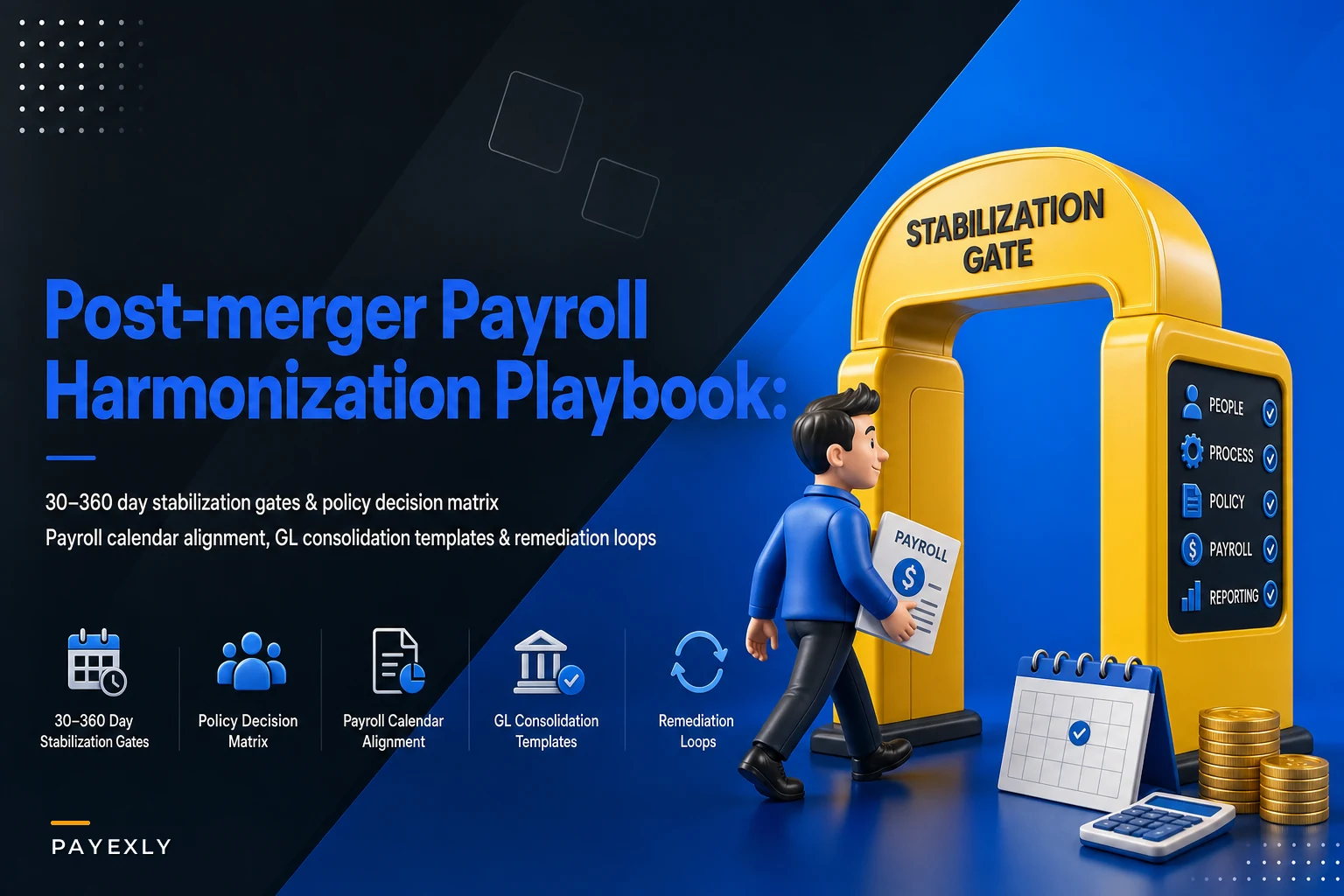
This playbook is about that back half. Specifically: how to run post-merger payroll harmonization using staged stabilization gates across a 30–360 day window, a policy decision matrix so you stop making one-off calls, payroll calendar alignment that doesn't trigger a cashflow crunch, and GL consolidation templates that keep finance sane.
Why harmonization fails after a "successful" cutover
The pattern repeats across almost every deal. The integration team is measured on cutover completion. Did everyone get paid on the first combined run? Yes? Great, project closed, team reassigned.
-
The acquired group's hourly staff are getting overtime calculated on a different weighting basis than your own crews doing identical work.
-
Two different holiday calendars mean two different accrual schedules, and your GL now has holiday pay hitting in months finance didn't forecast.
-
The legacy entity withheld for a local tax your system doesn't have configured, so those deposits are silently failing.
None of this breaks the pay run. That's exactly why it's dangerous — payroll keeps producing checks, so leadership assumes integration is done. The variances accumulate quietly until year-end close or the first combined audit, when someone finally asks why labor cost per head differs 11% between two sites doing the same work.
The stabilization gate model: 30, 90, 180, 360
Instead of treating harmonization as one big project, break it into gates. A gate is a checkpoint where you verify specific conditions are met before the integration is allowed to advance. If a gate fails, you remediate first and move forward after. This is the single biggest structural fix, because it forces the quiet variances into the open on a schedule instead of letting them surface at audit.
Eliminate payroll errors and delays.
Payexly streamlines every payroll cycle ensuring accuracy and compliance.
- Automated payroll processing
- Real-time tax compliance
- Benefits & deductions management
No credit card required
Here's how the gates map out.
| Gate | Window | Primary focus | Exit criteria (must pass to advance) |
|---|---|---|---|
| Gate 1 — Mechanical stability | Day 0–30 | Confirm nobody is paid wrong | Net pay parity confirmed, tax deposits clearing, no missed garnishments, bank files accepted |
| Gate 2 — Policy reconciliation | Day 30–90 | Surface every policy conflict | Decision matrix complete, no un-decided policy forks running in production |
| Gate 3 — Calendar & GL alignment | Day 90–180 | One calendar, consolidated chart | Single pay calendar in place, GL mapping unified, variance within tolerance |
| Gate 4 — Steady state | Day 180–360 | Prove it holds across a full cycle | Clean quarter close, no legacy-only exceptions, audit evidence packaged |
The point of gates isn't bureaucracy. Each one has a failure state that stops forward motion. Without them, there's nothing forcing anyone to confirm that policy forks got resolved before the next quarter's numbers get locked.
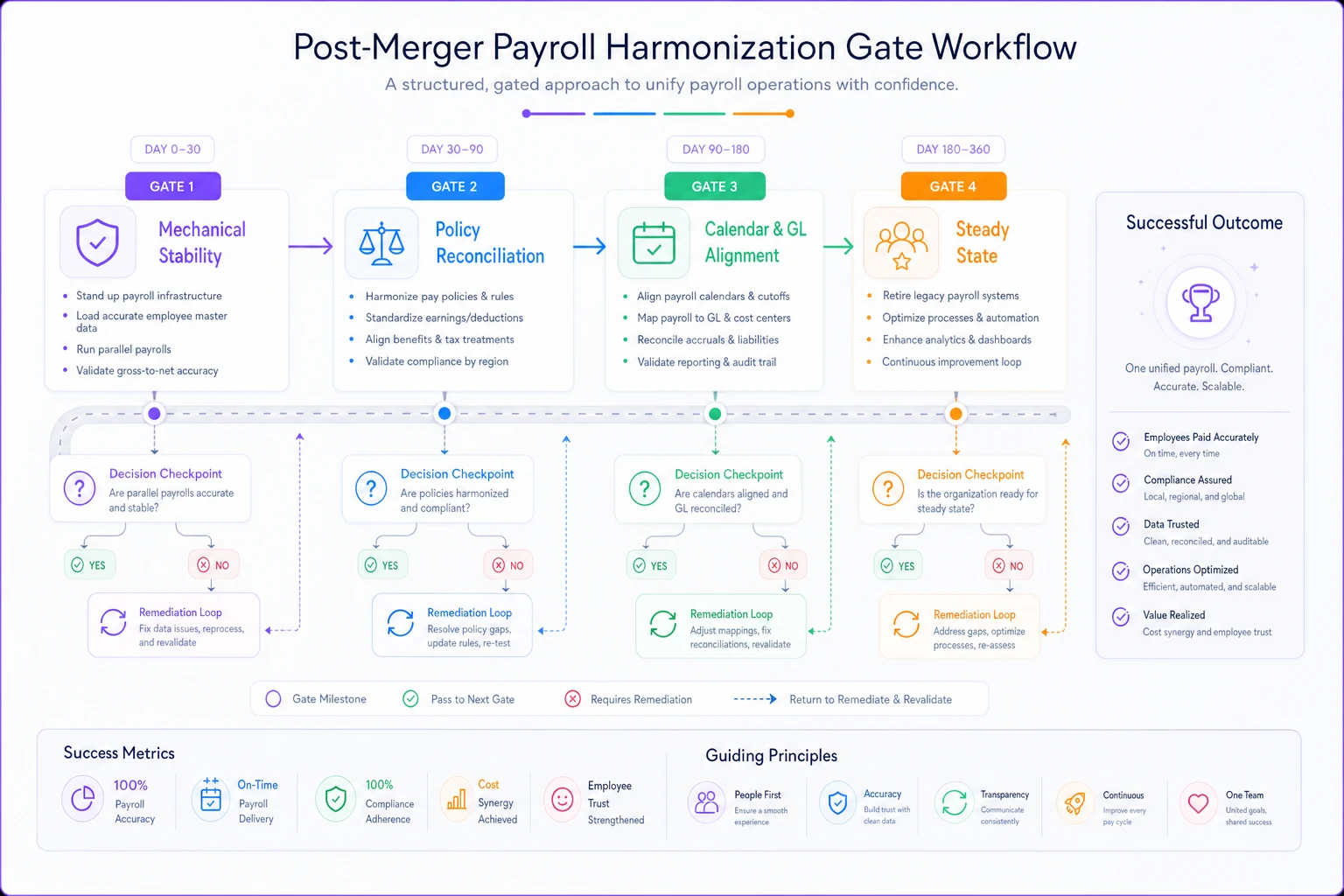
The diagram shows the gate progression and the decision checkpoints to stop failed gates from advancing.
Gate 1 — Mechanical stability (Day 0–30)
This overlaps with what cutover teams already do, but the exit criteria are stricter than "everyone got paid." You're confirming:
-
Net pay matches the final legacy run within a cent for every employee — not a sample.
-
Every tax jurisdiction that existed in the legacy entity now exists and is depositing correctly in the new system.
-
Garnishments, levies, and child support orders transferred with correct priority and remittance addresses.
-
Bank files are being accepted without manual intervention.
The most common Gate 1 miss isn't net pay — it's jurisdiction coverage. A typical example: the acquired company had three employees in a city with a local income tax your HQ state doesn't use. During migration, that tax code got dropped because it wasn't in your existing config. Pay looks fine. The deposits just aren't happening, and you find out six months later via a notice with penalties attached.
Gate 2 — Policy reconciliation (Day 30–90)
This is the gate everyone skips, and it's where harmonization actually lives. You can't align two payrolls until you've written down every place the two policies disagree and decided which one wins. That's what the decision matrix is for.
Stop making harmonization decisions one email at a time. Build a single matrix listing every policy area where the two entities differ, and force an explicit decision with an owner and effective date for each row. If it's not in the matrix, it's not decided, and it shouldn't be running in production.
The policy decision matrix
Stop making harmonization decisions one email at a time. Build a single matrix listing every policy area where the two entities differ, and force an explicit decision with an owner and effective date for each row. If it's not in the matrix, it's not decided, and it shouldn't be running in production.
Here's the structure that works:
| Policy area | Legacy (acquired) | Surviving (ours) | Decision | Rationale | Owner | Effective |
|---|---|---|---|---|---|---|
| OT calculation basis | Rate-in-effect | Blended regular rate | Adopt blended | Legal consistency | Payroll Mgr | Day 90 |
| PTO accrual | Lump annual Jan 1 | Per-pay accrual | Adopt per-pay, convert balances | Cash accuracy | HR Dir | Day 120 |
| Pay frequency | Bi-weekly | Semi-monthly | Keep separate until Gate 3 | Cashflow risk | Payroll Mgr | Day 180 |
| Holiday calendar | 11 days | 9 days | Adopt 9 + grandfather 2 | Retention | HR Dir | Day 90 |
| Shift differential | Flat $1.50/hr | 10% of base | Standardize to 10% | Equity | Comp | Day 150 |
The discipline that makes this work: every row must have a decision and an effective date before Gate 2 closes. A row sitting in "under discussion" means a policy fork is still running live — two employees doing the same job being paid under different rules. That's exactly what blows up pay equity analysis and audit findings later.
Grandfather deliberately, document the sunset plan, and keep the count small.
The non-obvious trap here is grandfathering. It feels generous and low-risk to let the acquired group keep a richer benefit. But every grandfathered rule is a permanent second code path you now maintain indefinitely. Each grandfathered policy roughly doubles the exception-handling time for that population at every close. Grandfather deliberately, document the sunset plan, and keep the count small.
Gate 3 — Calendar & GL alignment (Day 90–180)
Two things converge here and they're the hardest part of the whole playbook.
The classic problem: one entity runs bi-weekly (26 cycles) and the other runs semi-monthly (24 cycles). Leadership wants one calendar. The naive move is to just flip the bi-weekly group to semi-monthly on a chosen date.
Here's what that breaks. Bi-weekly employees are used to being paid every other Friday. Semi-monthly pays on the 15th and last day. When you convert, there's almost always a gap — a stretch where someone goes longer than usual between checks during the transition. For hourly workers living close to the margin, that gap is a real hardship and a retention risk, not a rounding issue.
The other half is employer cashflow. Bi-weekly means two months a year have three pay dates. If you forecasted labor cost on 24 cycles but the legacy group was on 26, your accruals and cash timing are off in those "third paycheck" months. Finance either over- or under-reserves.
-
Freeze both calendars through Gate 2. Do not touch frequency while policies are still being reconciled. One disruption at a time.
-
Model the transition gap per employee. Calculate the exact day count between the last legacy check and the first converted check for every person. Flag anyone whose gap exceeds their normal cycle.
-
Use a bridge payment for flagged employees. A one-time transition advance or a mid-period payment covers the gap so nobody takes an unexpected hit. Reconcile it against the first converted run.
-
Re-forecast the GL for cycle-count change. If you're moving 26→24, rebuild the labor accrual schedule so the "extra paycheck" months disappear cleanly from the model.
-
Convert at a quarter boundary, not mid-quarter. This keeps the cycle-count change from muddying a single quarter's numbers.
The mistake almost everyone makes is converting the calendar before the GL model is updated. Then the first post-conversion close shows a variance, finance panics, and three days get burned proving it's just the cycle-count change and not an actual error. Update the model first, then convert.
GL consolidation templates
The acquired company almost never maps payroll to the ledger the way you do. Same economic event, different account. Their employer FICA might hit one combined tax expense account; yours splits it. Their PTO liability might be a single accrual; you track accrued vs. used separately.
Until you unify this, every consolidated report is apples-to-oranges, and nobody can trust labor cost comparisons across sites.
The template that holds up is a canonical mapping table — one row per payroll element, with the legacy account, the surviving account, and the unified target. This same discipline shows up in broader payroll data work, and the multi-quarter payroll transformation roadmap covers how canonical data and phased pilots fit into the larger picture.
A simplified consolidation mapping:
| Payroll element | Legacy GL account | Surviving GL account | Unified target | Notes |
|---|---|---|---|---|
| Regular wages | 6000 Wages | 6100 Salaries / 6110 Hourly | 6110 Hourly | Split by employee type |
| Employer FICA | 6000 (combined) | 6200 Payroll Tax | 6200 | Re-class legacy history |
| PTO accrual | 2300 Accrued Leave | 2310 Accr / 2320 Used | 2310 + 2320 | Requires balance split |
| 401(k) match | 6500 Benefits | 6510 Retirement | 6510 | Separate from health |
| Health premiums | 6500 Benefits | 6520 Health | 6520 | Separate from retirement |
Historical re-classification. For year-over-year reporting to make sense, you often need to re-map the legacy entity's prior periods to the unified chart, not just go-forward entries. Decide early how far back you'll restate. The detailed journal and mapping mechanics belong in your month-end reconciliation SOP, but the consolidation decision — how far back, which accounts — has to be made here at Gate 3.
Tolerance thresholds. Define what variance is acceptable at close before you consolidate. A reasonable starting point is a dollar threshold plus a percentage — investigate anything over a few hundred dollars or more than 1% of the account balance. Without a defined tolerance, every close turns into chasing immaterial pennies while real variances hide in the noise.
Gate 4 — Steady state (Day 180–360)
You don't get to call harmonization done until the combined payroll has run cleanly through a full quarter close with no legacy-only exceptions and no un-decided policy forks.
-
A quarter close with GL variance inside tolerance and every exception explained.
-
Zero policy rows still "under discussion" in the matrix.
-
One calendar in production, bridge payments fully reconciled.
-
Grandfathered rules documented with sunset dates.
-
An audit-ready evidence pack covering the full harmonization.
The exit evidence:
A real scenario: regional HVAC rollup
A mid-market HVAC company acquired a smaller competitor — around 140 employees added to their existing 210. Cutover went fine: everyone got paid on the first combined run, and the integration team closed the project at day 35.
The problems showed up at the first quarter close. Labor cost per technician ran roughly 9–12% higher at the acquired sites, and nobody could explain it. Digging in revealed three stacked issues: the acquired group was still on their legacy overtime basis (rate-in-effect vs. the parent's blended rate), their PTO had been converted as a lump annual accrual hitting the GL in one month instead of per-pay, and a local tax for two technicians had been dropped during migration — those deposits had been failing silently for a full quarter.
Running a proper Gate 2 policy reconciliation and building the decision matrix — something that should have happened in the first 90 days — eventually cleaned most of this up. Resolving the OT basis and PTO accrual method alone eliminated most of the per-tech variance. The dropped local tax got caught before it compounded into anything worse than a few hundred dollars in penalties. Total cleanup took about two months of focused work that would have been maybe two weeks if the gates had run on schedule from the start.
The team wasn't careless. The problem was simpler than that: "everyone got paid" felt like completion, so the policy and GL work never got scheduled.
When this full model makes sense — and when it's overkill
When to run the full 360-day gate structure:
-
You're combining two entities with genuinely different pay policies, calendars, or charts of accounts.
-
Multiple jurisdictions involved, or significant hourly and OT populations where small rule differences compound quickly.
-
You answer to an audit, a board, or lenders who'll scrutinize consolidated labor cost.
When it's overkill:
-
A true asset acquisition where you're rehiring everyone onto your existing policies from day one — there's no second policy set to reconcile, so most of Gate 2 doesn't apply.
-
Very small additions (a handful of people) adopting your rules outright. Run a lightweight version: still do the GL mapping and jurisdiction check, skip the heavy matrix.
Who should not attempt this without help: if your team is already running on heroics every cycle, bolting a harmonization program on top will break something. Stabilize the core process first. And if the deal's real driver was cost consolidation, pressure-test the sourcing math early — the TCO and risk-weighted payroll sourcing framework is a better place to make the build-vs-outsource call than mid-harmonization.
Where tooling genuinely helps
Most of this is discipline, not software. But a few parts are genuinely painful to manage by hand. Running two rule sets in parallel and tracking which employees fall under which policy fork is exactly where a system that flags exceptions automatically — "these 14 employees are still on the legacy OT basis past the matrix effective date" — saves you from finding it at audit instead of earlier.
Same with GL consolidation: having mapping rules enforced against a canonical chart, with variances flagged against your defined tolerance before close, turns a multi-day reconciliation scramble into reviewing a short exception list. The value isn't automation for its own sake — it's that the quiet variances stop staying quiet.
Post-merger payroll harmonization goes wrong for a boring reason: cutover feels like the finish line, so the harder reconciliation work never gets scheduled. The fix is to refuse to call it done at cutover. Stage the work across 30/90/180/360-day gates, force every policy conflict into a decision matrix with owners and effective dates, sequence the calendar change so nobody takes an unexpected pay gap, and unify the GL against a canonical mapping with defined tolerances before you consolidate.
Do that, and the variances surface on your schedule — in a controlled Gate 2 review — instead of ambushing you at year-end close or in front of an auditor. The deal's labor-cost numbers finally mean the same thing across every site, which is the entire point of harmonizing in the first place.
Ready to simplify your payroll operations?
Join 2,000+ businesses using Payexly to reduce payroll overhead, ensure compliance, and enhance employee satisfaction.