

Managing payroll vendors isn't just about picking a provider and hoping they process paychecks correctly. The pattern across mid-sized companies is pretty consistent: businesses treat payroll vendor management like a set-and-forget contract when it should operate more like managing a critical supply chain partner.
The real problem hits when your payroll vendor is processing 2,400 employee payments monthly and you have zero visibility into their control environment until something breaks. By then you're dealing with incorrect tax filings, employee complaints, or worse — explaining to auditors why you can't prove your vendor followed proper procedures for the past year.
Most companies discover their vendor management gaps at three specific moments: when switching providers after a major incident, during their first SOC 2 audit, or after a compliance violation that triggers regulatory scrutiny. The scramble to build retroactive documentation typically costs somewhere between $15,000 and $45,000 in consultant fees and internal time. Sometimes more.
Why standard vendor contracts create operational blindness
Traditional payroll vendor relationships run on trust and annual reviews. You sign a master service agreement, negotiate some SLA terms around processing deadlines, then hand over one of your most critical business functions to an external party. The vendor sends monthly invoices, you spot-check a few payroll runs, and everything seems fine until it isn't.
The core problem becomes obvious when you actually map out what's happening operationally. Your vendor touches employee personal data, manages tax withholdings that directly affect your compliance status, and controls the timing of your largest regular cash outflow. Yet most companies have less visibility into their payroll vendor's operations than they do into their office supply vendor's delivery schedule.
Consider what happens when a payroll error hits 40 employees' direct deposits. The vendor apologizes, issues corrections, maybe offers a credit on next month's invoice. But your HR team spends three days fielding complaints, finance manually reconciles the corrections, and employees lose confidence in the reliability of their paychecks. The vendor's contract probably limits their liability to the monthly service fee — nowhere near the actual operational cost of their failure.
This gap between contractual terms and operational reality gets worse as companies grow. A 50-person company might manage vendor issues through direct relationships and quick phone calls. At 500 employees across multiple states, those informal controls break down completely.
Building selection gates that actually predict vendor reliability
Vendor selection typically focuses on features and pricing when it should be evaluating operational maturity. The sales demo shows a clean interface for running payroll, but what you actually need to understand is how they handle edge cases, maintain data integrity, and respond when their systems fail.
Eliminate payroll errors and delays.
Payexly streamlines every payroll cycle ensuring accuracy and compliance.
- Automated payroll processing
- Real-time tax compliance
- Benefits & deductions management
No credit card required
Start by understanding their operational model. Does the vendor process payroll in batches throughout the day or in concentrated windows? This affects your ability to make last-minute changes. How do they handle processing failures — redundant systems, or do all clients go down together? What percentage of their processing is automated versus requiring manual intervention?
A mature selection process evaluates five operational dimensions:
Processing architecture tells you about scalability and reliability. Vendors running modern cloud infrastructure with geographic redundancy handle growth and outages better than those on legacy systems. Ask specifically about their disaster recovery time objectives and whether they've actually tested failover in the last year.
Data handling practices reveal security and compliance readiness. Beyond certifications, understand how they segment client data, manage access controls, and handle data retention. A vendor processing payroll for thousands of companies shouldn't have all that data sitting in a single database where one breach exposes everyone.
Support structure indicates how problems get resolved. Tier 1 phone support reading from scripts won't help when you have complex retroactive adjustments across multiple pay periods. Map out exactly who you'll reach during critical issues and what authority they have to actually fix problems versus just logging tickets.
Integration capabilities determine your ongoing operational flexibility. Native API access lets you automate data flows and build proper controls. File-based batch uploads create timing dependencies and reconciliation headaches. That difference becomes critical when you need real-time visibility into processing status.
Change management processes signal operational maturity. How does the vendor handle system updates that might affect your processing? What's their rollback procedure if an update breaks something? Vendors who can't answer these questions precisely will eventually surprise you with unexpected changes that disrupt your operations.
During selection, create specific scenarios and walk through exactly how each vendor handles them — not hypothetically, but with actual screenshots, documentation, and escalation paths. Something like: "An employee reports their direct deposit went to the wrong account. Walk me through your investigation and correction process, including timelines and communication protocols." The vendors who can demonstrate operational depth beyond sales promises tend to deliver more reliable service.
Recurring health metrics that catch problems before they cascade
Traditional vendor management runs annual reviews that essentially ask "are you still doing what you promised?" This backward-looking approach means you find out about problems months after they started affecting operations. Continuous monitoring of operational health indicators is what actually keeps you ahead of vendor failures.
The challenge is figuring out which metrics actually predict performance versus just measuring activity. Processing volume and error rates give you basic visibility but don't reveal deteriorating service quality or emerging risks.
Start by establishing baseline operational metrics during your first 90 days with a vendor. This isn't about contractual SLAs yet — it's about understanding normal operating patterns. How long does tax filing typically take? What's the normal rate of processing exceptions? How quickly do they respond to different types of inquiries?
Track these monthly, looking for trends rather than absolute values:
Processing time degradation often signals capacity problems. If your regular payroll run took 4 hours in January but takes 6 hours by June, the vendor might be overloaded or running into technical issues. Longer processing windows also reduce your ability to make corrections before funds move.
Support response patterns reveal organizational health. Track not just average response time but the distribution. If 80% of issues resolve quickly but 20% disappear into a black hole, you have an escalation problem. Also watch whether the same issues require repeated contacts — a sign their tier 1 support can't actually close things out.
Error type evolution shows process maturity. New vendors make different mistakes as they learn your requirements. But if you're seeing the same tax calculation errors in month 6 that appeared in month 1, they haven't built proper controls. Categorize errors by root cause: data issues, processing logic, timing problems, or manual mistakes.
Communication consistency predicts future surprises. Track how often the vendor proactively flags issues versus you discovering problems yourself. Include planned maintenance windows, processing delays, and system changes. Vendors who go quiet usually have internal problems they're managing quietly.
Remediation velocity measures operational capability. When problems occur, how quickly does the vendor provide root cause analysis? How long until preventive measures are in place? Vendors who take weeks to explain simple processing errors probably lack proper logging and investigation tools.
Build a simple monthly scorecard tracking these metrics. Weight them by operational impact — processing reliability matters more than response time on routine questions. Share the scorecard with your vendor quarterly, focusing on trends rather than individual incidents.
Weight metrics by operational impact when building your monthly vendor scorecard.
More importantly, use these metrics to spot trouble early. When multiple indicators start degrading at the same time, that's usually a sign of vendor distress — lost technical staff, too many new clients, underinvestment in infrastructure. These patterns give you months of warning before service completely falls apart.
Audit evidence requirements beyond checkbox compliance
When auditors ask for evidence of vendor oversight, most companies scramble to compile emails, contracts, and meeting notes into something that resembles a management program. This reactive approach wastes time and rarely satisfies audit requirements for systematic vendor governance.
Auditors don't actually care about your vendor management process. They care about evidence that financial data and operational controls remain reliable despite outsourcing critical functions. Your evidence package needs to demonstrate continuous oversight, not just periodic check-ins.
Structure your evidence collection around three audit concerns:
Control effectiveness requires showing that vendor controls actually work. Don't just file away their SOC 2 report — document your review of any exceptions noted and how you verified they were addressed. When the vendor claims they perform daily backups, ask for restoration test results. When they tout access controls, request user access reviews for the team handling your account.
For payroll vendors specifically, maintain evidence of:
-
Tax filing confirmations for each jurisdiction
-
Bank reconciliation reports showing successful fund transfers
-
Error logs and correction documentation
-
Change logs for any configuration updates
-
User access reviews for your company's portal accounts
Operational oversight demonstrates active management of the relationship. Document monthly reviews even when nothing goes wrong. A simple email noting "Reviewed March payroll processing metrics, no issues identified" with attached reports provides better audit evidence than elaborate quarterly business reviews that don't actually happen consistently.
Build recurring evidence collection into your operational workflow. Every payroll run should generate a package of reports you archive: processing confirmation, funding summary, tax liability report, and exception report. Takes about five minutes to download and save, but provides a comprehensive audit trail.
Create standardized review templates for different oversight activities:
-
Monthly metric reviews with threshold breaches highlighted
-
Quarterly control assessments with specific test procedures
-
Annual contract reviews with documented change requests
-
Incident post-mortems with remediation tracking
Risk assessment updates show you're thinking about evolving threats. Your vendor risk profile changes as your business grows, regulations shift, and the vendor's own situation changes. Document annual reassessments that consider:
-
Changes in data volume or sensitivity
-
New regulatory requirements
-
Vendor financial stability
-
Technology architecture changes
-
Geographic expansion impacts
The audit evidence package should tell a story of continuous oversight. Include routine communications, not just escalations. Show preventive actions, not just incident response. Store everything in a centralized repository with consistent naming conventions and retention policies. When auditors request vendor oversight documentation, you should be able to pull a comprehensive package in hours, not days.
SLA clauses that address actual payroll operational risks
Standard vendor SLAs focus on system uptime and response times while ignoring the operational realities of payroll processing. Your system being "available" doesn't help much if tax filings are incorrect or direct deposits fail. Effective SLAs need to address the specific risks that actually disrupt operations.
Most payroll vendors push back on meaningful SLAs because they understand the complexity of what can go wrong. But without contractual accountability, you're essentially hoping they prioritize your issues over other clients' problems when things get busy.
Start by mapping your actual operational risks. What specifically would disrupt your business? Late payroll funding affects employee morale. Incorrect tax filings trigger penalties. Data breaches require expensive notifications. Each risk needs specific SLA coverage.
Processing accuracy SLAs should go beyond simple error rates. Define accuracy at multiple levels: gross pay calculations, tax withholdings, deduction processing, and net pay delivery. Set different thresholds for different error types — a single executive's incorrect bonus matters less operationally than 100 employees' missing 401k contributions.
Timing SLAs need operational precision. "Process payroll on time" is meaningless. Define specific cutoff times for data submission, processing completion, funding initiation, and fund availability. Include provisions for different scenarios: regular runs, off-cycle payments, corrections, and year-end adjustments.
| Timing SLA |
|---|
| For data submitted by 3 PM ET on processing day, vendor completes calculation by 8 PM ET, initiates funding by 10 PM ET, with funds available in employee accounts by 6 AM ET on pay date. |
| Off-cycle requests submitted by noon process same day. |
Tax compliance SLAs address your biggest financial risk. Specify filing deadlines relative to statutory requirements, not just "timely" filing. Include accuracy thresholds and explicit liability assignment for penalties resulting from vendor errors.
Critical provisions: "Vendor files all federal, state, and local tax returns no later than 2 business days before statutory deadlines. Vendor maintains 100% on-time filing rate. Any penalties, interest, or fees resulting from vendor filing errors are vendor liability, excluding those caused by client data errors documented in writing."
Remediation SLAs determine how quickly problems get fixed. Generic "best effort" language provides no recourse when errors hit your employees. Define specific remediation timelines based on issue severity and scope.
-
Critical errors (affecting >10% of employees or >$100k)
Resolution within 4 hours
-
Major errors (affecting 5-10% or $50k-$100k)
Resolution within 24 hours
-
Standard errors (affecting <5% or <$50k)
Resolution within 48 hours
Data security SLAs go beyond breach notifications. Include provisions for security testing, audit rights, and incident response procedures. Specify forensic investigation requirements and liability for downstream costs.
Key elements: "Vendor provides breach notification within 4 hours of discovery. Vendor covers all legally required notifications, credit monitoring for affected individuals for 24 months, and regulatory fines/penalties resulting from vendor security failures."
Build escalating remedies into each SLA tier. First violation triggers increased monitoring. Second violation allows partial fee recovery. Third violation enables contract termination without penalty. This creates meaningful incentive for vendor performance — a 5% monthly credit for missing SLAs doesn't compensate for the operational disruption of payroll failures. Structure credits to escalate with repeated failures and scale with actual impact.
Remediation playbooks for common vendor failures
When vendor failures happen, the operational response determines whether you're dealing with a minor inconvenience or a full crisis. Most companies react to each incident individually instead of following tested playbooks that minimize disruption — and that improvisation costs time and money.
Vendor failures follow patterns. The specific details vary, but the operational response stays consistent. Building playbooks for common scenarios means your team responds quickly and completely rather than working through the steps during the emergency itself.
Failed payroll funding creates immediate employee impact. Your playbook needs parallel workstreams: employee communication, alternative payment arrangements, vendor escalation, and reconciliation planning.
First hour: Confirm the failure scope through bank verification, not vendor reports. Initiate vendor escalation to dedicated contacts, not general support. Draft employee communication explaining the issue and expected resolution timeline.
Next four hours: Arrange bridge funding if the vendor can't correct immediately. For critical employees — hourly workers, new hires — consider manual checks or wire transfers. Document all manual payments for later reconciliation. Update employee communication with a specific resolution timeline.
Day two: Verify corrections processed successfully. Reconcile all manual payments against corrected payroll. Get root cause documentation from the vendor. Adjust future processing schedule if needed. Calculate any employee impact costs (overdraft fees, late payment charges) for reimbursement.
Tax filing errors require coordination between multiple parties. The playbook has to address immediate compliance requirements while pursuing vendor remediation.
Discovery phase: Document the error scope across all affected jurisdictions. Determine if you can file corrections before penalties trigger. Assess whether other filings might have similar issues. Engage tax advisors if penalties seem likely.
Correction phase: File amended returns immediately if within correction windows. Include explanation letters noting vendor error. Track all penalty notices for vendor liability claims. Verify corrections in all affected jurisdictions — not just where errors were first discovered.
Recovery phase: Compile total costs including penalties, interest, and professional fees. Submit formal liability claim to vendor with supporting documentation. If vendor disputes liability, get legal counsel involved early. Monitor future filings for similar errors.
Data exposure incidents require rapid response to minimize regulatory impact. Your playbook coordinates technical investigation, legal requirements, and employee communications.
Initial response: Isolate the exposure scope through vendor forensics and your own access logs. Determine what data was potentially accessed, not just what was confirmed compromised. Engage legal counsel to assess notification requirements across all applicable jurisdictions.
Investigation phase: Document the timeline of exposure, vendor response, and remediation steps. Preserve all relevant communications and logs. Assess whether other vendor clients were affected — that increases breach severity. Determine if cyber insurance covers the incident.
Notification phase: Follow legal requirements for timing and content, but go beyond minimums for employee trust. Offer credit monitoring even if not required. Prepare for employee questions about identity theft risks. Document all notification costs for vendor liability claims.
System access failures during critical processing windows need escalation paths that bypass normal support channels. Your playbook should include alternative processing methods.
Immediate response: Attempt access through multiple channels — web, API, batch upload. Contact dedicated escalation contacts, not tier 1 support. Assess whether the delay will affect payment timing.
Contingency activation: If access isn't restored within two hours, initiate backup processing. That might mean running payroll through previous period data with manual adjustments, using a backup vendor relationship, or processing internally. Document everything for the audit trail.
Post-incident review: Require vendor root cause analysis within 48 hours. Assess whether architectural issues increase recurrence risk. Consider requiring the vendor to maintain hot backup systems for your account. Adjust processing schedules to allow more buffer time.
Integrating vendor oversight into operational workflows
The biggest failure in vendor management happens when oversight becomes a compliance exercise separate from daily operations. Monthly reviews get skipped when things are busy. Documentation gets backfilled before audits. Issues get missed until they become crises.
Effective payroll governance frameworks embed vendor oversight into existing operational routines rather than creating new administrative burden. The same team running payroll should be capturing evidence and flagging issues as part of their normal workflow — not as a separate task they remember to do occasionally.
Think about the natural touchpoints with your vendor. Every payroll run involves data submission, processing confirmation, and results validation. These existing interactions can generate vendor performance data without additional effort.
During data submission, capture timestamps and confirmation numbers. Takes seconds but provides evidence of timely submission and vendor acknowledgment. When reviewing processing results, note any discrepancies or manual corrections required. This builds a pattern library of vendor issues without requiring formal incident reports for every small thing.
Your pre-filing validation routines already check for data accuracy. Extend these slightly to flag vendor-caused errors versus internal data issues. When tax deposits process, capture confirmation codes and reconciliation reports. You're already verifying these amounts — just save the evidence systematically.
Create simple operational dashboards that surface vendor health metrics alongside your internal payroll metrics. Processing time, error rates, and support tickets become visible patterns rather than isolated incidents. When metrics drift outside normal ranges, investigation happens naturally rather than waiting for a scheduled review.
Build vendor communication into team habits. Instead of ad hoc emails when problems arise, establish regular check-ins that follow standard formats: weekly processing confirmations, monthly metric reviews, quarterly business reviews. Consistent communication creates rhythm and documentation at the same time.
Modern operational platforms can automate a good chunk of this evidence collection and pattern recognition. Instead of manually compiling reports, AI-powered systems can continuously monitor vendor interactions, flag anomalies, and maintain audit trails — turning vendor management from periodic reviews into continuous operational intelligence. It removes a lot of the administrative friction that causes teams to skip oversight steps when they're busy.
Here's a visual representation of an integrated vendor oversight workflow.
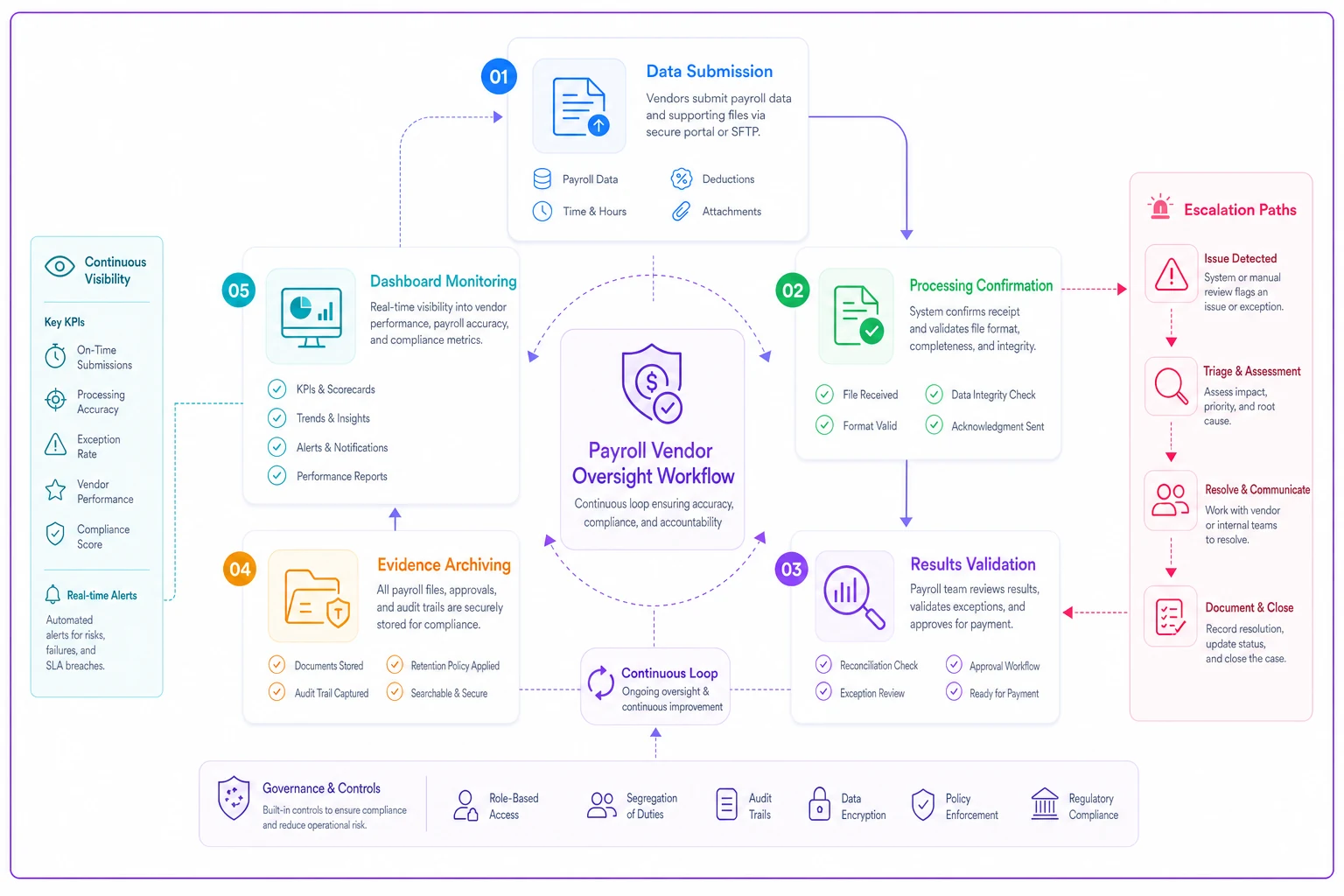
Use this flow to align daily tasks with audit-ready evidence.
When vendor oversight is woven into daily workflows, issues surface earlier, documentation stays current, and response times improve. And frankly, your vendor performs better when they know they're being monitored continuously rather than evaluated once a year.
Making vendor management systematic, not reactive
Companies typically manage payroll vendors through personal relationships and informal escalations until something breaks badly enough to force systematic change. Building proper vendor governance isn't actually more work — it's just different work done proactively instead of reactively.
The operational impact of weak vendor management compounds quietly. Small processing errors accumulate into reconciliation nightmares. Undocumented changes create audit findings. Performance degradation happens gradually until a critical failure forces an emergency vendor switch.
When vendor oversight is built into your operational fabric, evidence collection happens through normal workflows, performance issues surface before they cascade, and remediation follows tested playbooks rather than panicked improvisation.
Start with the highest-risk gaps in your current vendor management. If you lack SLAs with real teeth, negotiate meaningful terms at the next renewal. If you have no systematic evidence collection, start capturing basic processing confirmations now. If vendor issues keep surprising you, implement monthly metric tracking.
The companies that manage payroll vendors well don't have special resources or elaborate systems. They just recognized that outsourcing the function doesn't mean outsourcing the responsibility. Your vendor processes the payroll, but you own the outcomes.
Build the operational discipline before the next audit, vendor failure, or compliance issue forces you to explain why oversight wasn't in place. The infrastructure you build for managing one critical vendor becomes the template for all critical vendors — and that shift from reactive to systematic is often the difference between operational stability and constant crisis management.
Build the operational discipline before the next audit, vendor failure, or compliance issue forces you to explain why oversight wasn't in place. The infrastructure you build for managing one critical vendor becomes the template for all critical vendors — and that shift from reactive to systematic is often the difference between operational stability and constant crisis management.
Ready to simplify your payroll operations?
Join 2,000+ businesses using Payexly to reduce payroll overhead, ensure compliance, and enhance employee satisfaction.