



The part of a layoff that goes wrong isn't usually the decision. It's the pay run three days later.
Someone in leadership signs off on the headcount reduction, HR drafts the separation letters, and then the whole thing lands on the payroll team with a vague instruction like "pay them through Friday and add two weeks severance." That's where the real exposure starts — because "pay them through Friday" means fourteen different things depending on the state, the comp structure, and whether that person had unused PTO, a pending commission, or a sign-on bonus with a clawback.
This article is only about that part: how you build pay-run aligned SOPs so a workforce reduction doesn't turn into wage claims, penalty assessments, and a stack of amended returns. Not the strategy, not the morale conversation. Just the mechanics of final pay, severance, and tax treatment done in a way that actually holds up.
Why the final paycheck is where it falls apart
Final pay looks simple until you break it into components. A regular paycheck has maybe three or four moving parts. A separation paycheck in a reduction can easily have nine or ten, and each one has its own timing rule and its own tax behavior.
Most teams miss this: final pay deadlines are state-specific and often tied to the reason for separation. Several states require the final check immediately on an involuntary termination but give you until the next regular payday for a voluntary quit. A workforce reduction is involuntary. So the normal payroll cycle you'd lean on doesn't apply, and if you process these people in your standard bi-weekly run, you've already blown the deadline in a chunk of your jurisdictions.
Map separations to state final-pay deadlines before you build any batch to avoid missing immediate-pay states.
In real operations, this usually happens because the layoff list gets handed over without separation dates mapped against state rules. Payroll treats it as one batch. California employees needed paying the day of termination; they got paid the following Friday with everyone else. That's a waiting-time penalty exposure of up to 30 days of wages per person — and it doesn't care that it was an honest mistake.
The component-level breakdown you actually need
Before you calculate anything, you have to decompose each separation into its pay components and tag each one with a timing rule and a tax treatment. This is the single most useful artifact in the whole process, and most companies skip straight to a number.
Eliminate payroll errors and delays.
Payexly streamlines every payroll cycle ensuring accuracy and compliance.
- Automated payroll processing
- Real-time tax compliance
- Benefits & deductions management
No credit card required
| Pay component | Typical timing | Tax treatment note |
|---|---|---|
| Regular wages through last day | State final-pay deadline (often immediate for involuntary) | Standard withholding |
| Accrued unused PTO/vacation | Many states treat as earned wages — due with final pay | Supplemental or regular depending on method |
| Severance | Per agreement / release timing | Supplemental wages — flat 22% federal option up to $1M |
| Pending commissions | Due when "determinable," varies by state | Supplemental |
| Discretionary bonus | Often payable at normal cycle if not earned | Supplemental |
| Expense reimbursements | Not wages — pay promptly, no withholding | Not taxable |
| Sign-on / retention clawback | Netted or separately invoiced | Correcting a clawback has its own filing mess |
Two things people get wrong here constantly.
First, PTO payout is not universally "wages." In states that treat accrued vacation as earned wages, you can't forfeit it and you must include it in the deadline-bound final check. In states that don't, your written policy controls. If your policy is silent or contradictory, assume you owe it. The cost of guessing wrong is the payout plus penalties plus the legal time to argue it.
And this one causes more amended returns than anything: severance is supplemental wages, and the flat-rate withholding method is your friend. You can withhold federal income tax at the flat 22% supplemental rate (for amounts under $1M in the year), which keeps you from over- or under-withholding by trying to annualize a one-time lump. Where teams get burned is running severance through the regular tax tables, which can massively over-withhold on a large lump and generate a flood of "my check was wrong" emails during the worst possible week.
Severance accruals — the accounting piece people forget
If you've communicated the reduction and the severance is probable and estimable, you likely have an accrual obligation before the cash goes out. This matters because the severance expense and the cash disbursement happen in different periods, and your GL needs to reflect that cleanly.
A typical example: a company announces a reduction of around 40 people on the 20th of the month, with severance totaling somewhere in the $600k–$700k range paid out across the next two pay cycles. The expense belongs in the period the obligation became probable — not when the checks cut. If you only book it when payroll runs, your month-end is wrong and your auditors will find it.
The accrual entry at announcement is straightforward — debit severance expense, credit accrued severance liability. Then each payout cycle draws down the liability. The trap is reconciling the liability to zero when the payouts span periods and some employees reject the release and therefore don't get paid. You end up with a stranded liability balance that nobody wants to touch. Build the reversal step into the SOP so unaccepted severance gets reversed out, not left dangling.
The payout scheduling problem
Severance tied to a signed release has a timing dependency most payroll calendars can't handle natively. Under ADEA/OWBPA, employees over 40 get a consideration period (21 or 45 days depending on circumstances) plus a revocation window (usually 7 days) before a release is effective. You legally cannot pay the severance until that revocation period closes.
So you have two different payout tracks running at once:
-
Final wages + PTO — governed by state deadlines, often due immediately or near-immediately
-
Severance — gated behind release effectiveness, which could be 50+ days out
Collapsing these into one payment is a mistake. You either delay the legally-required final wages while waiting on the release, or you pay severance before the release is binding and lose your protection. Keep them on separate schedules. Final wages go out on the statutory clock. Severance goes out only after the release clears, tracked per employee.
A workable payout workflow
-
Map each separation to its jurisdiction and pull the final-pay deadline for involuntary termination in that state.
-
Calculate and schedule final wages + PTO to hit that deadline, independent of any severance decision.
-
Issue the release with the correct consideration/revocation period based on age and whether it's a group termination.
-
Track release status per person — sent, signed, revocation window open, cleared.
-
Release severance payment only when status = cleared, applying the flat supplemental withholding.
-
Draw down the severance accrual per payout and flag any non-signers for liability reversal.
-
Reconcile final-wage runs and severance runs separately against the headcount list.
Visual below shows the multi-track workflow and key status checkpoints.
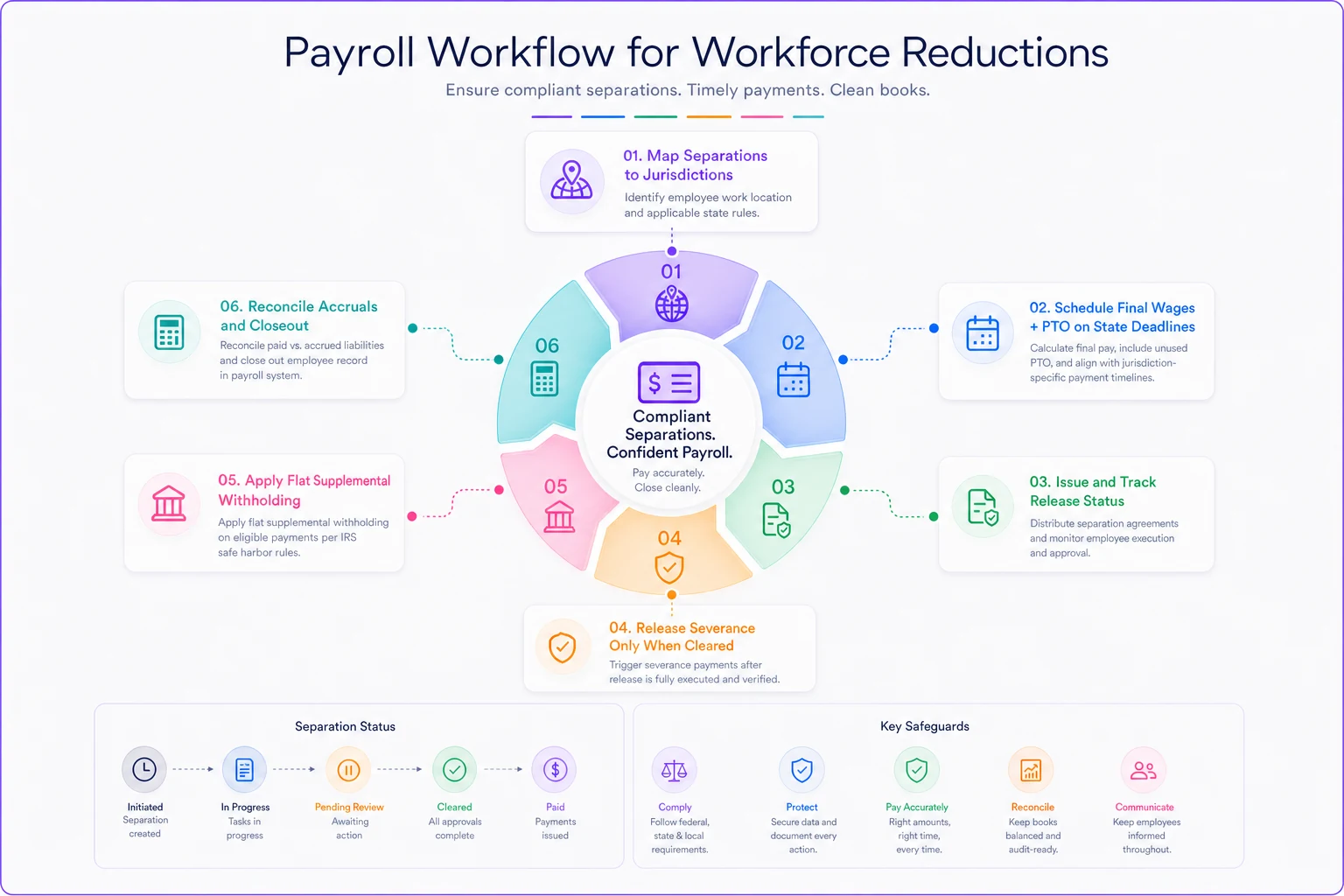
When a reduction involves a handful of people, you can run this on a spreadsheet. Past 15–20 separations across multiple states, the tracking is where errors creep in — mismatched statuses, a severance paid before a release cleared, a final check that missed a state deadline. This is exactly the kind of multi-track, status-dependent workflow where incident-grade payroll controls earn their keep, because a reduction pay run has the same failure profile as an incident: high stakes, compressed timeline, little room to redo it.
The communication pack that limits exposure
Most wage claims after a reduction don't come from the math being wrong. They come from the employee not understanding the math and assuming they got shorted. A clear, per-employee statement kills a large share of that before it starts.
-
A final pay statement that itemizes every component — regular wages, PTO hours and rate, any commission, and the dates covered
-
A separate severance letter stating the gross amount, the withholding method used, the expected pay date (tied to release clearance), and the net
-
The release document with the consideration and revocation periods spelled out plainly
-
Benefits continuation details — last day of coverage and COBRA timing
-
A single point of contact for pay questions, with a real response-time commitment
The itemization is what does the work. When someone can see their 68 hours of accrued PTO at their actual rate as a line item, they don't file a claim guessing you kept it. Ambiguity is what generates disputes, and the communication pack exists to remove it.
A real scenario
A regional services company with roughly 90 employees across four states ran a reduction of 22 people. The first attempt went out in their normal bi-weekly batch. Two problems surfaced within a week: three employees in a same-day-pay state got their final checks late, and severance for several over-40 employees had been paid before the revocation window closed — which technically voided the release protection on those.
Fixing it meant cutting penalty payments on the late finals, re-papering the releases, and reversing and re-cutting a couple of severance payments — which, because they crossed a quarter boundary, meant a correction to the quarterly filing. Not catastrophic, but a week of cleanup and a nervous conversation with counsel.
The second reduction, about a year later, used a decomposed component sheet and split schedules: final wages on each state's clock, severance gated on release status. Around 18 people, zero penalty exposure, no filing corrections. The difference wasn't effort — both took real work. It was sequencing and tagging the components correctly up front instead of treating the layoff as one payroll batch.
When a lump-sum severance is a bad idea
Flat 22% supplemental withholding is clean for most amounts, but if someone's severance is large enough to push their total supplemental wages for the year over $1M, the excess is subject to the mandatory 37% rate.
For executive separations, run that calculation deliberately. And if severance is structured as salary continuation — paid over the normal cycle rather than as a lump — the tax and benefits treatment shifts entirely. Continuation often keeps benefits running and is taxed like regular payroll, which changes your accrual and your communication pack. Don't let someone default to "lump sum" without checking what the agreement actually specifies.
Who should slow down before processing
If you operate in more than two states, do not run separations in your standard batch. The deadline differences alone will catch you.
If any affected employee is over 40 and part of a group termination, the OWBPA disclosure requirements (the list of ages and job titles in the decision group) apply — missing this invalidates the release even if everything else is perfect.
-
If you operate in more than two states, do not run separations in your standard batch. The deadline differences alone will catch you.
-
If any affected employee is over 40 and part of a group termination, the OWBPA disclosure requirements (the list of ages and job titles in the decision group) apply — missing this invalidates the release even if everything else is perfect.
-
If severance crosses a quarter or year boundary, map the filing impact before you cut anything, not after. Corrections that cross periods are the ones that multiply.
If severance crosses a quarter or year boundary, map the filing impact before you cut anything, not after. Corrections that cross periods are the ones that multiply.
Tying off the loose ends
A clean reduction pay run comes down to two things done in order: decompose every separation into its pay components with the right timing and tax tag, then run final wages and severance on separate, correctly-gated schedules. Everything that goes wrong — the penalties, the voided releases, the amended returns — traces back to collapsing those into one batch because the layoff felt like a single event.
It isn't a single event to payroll. It's a set of individual obligations with individual deadlines. When one of those does slip through and you have to unwind a payment after the fact, treat it with the same rigor you'd use for any retroactive correction workflow — document the original, the correction, and the filing impact — so the fix doesn't create its own second problem. Build the component sheet, keep the schedules separate, and the hardest part of the whole reduction becomes the part that's actually predictable.
It isn't a single event to payroll. It's a set of individual obligations with individual deadlines. When one of those does slip through and you have to unwind a payment after the fact, treat it with the same rigor you'd use for any retroactive correction workflow — document the original, the correction, and the filing impact — so the fix doesn't create its own second problem. Build the component sheet, keep the schedules separate, and the hardest part of the whole reduction becomes the part that's actually predictable.
Ready to simplify your payroll operations?
Join 2,000+ businesses using Payexly to reduce payroll overhead, ensure compliance, and enhance employee satisfaction.