

Most payroll breaches don't start with a dramatic hack. They start with an HRIS integration that was set up once, given way too much access, and then forgotten for three years. The token never rotated. The vendor pulled the full employee record when all they needed was a pay-rate field. And nobody checked whether the consent language on file actually covered what the API was doing.
This piece is narrow on purpose. It's about the plumbing between your HRIS and the systems that read from it — benefits brokers, time platforms, analytics tools, 401(k) recordkeepers — and how to design that plumbing so payroll PII doesn't leak out the side door. If you want the broader data-retention and cross-border story, that's covered in the piece on making payroll data audit-ready. Here we stay on the API surface.
The default integration is almost always over-scoped
Same pattern, over and over. A company buys a benefits admin platform. The implementation consultant says "just give us read access to your HRIS employee endpoint." The admin, wanting the project done, grants a token scoped to the entire /employees object. That object includes SSN, bank routing and account numbers, home address, date of birth, compensation history, and sometimes dependents' PII.
The benefits platform needed maybe six fields. It got forty.
Why does this happen so predictably? Three reasons:
-
HRIS APIs are built around coarse-grained objects. You get "the employee record," not "the four fields this vendor requires." Field-level scoping often exists but takes extra configuration nobody budgets time for.
-
The vendor's integration is generic. It's built to work for every customer, so it requests the superset of fields any customer might need.
-
Nobody owns the question "what's the minimum this integration actually requires?" Procurement signs the contract, IT flips the switch, and the mapping never gets reviewed.
The result is a dozen external systems each holding a near-complete copy of your workforce PII, most of which they don't use.
Field-level minimization templates
The fix isn't philosophical. It's a spreadsheet you fill out per integration, before the token is ever issued. A minimization template forces someone to justify every field leaving your HRIS.
Eliminate payroll errors and delays.
Payexly streamlines every payroll cycle ensuring accuracy and compliance.
- Automated payroll processing
- Real-time tax compliance
- Benefits & deductions management
No credit card required
A workable template has these columns:
| Field | Needed? | Justification | Transform | Refresh freq |
|---|---|---|---|---|
| legal_name | Yes | Match employee record | None | On change |
| ssn | No | Vendor uses internal ID | — | — |
| ssn_last4 | Yes | Identity verification | Truncate to last 4 | On change |
| bank_account | No | Payments run through us | — | — |
| pay_rate | Yes | Benefits eligibility tiers | Round to band | Per pay period |
| dob | Yes | Age-banded premiums | Year only | On change |
| home_address | No | Vendor is digital-only | — | — |
Two things worth calling out. First, the transform column does a lot of quiet work. A benefits vendor almost never needs a full SSN — last four digits plus an internal employee ID is enough to match records. A vendor pricing age-banded coverage needs the birth year, not the full date. Shipping dob_year instead of dob removes a field that's useful to identity thieves and useless to almost everyone else.
Second, "Needed? No" fields should be technically blocked, not just left unmapped. If the token can read SSN, assume SSN will eventually get read — through a bug, a misconfiguration, or a support engineer debugging in production. Minimization that lives only in a mapping doc is minimization that isn't enforced.
Block "Needed? No" fields at the API gateway rather than relying solely on mapping sheets.
The first time a team fills one of these out for an existing integration, they almost always find three or four fields flowing out that no one can justify. That's the whole point.
Consent-record schemas that match what the API actually does
This is where things get legally sharp. Most employee data notices say something vague like "we may share your information with third-party service providers." That holds up until an employee asks what specifically left the building, or a regulator asks you to demonstrate that your disclosures match your actual data flows.
The problem is that consent records and integration configs live in two different universes. Legal owns the notice. IT owns the token. Nobody reconciles them. So you end up disclosing "benefits administration" while your API is also quietly feeding an analytics vendor and a background-check platform that the consent language never mentioned.
A consent-record schema fixes the drift by making consent machine-checkable against the integration itself. A practical schema captures, per data flow:
-
purpose — the specific reason (e.g. "medical premium calculation"), not a category
-
fields_disclosed — the exact minimized field list, pulled from the template above
-
recipient — legal entity name, not product name
-
legal_basis — contract, consent, legitimate interest, statutory
-
jurisdiction — which employees this applies to
-
effectivedate and reviewdate
-
linkedtokenid — the actual credential this consent authorizes
That last field is the one most schemas miss. When consent is tied to a specific token ID, you can run a check: does every active token have a matching, current consent record, and do the fields the token can read match the fields consent authorizes? Any mismatch is a finding. A token reading fields outside its consent record is exactly the kind of gap that turns a routine audit into a bad afternoon.
The payoff when an employee files a data-access request: instead of a frantic email thread, you pull the consent records keyed to that employee's jurisdiction and hand over an exact list of what went where and why.
Token lifecycle: the part everyone skips
Tokens are where good intentions go to die. The integration gets built, the token gets minted, and then it just sits there — long-lived, broadly scoped, and apparently immortal. A large share of real-world payroll data exposure traces back to credentials that should have been rotated or revoked and weren't.
-
Issuance — Scope the token to the minimized field list, set an expiry, and tag it with the integration owner and linked consent record. A token with no named owner is an orphan from birth.
-
Rotation — Rotate on a schedule, not "when we remember." Quarterly is a reasonable baseline for payroll-grade access; monthly for anything touching full financial detail. Automated rotation beats calendar reminders because calendar reminders get dismissed.
-
Scope review — At each rotation, re-run the minimization template. Integrations accumulate fields over time as vendors add features. The scope that was minimal last year may be bloated now.
-
Revocation triggers — Define the events that kill a token immediately: vendor contract ends, integration owner leaves, the vendor discloses a breach, or the token hasn't been used in 60 days. An unused token is pure downside risk.
-
Decommission — When an integration is retired, the token must be revoked and you need written confirmation the vendor has deleted the data it held. Revoking access doesn't un-copy the records already pulled.
The dead-token problem is worth dwelling on. When you offboard a benefits broker, cancelling the contract and revoking the token feels like you're done. But that broker's system still holds months of employee PII it pulled while active. Decommission isn't complete until deletion is confirmed in writing. That confirmation becomes part of your evidence trail — and if you're already mapping payroll events to telemetry the way the payroll logging and SIEM checklist lays out, token issuance, rotation, and revocation events should be flowing into that same pipeline so there's a forensic record of exactly who held access and when.
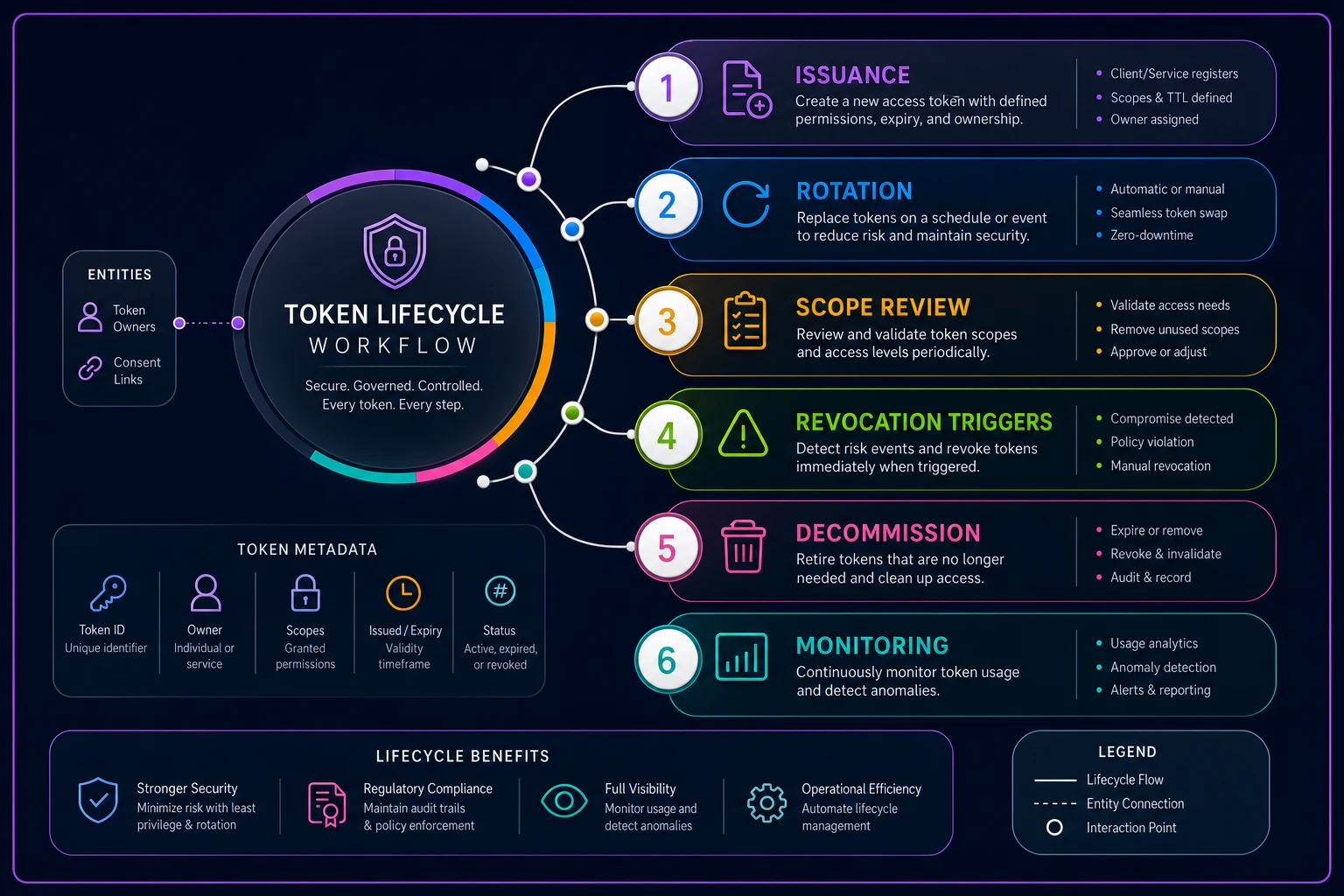
A simple visual of the lifecycle makes responsibilities and handoffs clear for engineering and security teams.
Vendor verification cadence — tiered by what they can actually touch
Not every integration deserves the same scrutiny. A vendor reading payrate and dobyear is a different risk than one with full SSN and bank detail. Flat vendor review schedules waste effort on low-risk integrations and under-scrutinize the dangerous ones.
Tier by PII sensitivity and breadth of access:
| Tier | What they access | Verification cadence | What you check |
|---|---|---|---|
| High | Full SSN, bank, comp history | Quarterly | SOC 2, token scope, breach history, subprocessors, deletion proof |
| Medium | Truncated identifiers, pay bands | Semi-annual | SOC 2, token scope, incident log |
| Low | Non-sensitive IDs, names only | Annual | Attestation, contract currency |
The mistake teams make is setting cadence by contract value instead of data sensitivity. A cheap analytics tool with read access to full employee records is a higher risk than an expensive platform that only sees truncated fields. Price tells you nothing about exposure.
What "verification" actually means for a high-tier vendor:
-
Current SOC 2 Type II report, actually read, not just filed
-
Confirmation their subprocessor list hasn't changed — a vendor quietly adding an offshore data processor changes your cross-border posture
-
Their token scope still matches your minimization template
-
Any security incidents since last review, disclosed or discovered
-
For anything decommissioned since last review, written deletion confirmation on file
What "verification" looks like in practice is a checklist and evidence bucket for each item above that you can produce during an audit.
Monitoring KPIs that tell you something is wrong
Point-in-time reviews miss drift between review dates. You want a handful of metrics that surface problems continuously — not a 40-line dashboard nobody reads. The ones that actually earn their place:
-
Orphaned tokens — active credentials with no named owner or no linked consent record. Target: zero. Anything above zero is a live gap.
-
Token age distribution — how many tokens exceed their rotation window. A rising count means rotation is slipping.
-
Consent-to-scope mismatches — tokens reading fields outside their consent record. Every instance is a potential disclosure violation.
-
Field volume per integration — average fields pulled per API call, trended over time. A sudden jump often means a vendor update quietly started pulling more than before.
-
Dormant active tokens — credentials unused for 30+ days but still live. Prime revocation candidates.
-
Deletion confirmations outstanding — decommissioned integrations without written deletion proof.
The field-volume metric catches the sneakiest failures. Vendors push updates that expand their API queries without telling you. If your integration was pulling six fields and the average quietly climbs to eleven, something changed on their side that your consent records never accounted for. Watching the trend catches it before an audit does.
A short real scenario
A regional healthcare group with around 900 employees had eleven HRIS integrations built up over several years. When they ran minimization templates across all of them, seven were pulling full SSN and six had read access to bank account fields — and at most two actually needed either.
Three tokens had no identifiable owner. One belonged to a benefits broker they'd stopped using about fourteen months earlier; the token was still live, and nobody had ever asked for a deletion confirmation, so none existed.
The cleanup took roughly six weeks. They re-scoped every integration to minimized field lists, replaced full SSN with truncated identifiers on nine of the eleven, revoked the orphaned active tokens, and chased deletion confirmations from the three former vendors. Of the original eleven integrations, the number holding full-sensitivity PII dropped from seven to one — a single payroll-adjacent system that genuinely required it.
Nothing about this was exotic. It was a spreadsheet, a token audit, and a few uncomfortable vendor emails. But it turned "we're not entirely sure who has our employees' SSNs" into a defensible, documented answer.
When tighter patterns make sense — and when they're overkill
Full field-level minimization, per-token consent linking, and quarterly high-tier verification is the right posture when you're running multiple HRIS integrations, handling multi-state or cross-border workforces, or operating in a regulated industry. The overhead pays for itself the first time a regulator or an employee asks a pointed question.
It's overkill if you have a single payroll provider, no third-party integrations, and a dozen employees. At that scale, a basic access review once a year is proportionate. Building a consent schema for one vendor is effort you don't need.
The honest middle ground: most companies don't need every control at maximum intensity, but almost everyone with more than two external HRIS integrations is under-managing tokens and over-sharing fields. If you've never run a minimization template against your existing integrations, that's the single highest-value thing to do first — before you touch consent schemas or rotation schedules. You usually find the problems hiding in integrations you'd completely forgotten were still connected.
The one habit that holds all of this together
Everything above comes down to a single discipline: nothing gets API access to payroll PII without a named owner, a minimized field list, and a consent record it's tied to. Get that gate in place for new integrations, then work backward through the ones you already have.
The field templates, the token lifecycle, the vendor cadence, the KPIs — those are the mechanics. But the reason payroll data leaks through API integrations is almost never a sophisticated attack. It's an old token, over-scoped, owned by nobody, pulling fields no one remembers approving, into a vendor system no one's reviewed since the day it was turned on. Close that gap and you've closed the one that actually gets most companies in trouble.
The field templates, the token lifecycle, the vendor cadence, the KPIs — those are the mechanics. But the reason payroll data leaks through API integrations is almost never a sophisticated attack. It's an old token, over-scoped, owned by nobody, pulling fields no one remembers approving, into a vendor system no one's reviewed since the day it was turned on. Close that gap and you've closed the one that actually gets most companies in trouble.
Ready to simplify your payroll operations?
Join 2,000+ businesses using Payexly to reduce payroll overhead, ensure compliance, and enhance employee satisfaction.