
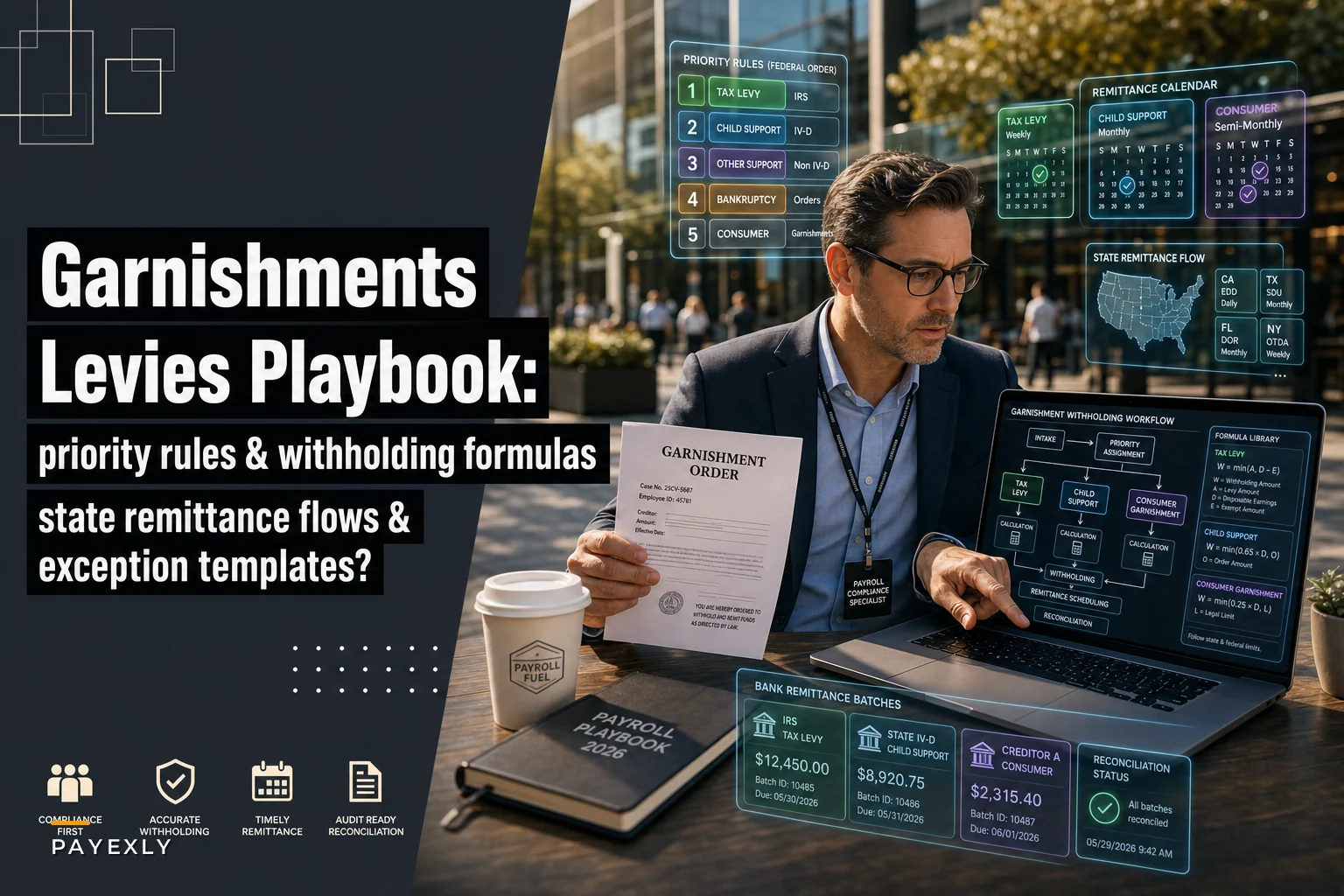

The payroll garnishment process breaks most companies the same way. An employee gets hit with multiple garnishments—child support from California, federal tax levy, credit card judgment from Texas—and suddenly your payroll team is drowning in conflicting priority rules, incompatible withholding calculations, and remittance deadlines that don't line up with your pay cycles.
When a single garnishment order can trigger weeks of payroll chaos
One medical practice had their payroll manager spend 14 hours manually recalculating garnishments after discovering they'd been applying Texas rules to a California child support order for three months. The employee's take-home had been wrong the entire time, remittances were late, and fixing it meant adjusting six pay periods while trying to avoid penalties from two different states.
The mess happens because garnishment processing sits at this weird intersection of federal law, state regulations, and court orders that all speak different languages. Your payroll system might handle basic wage attachments fine—but throw in a priority conflict between an IRS levy and a tribal court order, and watch everything grind to a halt.
Priority rules that actually match reality
Most garnishment guides hand you the federal priority list and call it a day. Real garnishment conflicts don't resolve that cleanly. The standard hierarchy goes: child support, federal tax levies, student loans, then consumer garnishments. Except when it doesn't.
Eliminate payroll errors and delays.
Payexly streamlines every payroll cycle ensuring accuracy and compliance.
- Automated payroll processing
- Real-time tax compliance
- Benefits & deductions management
No credit card required
State-specific rules destroy this neat ordering constantly. In Pennsylvania, spousal support can jump ahead of federal student loans if the order predates the loan garnishment by six months. California treats earnings withholding orders for taxes differently than federal tax levies, creating a parallel priority track. Texas allows certain small claims judgments to aggregate, which can push them up the ladder.
The messiest situations involve tribal garnishments, military allotments, and bankruptcy automatic stays. A bankruptcy filing doesn't automatically stop child support garnishments but might pause everything else—except the notification requirements still apply, and you need documentation showing why you stopped withholding. Miss that documentation window and you're personally liable as the employer.
Priority conflicts usually surface in a few predictable ways.
When multiple garnishments exceed the federal 25% disposable income cap, you need to know which ones to short. The answer changes depending on whether you're dealing with Title III limits, state-specific caps, or orders with their own percentage calculations. Consumer garnishments always lose, but the order among government garnishments gets murky fast.
Timing gaps create a different kind of confusion. An IRS levy arrives Monday, a child support order arrives Wednesday, but the child support is dated two weeks earlier. Which takes precedence depends on your state's interpretation of "first in time" versus federal priority. Some states honor postmark dates, others use receipt dates, a few use court filing dates.
Things get even messier when garnishment types blend together—a child support order that includes medical support, spousal maintenance, and arrears all at once. Each component might have different priority levels and withholding limits. Medical support often bypasses the usual percentage caps, while arrears might be subject to different interest calculations entirely.
State withholding formulas beyond the basics
The federal 25% of disposable income rule is just the starting point. Every state layers on its own calculations, exemptions, and special cases that turn simple math into something much messier.
Take Minnesota: they protect 40 times the federal minimum wage per week, or 75% of disposable earnings, whichever is greater. But for child support, that protection disappears. And if the employee has dependents, additional exemptions kick in—$4.50 per dependent per week—unless it's a student loan garnishment, where dependent exemptions don't apply at all.
Illinois uses a sliding scale based on gross income. Under $290 per week is fully exempt. From $290 to $580, only the amount over $290 can be garnished. Over $580, it's 15% max. Unless it's child support—then the percentages jump to 20% for one child, 28% for two, up to 50% for six or more.
The calculation headaches multiply when employees work across state lines. A New Jersey resident working in New York with a garnishment from Pennsylvania—which state's formula applies? Generally it's the state where wages are earned, but multi-state employers often need to track employee work locations daily just to apply the right formula.
Some states treat tips, commissions, and bonuses differently within garnishment calculations. California includes tips in disposable income for child support but excludes them for consumer garnishments. New York treats lump sum bonuses as separate from regular wages, applying different withholding percentages. These distinctions matter when your restaurant staff or sales team gets hit with garnishments.
Remittance flows that prevent penalties
Getting the money withheld is only half the battle. Remitting it correctly, on time, to the right agency is where most penalties actually come from. Each garnishment type follows different remittance rules, and missing deadlines triggers employer penalties that can dwarf the original garnishment amounts.
Child support remittances typically flow through state disbursement units (SDUs) within seven business days of withholding. Some states want faster—Indiana requires remittance within two business days, Texas wants electronic payments by the next business day. Miss these windows and you're looking at penalties starting around $100 per day, plus potential contempt charges.
Federal tax levies follow IRS deposit schedules, which might not align with your payroll dates. If you're a semi-weekly depositor for employment taxes, garnishment remittances follow the same schedule. Monthly depositors get different rules. The IRS expects you to know your deposit schedule and apply it to levy remittances without being told.
Student loan garnishments go to various servicers, each with their own remittance addresses, formats, and schedules. FedLoan wants electronic remittances within 10 days. Navient accepts checks but requires specific employee identifiers in the memo line. Great Lakes processes through a third-party lockbox that has been known to change addresses every few years.
The expensive mistakes happen with bankruptcy-related garnishments. Once you receive a bankruptcy notice, existing garnishments might need to stop immediately—but any funds already withheld and not yet remitted enter legal limbo. Some courts want the funds held in escrow, others want immediate remittance to the court, and some require return to the employee. Guess wrong and you're paying twice.
For multi-state employers, remittance complexity really compounds. California wants electronic remittance through their state portal. Texas requires registration with their system before you can remit anything. New York still accepts paper checks for some garnishment types but mandates electronic filing for others. Keeping these straight across 30+ employees with active garnishments requires serious workflow discipline.
Exception templates for common scenarios
Standardizing exception handling saves your payroll team from making expensive judgment calls in the moment. These templates cover the majority of garnishment exceptions without legal risk.
Insufficient funds template: When an employee's check won't cover all garnishments after taxes and required deductions, document the shortfall calculation. List each garnishment in priority order, show the available funds after each deduction, and note where the money ran out. Send this to all garnishment creditors, including the ones who got nothing. This prevents "failure to withhold" penalties by proving impossibility.
Termination during garnishment: Employee terminations require notification to all active garnishment creditors within specific timeframes—usually 10 days, sometimes less. Include the termination date, final check date, amount withheld from the final check, and any known forwarding address. Even if nothing was owed on the final check, send the notification. Some states fine employers $500 or more for missing these notices.
Contested garnishment template: When employees claim exemption from garnishment (head of household, incorrect identity, already paid), you need a holding pattern. Withhold the funds but don't remit. Notify the creditor of the contest within 5 business days, hold funds for the state-specific period (usually 10–20 days), then follow the court's direction or remit if no court response arrives.
Multi-state conflict template: When garnishments from different states create conflicts, document your resolution logic. "Employee primarily works in [State A], garnishment received from [State B]. Applying [State A] withholding rules per [cite state statute]. Maximum withholding is [X%], allocated among creditors as follows..." This documentation protects you when creditors challenge your calculations.
Bankruptcy stay notification: The moment you receive bankruptcy notice, freeze all non-priority garnishments. Your template should acknowledge receipt of the notice, confirm cessation of withholding, report amounts withheld but not yet remitted, and request direction for held funds. Send this within 48 hours to avoid automatic stay violations.
Operational workflows that scale
Small companies handle garnishments ad-hoc until the volume breaks them. Somewhere around 15–20 active garnishments, manual processing starts falling apart. Building repeatable workflows before hitting that wall is the difference between a manageable process and a scramble.
Start with intake standardization. Every garnishment order needs the same review: verify employee identity, confirm employment status, calculate priority position, determine withholding amount, set remittance schedule, and create an audit trail. Whether it's your first garnishment or your fiftieth, the intake process should be identical.
The calculation workflow branches based on garnishment type. Child support follows one path with specific percentage calculations and state SDU remittance. Tax levies follow another path using IRS Publication 1494 exempt amount calculations. Consumer garnishments take a third path with 25% federal limits and state-specific exemptions. Separate workflows for each type reduce the errors that come from applying the wrong formula.
GARNISHMENT INTAKE → TYPE IDENTIFICATION → PRIORITY ASSIGNMENT → CALCULATION PATH ↓ Child Support → SDU Remittance Schedule Tax Levy → IRS Deposit Schedule Consumer → Court-Ordered Deadline ↓ WITHHOLDING → REMITTANCE → RECONCILIATION
Here's a visual depiction of the intake-to-reconciliation workflow.
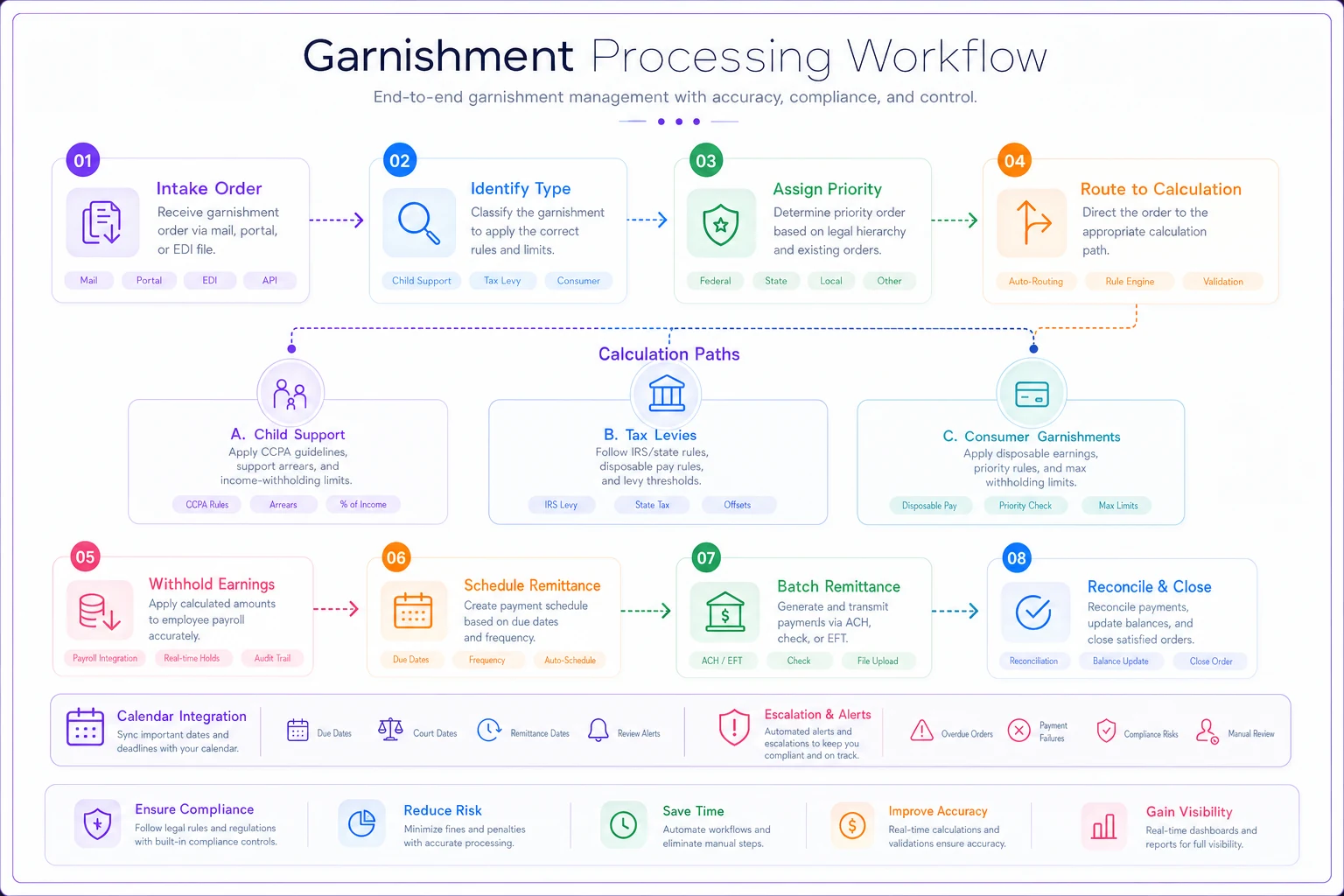
Standardize a single intake checklist and use it for every order to reduce onboarding errors and speed processing.
Remittance workflows need calendar integration. Every garnishment creates recurring remittance obligations with different deadlines. Map each garnishment to your payroll calendar—when withholding occurs, when remittance is due. Some companies run garnishment remittances weekly regardless of pay frequency just to stay compliant.
Reconciliation catches problems before they compound. Every pay period, reconcile amounts withheld against amounts remitted. Check that priority orders were followed correctly, maximum withholding wasn't exceeded, and all required notifications went out. Skip this step and you end up doing archaeology months later when errors finally surface.
Volume triggers for workflow upgrades are fairly predictable:
| Active Garnishments | Recommended Approach |
|---|---|
| Under 10 | Spreadsheets with manual tracking |
| 10–25 | Dedicated tracking software or enhanced payroll features |
| 25–50 | Automated priority resolution and calculation tools |
| 50+ | Automated calculation engines or outsourced garnishment function |
When one piece of the workflow is missing, the others degrade—document the calendar obligations and reconciliation steps early.
Building automation that handles edge cases
The payroll garnishment process is a natural fit for automation, but most platforms only handle the simplest scenarios. Real automation needs to manage priority conflicts, state-specific calculations, and the exception cases that break standard logic.
Effective garnishment automation starts with rules engines that understand hierarchy. When multiple orders arrive, the system should automatically sort them by federal priority, state-specific rules, and timing. But it also needs override capability for edge cases—like when a tribal court order includes language that affects normal priority rules.
Calculation automation must go beyond simple percentages. It needs to understand disposable income definitions that vary by state and garnishment type. In some states, disposable income for child support includes tip income while the same figure for consumer garnishments doesn't. The system needs to track these distinctions and apply them correctly without someone manually intervening each time.
Remittance automation is where companies typically save the most time. Instead of manually cutting checks or initiating transfers for each garnishment, platforms can batch remittances by creditor type and schedule them according to requirements—IRS levies on federal deposit schedules, child support on state SDU timelines, consumer garnishments meeting court-ordered deadlines.
Notification automation prevents the penalties that come from missed communications. When an employee terminates, the system generates notices to all active garnishment creditors. When garnishments exceed available wages, shortage notices go out automatically. When bankruptcy notices arrive, the system freezes appropriate garnishments and sends required acknowledgments.
AI-powered operational software takes this further by learning from exception patterns over time. If your company repeatedly sees California child support orders with medical support riders, the platform adapts to handle these automatically. If Texas credit card garnishments consistently come with specific calculation quirks, the system builds those into its logic. The integration piece matters just as much as the automation itself—garnishment platforms that don't connect to your payroll system create new problems. You need bi-directional sync: garnishment calculations flowing into payroll, and payroll results flowing back to update garnishment balances and trigger remittances. That integration is what actually eliminates the manual data entry that introduces errors in the first place.
State-specific gotchas that trigger audits
Every state has garnishment quirks that don't show up in standard compliance guides. These create audit triggers when companies apply generic rules to state-specific situations.
North Carolina's contributory negligence doctrine extends to garnishments—if an employer makes any error in processing, even a minor one, they can lose all protection from liability. One decimal point error and you might owe the full amount to both employee and creditor. Most states offer good faith protection. North Carolina doesn't.
Pennsylvania requires employers to notify employees 10 days before implementing any garnishment, even IRS levies. Miss this notice period and the garnishment is void—but you're still liable to the creditor. You essentially eat the garnishment amount yourself. This pre-notification requirement doesn't exist in neighboring states, which catches multi-state employers constantly.
Florida protects head-of-household wages almost completely, but the employee must claim this exemption within very specific timeframes. As an employer, you're supposed to notify employees of their exemption rights. Most companies don't know this requirement exists. Failure to notify can make you liable for improperly garnished wages, even if the employee never would have qualified for the exemption anyway.
Kentucky allows something called "slow pay" agreements where employees can negotiate payment plans directly with creditors to avoid garnishment. If you receive a garnishment order while a slow pay agreement exists, you're supposed to honor the agreement—not the garnishment. Except there's no standard way creditors notify employers about these agreements, which creates a compliance nightmare with no clean solution.
Massachusetts went through a significant garnishment law overhaul that created a transitional mess. Garnishments issued before 2020 follow old rules, those after follow new rules, and some straddle both periods. The withholding calculations are completely different between the two systems. Companies operating in Massachusetts need to track which rules apply to each garnishment individually—there's no shortcut.
Building your garnishment response system
The companies that handle garnishments smoothly treat them as a system, not a series of individual events. That starts with clear ownership and escalation paths.
Assign garnishment coordination to someone who understands both payroll mechanics and basic legal compliance. This person doesn't have to process every garnishment, but they own the workflow, maintain templates, and handle escalations. In companies under 200 employees, this is usually a senior payroll specialist. Above that size, you probably need a dedicated role or an outsourced function.
-
Intake checklist — captures garnishment type, issuing authority, priority level, calculation method, and remittance requirements. Should take under 10 minutes to complete but capture everything needed for processing. Build separate checklists for each major garnishment type rather than one massive catch-all.
-
Calculation worksheets — show the math transparently. When employees or creditors challenge calculations, you need clear documentation showing how you arrived at withholding amounts. These worksheets should reference specific statutes or garnishment order sections that justify your numbers.
-
Governance documentation — your governance framework should explicitly address garnishment approvals and reviews. Who can modify garnishment calculations? Who approves remittances over certain amounts? Who handles employee disputes? Without clear governance, garnishment processing becomes a finger-pointing exercise when things go wrong.
-
Communication protocol — employees need to know what's being withheld and why. Creditors need confirmation of receipt and processing. Retroactive corrections involving garnishments need special handling. Your protocol should specify timing, method, and documentation for each communication type.
-
Escalation triggers — when garnishments exceed 40% of disposable income, escalate for review. When priority conflicts can't be resolved by standard rules, escalate to legal counsel. When employees claim financial hardship, escalate to HR. These triggers prevent your payroll team from making decisions that are genuinely above their pay grade.
Each component reinforces the others. The intake checklist feeds the calculation worksheets, which feed the communication protocol, which feeds governance review. When one piece is missing, the whole system gets shaky.
Signs your garnishment process needs work
Watch for these warning signs that your payroll garnishment process is starting to strain:
-
Processing time per garnishment exceeds 45 minutes. Initial setup might take that long, but ongoing processing shouldn't. If your team is spending nearly an hour each pay period on individual garnishments, your workflows need attention.
-
Garnishment-related inquiries consume more than 10% of payroll time. Constant questions from employees, creditors, or managers usually means unclear processes or poor communication. A well-run garnishment process operates quietly in the background.
-
You're holding garnishment funds in suspense accounts on a regular basis. Occasional holds for contested garnishments make sense. Routine holding suggests a remittance process problem, and money sitting in suspense accounts attracts audit attention.
-
Different team members calculate garnishments differently for similar situations. Two payroll specialists should arrive at the same withholding amount given the same garnishment order. If they don't, you have a standardization gap.
-
Retroactive garnishment adjustments happen more than once or twice a quarter. Each retroactive fix creates downstream complications with remittances and reporting—and frequent corrections suggest systematic errors, not one-off mistakes.
-
Audit findings repeatedly cite garnishment issues. Whether internal or external, repeated findings indicate process gaps that tend to precede penalty notices from creditors or state agencies.
If two or three of these are true for your organization right now, the process problems are almost certainly compounding quietly in the background.
Moving forward
The payroll garnishment process will keep getting more complex as states add requirements and creditors get more aggressive. Building solid workflows now prevents the crisis management that hits when garnishment volumes spike unexpectedly.
Start by documenting your current process, whatever state it's in. Even flawed processes improve with documentation because you can actually see where breaks occur. Map each garnishment from receipt through final remittance, noting where manual intervention happens and where errors typically surface.
Then stress-test your workflows. Start with a single consumer garnishment, add child support, then layer in an IRS levy. Watch where the process strains. Those stress points tell you where automation or additional resources would actually make a difference.
The companies handling garnishments most effectively treat them as a specialized function, not just another payroll task. Generic payroll knowledge isn't enough—you need people or systems that understand the intersection of federal law, state regulations, and operational reality. Specialization wins over generalist approaches every time.
Your garnishment process directly impacts employee financial stability and your company's compliance standing. Getting it right means fewer penalties, less time in crisis mode, and employees who trust you're handling their sensitive financial information correctly. The operational investment pays off faster than most people expect.
Your garnishment process directly impacts employee financial stability and your company's compliance standing. Getting it right means fewer penalties, less time in crisis mode, and employees who trust you're handling their sensitive financial information correctly. The operational investment pays off faster than most people expect.
Ready to simplify your payroll operations?
Join 2,000+ businesses using Payexly to reduce payroll overhead, ensure compliance, and enhance employee satisfaction.