


Most teams don't realize their 1099 problem started back in March — when a hiring manager emailed a freelancer a contract, asked accounting to "just cut them a check," and nobody collected a W-9. By the time year-end hits, you're reverse-engineering nine months of payments across three different payment methods, chasing TINs from people who stopped answering emails in September, and trying to figure out whether the "consultant" you paid $42k was actually an employee the whole time.
The contractor 1099 lifecycle is cheap and manageable if you handle it at intake. Defer it, and it gets brutally expensive. A missing W-9 in Q1 becomes a backup withholding headache in Q4. A sloppy classification call at onboarding becomes a reclassification audit two years later. This post is about building the lifecycle so the year-end 1099 run is boring — which is exactly what you want it to be.
The real failure point: nobody owns the handoff between hiring and paying
The pattern shows up constantly. A department head finds a contractor, negotiates a rate, kicks off the work. Payment gets arranged informally — maybe through the corporate card, maybe a wire, maybe the owner's Venmo during a cash crunch. Accounting finds out about the relationship only when an invoice lands.
That gap is where 1099 operations quietly fall apart. The person who onboards the contractor isn't the person who has to file on them in January, so the information that filing actually needs — legal name, TIN, entity type, address, exemption status — never gets captured at the one moment the contractor is motivated to give it to you: before their first payment.
What a real intake template needs to capture
A usable contractor intake template isn't a W-9 with a cover sheet stapled to it. It's the full set of fields that every downstream step — payment, reconciliation, 1099 generation — will pull from. Collect these once, structured, at onboarding:
-
Legal name and DBA (these differ constantly and wreck 1099 matching)
-
TIN or EIN, with a note on which one the W-9 actually shows
-
Entity type
sole prop, single-member LLC, S-corp, partnership, C-corp
-
1099 reportability flag (S-corps and C-corps are generally exempt for services — capture this so you don't over-report)
-
Remittance address vs. physical address
-
Preferred payment rail + banking details for that rail
-
Contract scope, rate, and expected engagement length
-
Classification determination and who made it
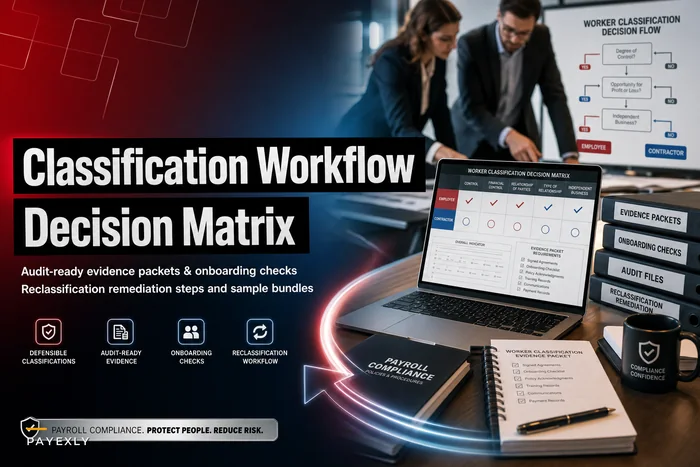
That last field matters more than most people give it credit for. If you ever face a reclassification question, having a dated record of who decided this person was a contractor and on what basis is worth more than any amount of after-the-fact explanation. If you haven't built a defensible process for that decision yet, the worker classification workflow with a decision matrix and audit-ready evidence packet pairs directly with this one.
Pick the payment rail on purpose, not by accident
Most small businesses end up paying contractors across four or five different rails with no real logic behind it — whichever was convenient that week. That's fine until reconciliation season, when you're pulling contractor payments out of ACH batches, card statements, wire confirmations, and a PayPal export, trying to piece together one clean total per contractor.
Eliminate payroll errors and delays.
Payexly streamlines every payroll cycle ensuring accuracy and compliance.
- Automated payroll processing
- Real-time tax compliance
- Benefits & deductions management
No credit card required
The deeper issue is reportability. Payments made through a third-party settlement network — PayPal, certain card platforms — can fall under 1099-K reporting by the processor, which means you should not also report them on a 1099-NEC. Double-reporting creates a mismatch that triggers notices. The rail you choose literally determines which form the income lands on and who files it. That's worth deciding deliberately.
A practical decision matrix for choosing a rail at onboarding:
| Scenario | Recommended rail | Why | 1099 implication |
|---|---|---|---|
| Recurring domestic contractor, predictable amounts | ACH | Cheap, traceable, batchable | You file 1099-NEC |
| One-off small payment, speed matters | ACH or check | Avoid card-network reporting overlap | You file 1099-NEC |
| International contractor | Wire or specialized FX rail | ACH won't reach them cleanly | Generally W-8BEN, not 1099 |
| Contractor insists on card/PayPal | Third-party processor | Their choice, but flag it | Processor may issue 1099-K — don't double-report |
| High-value milestone payment | Wire | Confirmation + same-day certainty | You file 1099-NEC |
The default should be ACH for anyone who can receive it. One rail for 80% of your contractors means one clean data source at year-end instead of five messy ones. The exceptions — international contractors, card-preferred — get flagged at intake so nothing surprises you later.
Reconcile monthly, not annually — this is the whole game
The single biggest driver of a painful year-end is that nobody touched contractor payment reconciliation during the year. Everything got pushed to December, and now you're doing twelve months of matching in two weeks while also handling everything else year-end demands.
Flip it. A recurring monthly reconciliation of contractor payments takes maybe 30–45 minutes and catches problems while they're small and the context is still fresh.
Monthly workflow that keeps January boring:
-
Pull every contractor payment from every rail for the month into one list — amount, date, contractor, rail.
-
Match each payment to a contractor record with a completed intake packet. Any payment without a matching record is your exception list.
-
Chase the exceptions immediately. These are contractors who got paid before onboarding completed, or whose W-9 is still incomplete. Fix it now while they still know who you are.
-
Update running YTD totals per contractor, so you always know who's crossing the $600 reporting threshold.
-
Flag reportability edge cases
card/PayPal payments a processor might report, reimbursements that shouldn't count toward the 1099 total, payments to exempt S-corps.
Step 4 is underrated. When you track running totals monthly, you know by October exactly who needs a 1099 and whether any packets are incomplete — giving you a full quarter to fix problems instead of discovering them at the deadline.
The reimbursement trap
One specific reconciliation mistake worth calling out: lumping expense reimbursements into the contractor's 1099 total. If you reimburse a contractor $3,800 for travel on top of $31k in fees and your 1099 reports $34,800, you've overstated their income and you'll both hear about it. Tag reimbursements as non-reportable at the point of payment so the monthly reconciliation naturally excludes them from the running total. Trying to untangle this in January from a pile of invoices is how errors slip through.
[Collect payments from all rails] ↓ [Match to contractor intake records] ↓ [Identify and chase exceptions] ↓ [Update YTD totals per contractor] ↓ [Flag reportability edge cases] ↓ [Close month — no exceptions outstanding]
Here's a simple visual of that monthly workflow.
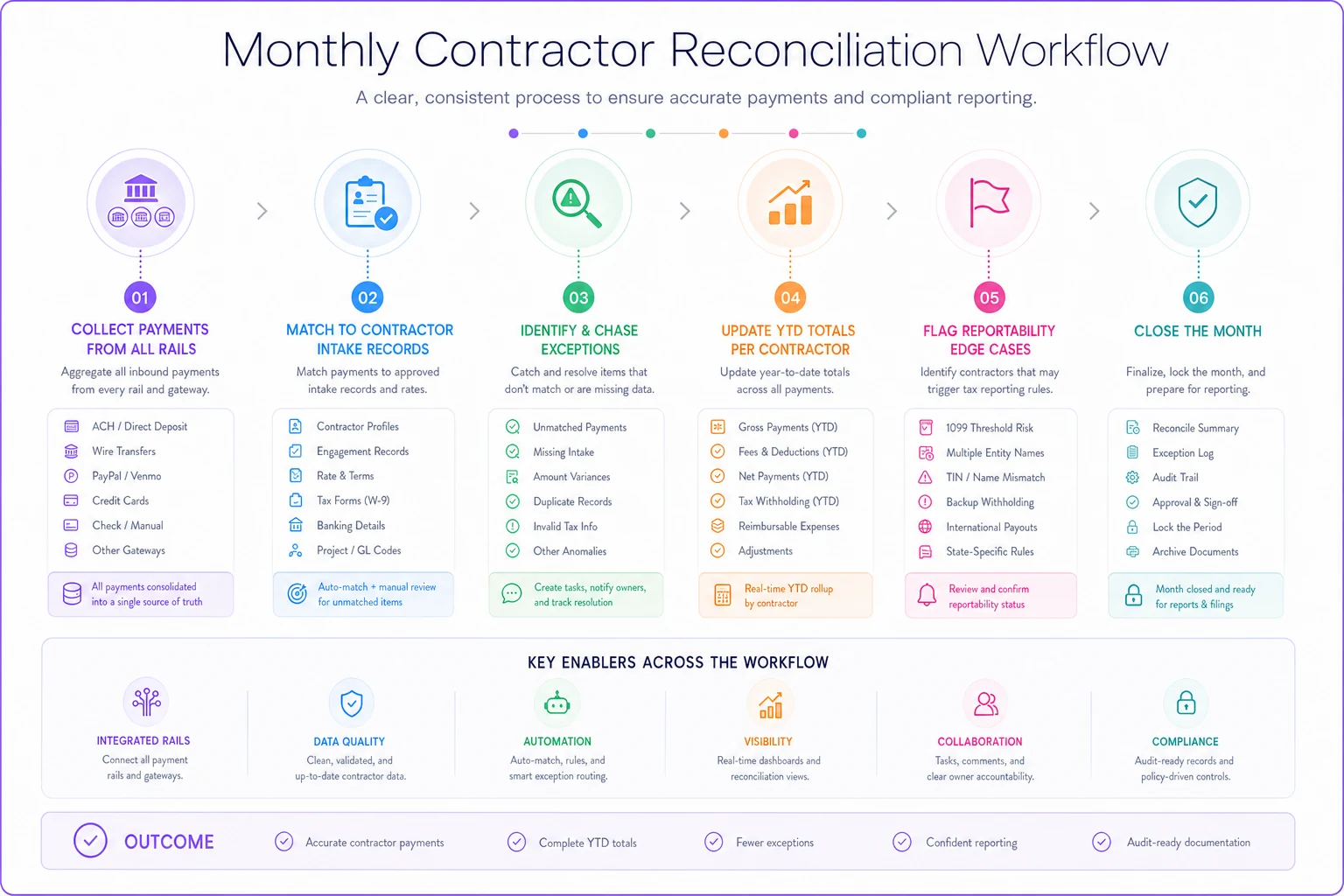
Use this to align your team on the monthly steps.
Generating the 1099 packs: make it a scheduled event, not a scramble
If you onboarded cleanly and reconciled monthly, 1099 generation becomes an assembly job rather than an investigation. The pack for each reportable contractor should come together from data you already have on file.
A complete 1099 pack per contractor includes:
-
The 1099-NEC (or -MISC where applicable) with verified name/TIN
-
The underlying W-9 on file, dated
-
The YTD payment detail supporting the box totals, broken out by rail
-
Reimbursement exclusions documented
-
Classification determination record
-
TIN match result — run TIN matching before you print, not after a rejection
That TIN match step prevents the most common year-end rejection. A name/TIN mismatch gets your filing kicked back, and if you'd been applying backup withholding correctly all year you'd have avoided the penalty exposure — but that only works if the W-9 came in at onboarding. Everything traces back to intake.
A realistic example. A design-and-build firm with around 18 recurring contractors used to spend the first two weeks of January rebuilding contractor totals from scattered payments and chasing five or six missing W-9s every year. They'd file two or three corrections after the fact and had eaten a penalty notice the year before. After moving to payment-gated intake and a monthly reconciliation, the January run dropped to about a day and a half. The corrections stopped — not because they got more careful in December, but because the problems that used to surface in December were getting caught in February, May, and August instead.
Build the audit-ready evidence bundle as you go
If a classification or reporting question ever gets raised, the difference between a stressful audit and a short one is whether your evidence already exists in assembled form. A contractor treated as 1099 who looks like an employee under the relevant test can create back-tax, penalty, and benefit-eligibility exposure that dwarfs the cost of the original engagement.
The evidence bundle per contractor should be a byproduct of normal operations, not a special project you scramble to put together:
-
Signed contract defining scope and independence
-
W-9 and TIN match result
-
The classification determination, dated, with the reasoning
-
Payment history by rail reconciled to filed totals
-
Invoices submitted by the contractor
-
Evidence supporting independence — their own tools, multiple clients, control over how the work gets done
Keeping these bundles retained and organized connects to broader record-retention discipline. The same principles covered in making payroll data audit-ready with retention, minimization, and cross-border transfer policies apply directly to contractor records, especially for international contractors where data handling rules differ.
When tight 1099 operations actually matter — and when they're overkill
When this makes sense: You pay more than a handful of contractors, use more than one payment method, or have contractors whose classification could realistically be questioned. Once you cross roughly 8–10 contractors across multiple rails, informal tracking stops scaling and the year-end cost of disorganization starts exceeding the ongoing cost of doing it right.
When it's lighter: If you pay one or two clearly independent contractors a year through a single rail, you don't need a full matrix and monthly reconciliation cadence. Collect the W-9 before the first payment, keep the contract, total it up once. Don't build machinery you won't use.
Who should be paying attention: Businesses using card platforms or PayPal as a primary contractor rail without understanding the 1099-K overlap. That's the group that most often double-reports or under-reports, and it's entirely avoidable by deciding the rail deliberately at intake rather than defaulting to whatever's convenient that week.
The thread running through all of it
Every expensive 1099 problem is a cheap onboarding problem that got deferred. The missing W-9, the ambiguous classification, the untracked PayPal payment, the reimbursement mixed into fees — each one costs almost nothing to handle at the moment it occurs, and a lot to untangle months later with the context gone and the contractor unresponsive.
Gate payment on a complete intake packet, pick the rail deliberately, reconcile monthly instead of annually, and let the 1099 packs and evidence bundles assemble themselves from data you already captured. Do that, and year-end stops being something you dread and turns into an afternoon of printing.
Gate payment on a complete intake packet, pick the rail deliberately, reconcile monthly instead of annually, and let the 1099 packs and evidence bundles assemble themselves from data you already captured. Do that, and year-end stops being something you dread and turns into an afternoon of printing.
Ready to simplify your payroll operations?
Join 2,000+ businesses using Payexly to reduce payroll overhead, ensure compliance, and enhance employee satisfaction.