



When Amazon announced plans to hire more than 300,000 U.S. workers for the 2026 holiday season—its first hiring jump in three years—most of the coverage focused on the headline number and the wage figures. What caught the attention of anyone who actually runs payroll was buried further down: the company is expanding benefits to include first-day healthcare eligibility for eligible seasonal employees starting Jan. 1, 2027.
That one detail changes the entire operational calculus. You're not just onboarding bodies and running a bigger pay file. You're configuring benefits eligibility against a hard date that lands right in the middle of year-end close, W-2 season, and the exact moment your seasonal population is either rolling off or converting to permanent.
Amazon can throw an army of systems engineers at this. Most businesses running a seasonal surge—retailers, 3PLs, hospitality groups, distribution companies—cannot. But the operational problems scale down almost perfectly, and the mistakes look nearly identical whether you're hiring 300 people or 30,000. This is a pay-cycle problem wearing a recruiting costume, and the teams that recognize it early are the ones still standing in late December.
The real problem isn't volume. It's timing collisions.
The headcount itself rarely breaks payroll. Modern processors can handle the volume. What breaks is the overlap—events that normally live on separate calendars suddenly firing at the same time.
Think about what's stacking up between October and January:
-
Thousands of new hires needing pay rates, shift differentials, and location codes configured
-
Time & attendance feeds scaling 3–5x normal volume
-
Benefits eligibility windows opening on a fixed date
-
Year-end reconciliation and W-2 prep running in parallel
-
Seasonal-to-permanent conversions changing tax and benefits treatment mid-cycle
-
Higher aggregate wages shifting your tax deposit frequency and liability
Any one of these is routine. All of them compressed into the same eight to ten pay cycles is where things fall apart. A typical failure looks like this: a distribution company adds 1,200 seasonal pickers in November, their time clock integration starts dropping punches because the batch size exceeded what the nightly feed was tuned for, and nobody catches it until the first big run produces 180 timecards with zero hours. Now you're doing manual corrections during the busiest retail week of the year.
The volume didn't cause that. The unvalidated scaling of an existing integration did.
Start with a pay-cycle calendar, not a hiring plan
Recruiting owns the hiring plan. Payroll needs its own artifact: a surge calendar mapped to actual pay periods, not weeks or months. Sounds obvious. Almost nobody does it until their second bad season.
Eliminate payroll errors and delays.
Payexly streamlines every payroll cycle ensuring accuracy and compliance.
- Automated payroll processing
- Real-time tax compliance
- Benefits & deductions management
No credit card required
The reason it matters is that every operational decision has to resolve against a specific pay-cycle cutoff. "We'll onboard 500 people the week of the 10th" is useless. "These 500 people need to be fully configured and validated before the biweekly cutoff on the 8th, or they slip to the next run" is something you can actually act on.
Lay it out like this:
| Pay Cycle | Expected New Hires | Config Deadline | Benefits Eligibility Event | Tax/Deposit Impact | Validation Gate |
|---|---|---|---|---|---|
| Cycle 1 (early Nov) | ~600 | Cutoff −3 days | None | Monitor deposit threshold | New-hire pay rate audit |
| Cycle 2 (mid Nov) | ~900 | Cutoff −3 days | None | Possible semiweekly shift | T&A punch completeness |
| Cycle 3 (early Dec) | ~700 | Cutoff −3 days | Enrollment window opens | Peak liability | Deduction config check |
| Cycle 4 (late Dec) | Conversions begin | Cutoff −3 days | Coverage effective prep | Year-end reconcile overlap | Conversion tax treatment |
| Cycle 5 (early Jan) | Roll-off + permanent | Cutoff −3 days | First-day coverage live | Deposit recalculation | Full parallel check |
The config deadline column is the one teams skip. If onboarding doesn't know that a hire configured after the cutoff simply doesn't get paid on time, they'll keep feeding people into the system right up to run day and wonder why off-cycle checks are piling up.
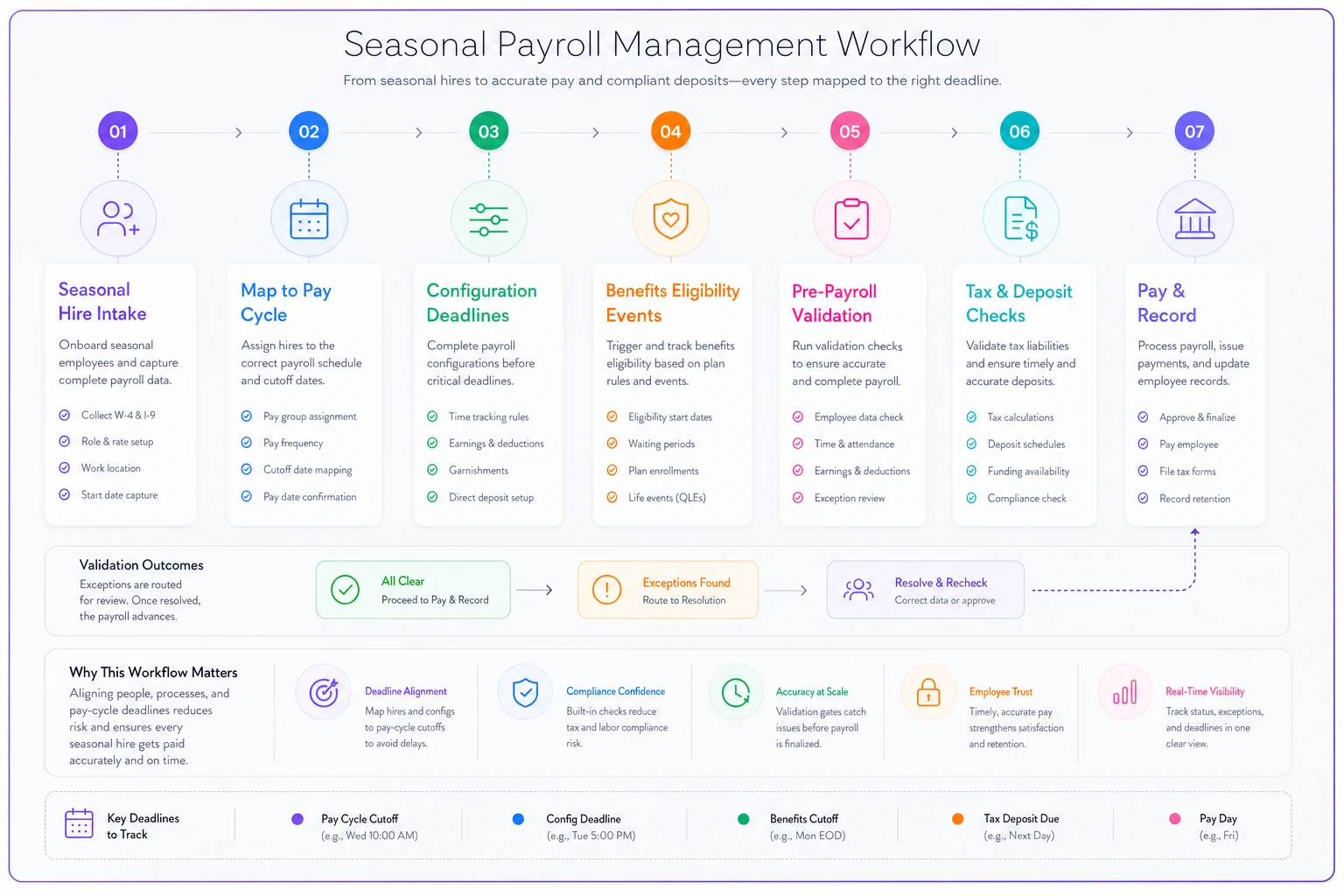
This visual shows how to map hires to pay-cycle cutoffs and validation gates.
The tax deposit trap most teams walk into
This one's quiet. When your total wage base jumps because you've added a few thousand hourly workers, your payroll tax liability jumps with it—and that can push you across a deposit frequency threshold without anyone flagging it.
In practice, this usually hits businesses that have comfortably been monthly depositors. The surge-period liability builds fast enough during the lookback period to flip them semiweekly, but nobody's watching that threshold because it's never been close before. A deposit deadline that used to be comfortably monthly is suddenly due within days of payday. Miss it by two days and you're looking at a failure-to-deposit penalty that scales with the amount owed.
The fix is unglamorous: forecast your surge-period liability before the surge, not after. Run a projection based on expected incremental headcount and average wage, then check it against the deposit frequency rules. If you're going to cross the threshold, you want to know in October—not when the notice shows up in February.
A rough projection for a mid-size surge: 2,000 seasonal workers at around 32 hours a week, average rate somewhere in the $18–$20 range, over an eight-week peak. That's somewhere around $9M–$10M in incremental gross wages, and the employment tax liability on top of that is more than enough to reshuffle your deposit obligations. Don't guess at this—model it.
Time & attendance is where seasonal payroll actually lives or dies
For an hourly seasonal workforce, nothing matters more than the integrity of the time feed. Pay rate errors are visible and get caught. Dropped punches, misapplied rounding, and broken shift-differential rules are invisible until they aggregate into a wrong paycheck—and with thousands of new hires, "wrong paycheck" becomes "hundreds of corrections."
The patterns that cause the most trouble during a surge:
-
Rounding rules that were fine at low volume start producing systematic over- or under-payment when applied across thousands of short shifts. A rounding policy that quietly favors the employee by a few minutes per shift is a rounding error at 200 people and a real cost at 4,000.
-
Shift differentials and premium pay for seasonal night and weekend coverage often aren't mapped correctly for new location or department codes, so the differential silently doesn't apply.
-
Batch feed limits that were never stress-tested quietly truncate at peak volume.
-
Meal and break compliance rules vary by jurisdiction, and a surge almost always introduces new locations with rules your config has never handled.
If you're scaling time and attendance for a seasonal wave, the configuration details—how rounding is applied, how punches map to pay codes, what pre-run checks catch missing hours—deserve real attention before the first big run. We walk through that end to end in our time & attendance integration playbook, and it's worth working through before the volume hits rather than diagnosing it mid-surge.
Run a punch-completeness check against the active headcount before every surge-period payroll—expected timecards minus received timecards should equal a number you can explain.
The single most valuable habit here is a punch-completeness check run against the active headcount before every surge-period payroll. Expected timecards minus received timecards should equal a number you can explain. If 1,400 people are scheduled and you have 1,290 timecards, you need to know why before you run—not after.
The benefits eligibility curveball
First-day healthcare eligibility for seasonal workers—the piece Amazon is rolling out—is operationally harder than it sounds, and the Jan. 1 effective date makes it worse.
Benefits deductions and eligibility events don't align neatly with pay cycles or with the seasonal roll-off calendar. If coverage is effective on day one, your deduction configuration has to be correct from the first paycheck, your carrier feed has to carry the new enrollees accurately, and your termination process has to handle coverage end-dates cleanly when those same seasonal workers roll off in January.
A few things that reliably go wrong:
-
Deduction timing mismatches. Coverage is effective on the 1st, but the deduction logic was set up for a mid-period start, so the first deduction is wrong or missing entirely.
-
Carrier feed lag. You enroll a few thousand people, but the eligibility file to the carrier doesn't scale on the same timeline, and employees show up at a pharmacy with no active coverage on record.
-
Roll-off cleanup. Seasonal workers who got first-day coverage terminate in January, and if the coverage end-date and final deduction aren't synchronized, you either over-deduct or carry someone on coverage you're still paying for.
The underlying issue is that eligibility, deductions, and terminations are usually owned by three different people or systems, and a surge exposes every seam between them. Map those handoffs explicitly before December.
A real scenario: regional 3PL, roughly 2,500 seasonal hires
A regional third-party logistics operator ran a seasonal surge adding about 2,500 warehouse and sorting workers across four facilities. Prior year, they'd processed the surge the way they always had—recruiting fed names into onboarding, onboarding configured people as they came in, payroll ran and fixed problems after the fact.
That prior season produced somewhere around 400 off-cycle corrections over the peak, mostly from missing or wrong time data, plus a late tax deposit when their liability crossed into semiweekly territory without anyone noticing. The corrections alone ate most of two people's time for roughly six weeks, and the deposit penalty ran a few thousand dollars.
The following year they made three changes before the surge: built the pay-cycle surge calendar with hard config cutoffs, ran a liability projection in October that caught the deposit frequency change in advance, and added a pre-run punch-completeness check at each facility. Nothing complicated.
Off-cycle corrections dropped to well under a hundred over the same peak. The deposit change was handled as a planned cadence shift instead of a scramble. The payroll team still worked hard, but they were running a process they'd actually designed for the volume—not reacting to fires.
The pre-surge checklist worth actually running
Before your first surge-period payroll, work through this:
-
Surge calendar built against real pay-cycle cutoffs, with config deadlines communicated to onboarding
-
Incremental tax liability projected and checked against deposit frequency thresholds
-
Pay rate, shift differential, and location/department codes validated for every new hire batch
-
Time & attendance feed stress-tested at expected peak batch size
-
Rounding and premium-pay rules reviewed for new locations and jurisdictions
-
Punch-completeness check built into every surge-period pre-run
-
Benefits deduction logic validated against the actual coverage effective date
-
Carrier eligibility feed confirmed to scale with enrollment volume
-
Seasonal-to-permanent conversion tax/benefits treatment documented
-
Roll-off process tested for clean coverage end-dates and final deductions
-
Vendor SLAs (processor, carriers) confirmed to cover peak volume and holiday blackout dates
-
Year-end close timeline reconciled against surge pay cycles so they don't collide blindly
You won't get all of it perfect. But working through the list surfaces the collisions early, and early is the entire game here.
When a seasonal surge is worth re-architecting for—and when it isn't
Not every business should overhaul its payroll operation for a seasonal wave. If your surge adds a couple hundred people and your systems have handled similar volume before, tighter process discipline is the right call—the calendar, the projection, the pre-run checks. Not new infrastructure.
Re-architecting genuinely makes sense when the surge crosses a structural line: new jurisdictions, a new deposit frequency, first-time benefits eligibility for seasonal staff, or when you're repeatedly converting large numbers of seasonal workers to permanent roles. At that point you're not managing a spike, you're running two different operating models, and bolting the second one onto the first by hand is where the expensive errors accumulate.
Who should not treat this as a systems project: a business with a stable seasonal pattern, no benefits eligibility change, and no deposit-threshold risk. For them, the surge is a scheduling and validation exercise. Spending months reconfiguring systems is wasted effort.
Seasonal hiring surges expose whatever was already fragile in your payroll operation—they just do it under time pressure and at scale. The businesses that handle a surge cleanly, whether that's 300 hires or 30,000, aren't the ones with the fanciest software. They're the ones who stopped treating the surge as a recruiting event and started treating it as a pay-cycle event with hard deadlines, forecasted liabilities, and validation gates before every run.
The hire count is the headline. The config cutoffs, deposit thresholds, time-feed integrity, and benefits eligibility timing are the actual work. Get those sequenced against your pay calendar now, while you still have room to be deliberate—because once the volume lands, your only options are the ones you built in advance.
Ready to simplify your payroll operations?
Join 2,000+ businesses using Payexly to reduce payroll overhead, ensure compliance, and enhance employee satisfaction.