

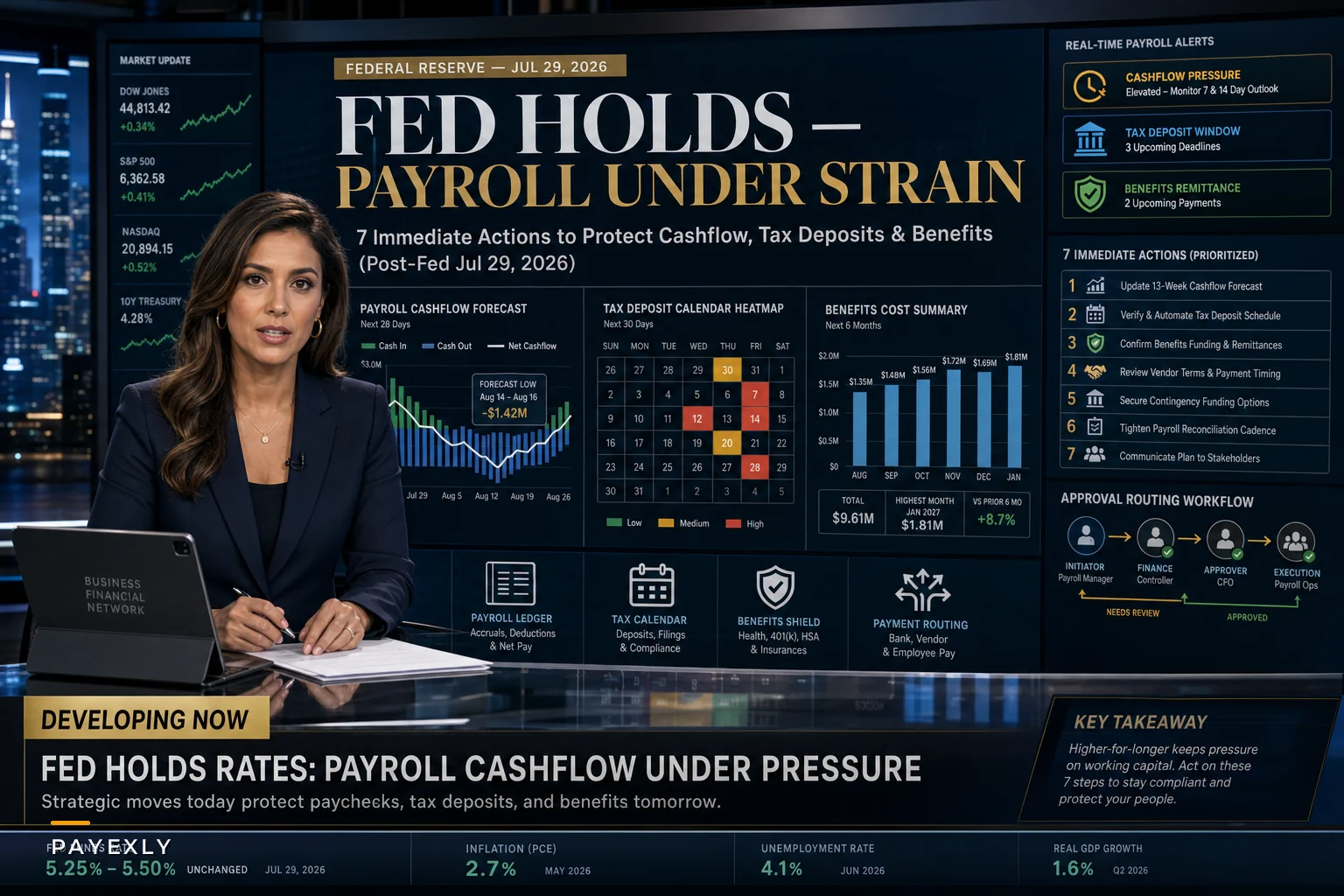

The Fed just held rates at 3.50%-3.75%, with three dissenting votes pushing for a hike. That's not just a Wall Street headline — it's a direct hit to payroll operations starting right now.
What this means operationally: your line of credit costs more, vendor payment terms are tightening, and that cushion between payroll processing and tax deposits just got thinner. This exact scenario played out in 2019 when rates stayed elevated for months. Companies that adapted their payroll cashflow planning survived. Those that didn't ended up with IRS penalties, rushed benefit terminations, and scrambled Friday afternoon wire transfers.
The businesses that came through that period all did the same thing — they stopped treating payroll as a fixed operational cost and started managing it like a dynamic cashflow event.
Action 1: Map your actual payroll float exposure
Most companies think they know their payroll float. They're usually off by 2-3 days. Your real exposure isn't just the gap between processing and direct deposit — it's the entire chain from timecard approval through tax remittance.
Pull your last three months of bank statements and map every payroll-related transaction against its actual clearing date. Not the date you initiated it, not the date your payroll system shows — the actual date money left your account.
-
ACH payroll clears 1-2 days after you expect
-
Tax deposits sit in limbo for 24-48 hours before processing
-
Benefits deductions clear on completely different schedules
-
Garnishment payments float for up to a week
One manufacturing client found they were carrying nearly $47,000 in float exposure they had no idea existed. Their payroll system showed everything settling Thursday, but actual bank clearings stretched into the following Tuesday. At current rates, that's roughly $140 per pay period in carrying costs they weren't budgeting for.
Build a simple table tracking each payroll-related transaction:
| Transaction Type | System Date | Actual Clearing Date | Float Days | Dollar Amount in Float |
|---|---|---|---|---|
| ACH Payroll | Pay date | Pay date + 1-2 days | 1-2 | Gross payroll |
| Federal Tax Deposit | Deposit date | Deposit date + 1-2 days | 1-2 | Tax liability |
| Benefits Remittance | Deduction date | Variable | 2-5 | Benefits total |
| Garnishments | Pay date | Up to 7 days | 3-7 | Garnishment total |
Once you see the real numbers, you can actually manage them.
Action 2: Renegotiate your payroll funding arrangement today
Your bank relationship manager is expecting your call. Every business banking team got the same memo after the Fed announcement — clients will be coming in asking for breathing room.
Eliminate payroll errors and delays.
Payexly streamlines every payroll cycle ensuring accuracy and compliance.
- Automated payroll processing
- Real-time tax compliance
- Benefits & deductions management
No credit card required
Most businesses get this wrong though. They ask for a credit line increase when they should be negotiating sweep timing and overdraft structures.
The conversation you want goes like this: you need to adjust the timing of your sweep arrangements to align with actual payroll clearing patterns, not increase your exposure. Banks prefer this because it reduces their risk while solving your problem.
-
Intraday sweep delays on payroll processing days
-
Separate sweep accounts for tax deposits vs. regular payroll
-
Overdraft protection that triggers only for payroll-coded transactions
-
Grace periods on negative balances specifically for benefits remittances
A retail chain with 85 locations restructured their sweep arrangements last month and freed up around $120,000 in working capital without touching their credit line. They simply aligned their sweep schedule with actual payroll clearing patterns instead of the default daily sweep their bank had set up years earlier.
Action 3: Split your tax deposit strategy
Federal tax deposits don't have to move in one chunk. The IRS actually prefers multiple smaller deposits that reconcile correctly over one large deposit that might bounce or delay.
Divide your total deposit liability into three tranches:
-
40% on the standard due date
-
40% one business day later
-
20% as a cleanup deposit
This isn't about delaying payment — you're still meeting your deposit schedule. You're managing cashflow risk. If something goes wrong with your primary funding source, you have time to adjust without triggering penalties.
The math usually surprises people. A $50,000 semi-weekly deposit that bounces triggers a 2% penalty ($1,000) plus a mandatory switch to monthly depositor status. Three properly-timed deposits of $20,000, $20,000, and $10,000 face no penalties as long as they clear within the deposit period.
The catch is that manual splitting creates more problems than it solves. You need your payroll tax deposits automated with proper alerts and reconciliation checkpoints to make this work without adding operational risk.
Action 4: Create a benefits funding firewall
Benefits vendors are the first to restrict services when payments delay. Unlike employee payroll, which carries legal protections, benefits can be terminated immediately for non-payment.
The fix isn't keeping more cash on hand — it's creating operational separation between benefits funding and general payroll cashflow.
Set up a dedicated benefits holding account that funds automatically three days before each benefits remittance. Not a second checking account at the same bank — an actual segregated account, ideally at a different institution, that can't be swept or borrowed against.
-
Take your monthly benefits cost
-
Divide by number of pay periods
-
Add a 10% buffer
-
Auto-transfer that amount with each payroll
A dental practice group implemented this after their vision insurance lapsed for 400 employees when a large insurance payment delayed their cashflow. They now maintain a rolling $18,000 benefits buffer that's completely isolated from operational funds. The operational friction is intentional — you want benefits funding to be automatic and impossible to tap for other needs.
Action 5: Build payment fallback procedures before you need them
Every payroll system has a fallback payment option — manual checks, wire transfers, pay cards. But trying to execute these during a cashflow crunch is like reading the fire escape map while the building is on fire.
Document and test your fallback procedures now:
-
Who can authorize emergency payment methods?
-
What's the cutoff time for same-day wires?
-
Which employees have updated banking information for manual deposits?
-
How do you handle tax withholding on manual payments?
Run a tabletop exercise with your actual payroll team. Pick five random employees and walk through exactly how you'd pay them if ACH processing failed tomorrow morning. Time it. You'll find gaps you didn't know existed.
Most companies can't execute their backup plan when it actually matters. The check stock is expired, wire transfer limits are too low, or nobody knows the approval sequence for manual payments. Fix these gaps now while there's no pressure.
Action 6: Accelerate your cashflow forecast frequency
Monthly cashflow forecasting isn't enough when rates are elevated and volatile. You need rolling 13-week forecasts updated at least twice a week.
More importantly, your forecast needs to separate payroll cashflow from operational cashflow. Most businesses mix them together, which hides where the actual risk is sitting.
Run two parallel forecasts:
-
Payroll-specific cashflow showing every payroll-related transaction
-
Operational cashflow excluding all payroll events
This separation surfaces patterns you'd never catch otherwise. A logistics company found their payroll float went negative every third Friday because quarterly commission payments landed the same day as regular payroll. They'd been covering this with operational funds without realizing it — hidden borrowing costs, quietly compounding.
Your payroll forecast should track:
-
Gross payroll by pay date
-
Tax deposits by due date (not payroll date)
-
Benefits remittances by vendor
-
Garnishment schedules
-
Quarterly filing payments
-
Annual reconciliation adjustments
Update it every Tuesday and Thursday. Tuesday catches weekend processing delays. Thursday gets you ready for Friday payroll runs.
Action 7: Establish vendor payment priorities now
When cashflow tightens, payment decisions happen fast. Without documented priorities, you'll make expensive mistakes under pressure.
Lay out your payment hierarchy explicitly:
-
Net payroll to employees
-
Federal tax deposits
-
State tax deposits
-
Court-ordered garnishments
-
Health insurance premiums
-
Retirement contributions
-
Voluntary deductions
This isn't just a list — it's an operational procedure. Each level needs specific triggers and escalation paths. For example: if cashflow projects short on a Tuesday for Friday's payroll, levels 1-4 process normally, level 5 requires CFO approval, levels 6-7 defer automatically.
A construction firm avoided roughly $23,000 in penalties last quarter by following this kind of matrix when a major client payment delayed. They deferred retirement contributions for one pay period — legal under their plan — while keeping all tax deposits current. Without predetermined priorities, they would have tried to cover everything and triggered multiple penalties.
The following diagram shows how a payment priority decision flows in practice:
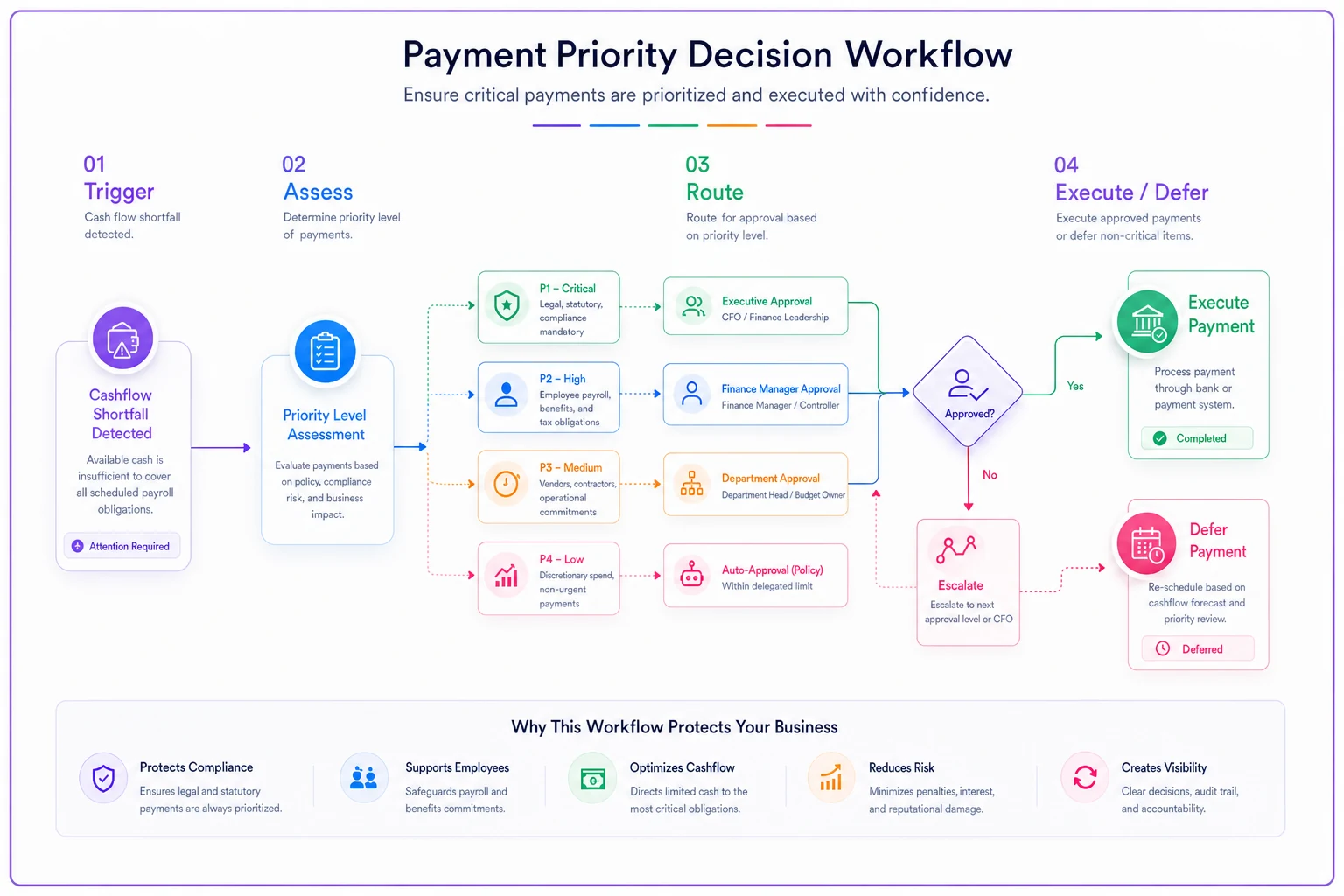
Having this documented before a crisis means no one is making judgment calls under pressure on a Friday afternoon.
Where AI automation actually helps here
This is where modern AI-powered payroll operations create real advantage — not the hype about replacing payroll departments, but practical automation that prevents costly mistakes when margins are thin.
These platforms are genuinely good at monitoring multiple cashflow streams simultaneously and flagging conflicts before they become crises. A human can miss that a quarterly FUTA deposit coincides with the annual workers comp adjustment. A properly configured system catches it weeks in advance.
The pattern recognition is useful in ways that aren't obvious until you're running it. Identifying that your third-Thursday payrolls consistently run higher due to overtime trends, or that January benefits remittances always spike due to plan changes — these are signals that let you adjust funding before problems show up. No drama, just earlier visibility.
Automated workflows also remove pressure from cashflow decisions. When rates are high and money is tight, the temptation to float tax deposits or delay vendor payments gets real. A well-configured system follows the rules you set during calm periods, not the pressures you're feeling during a crunch.
Moving forward
The Fed's signal wasn't just about this meeting — it's about the next six months. The formal statement emphasized "patience" and "sustained evidence" before any cuts. Plan for these rates through at least year-end.
This isn't 2008 where everything froze overnight. It's a slow squeeze that rewards operational discipline. Your competitors face the same pressures. The ones managing payroll cashflow poorly will deal with penalties, terminated benefits, and employee trust problems. That's an opening for businesses that tighten operations now.
Start with the seven actions above — but not all at once. Pick the two that address your biggest current exposure and get them done before your next payroll run. Layer in the others over the following month. Your payroll runs next week regardless of what the Fed does, so the only real question is whether you're running it with visibility into every dollar of float, or scrambling to cover gaps you didn't see coming.
Ready to simplify your payroll operations?
Join 2,000+ businesses using Payexly to reduce payroll overhead, ensure compliance, and enhance employee satisfaction.