

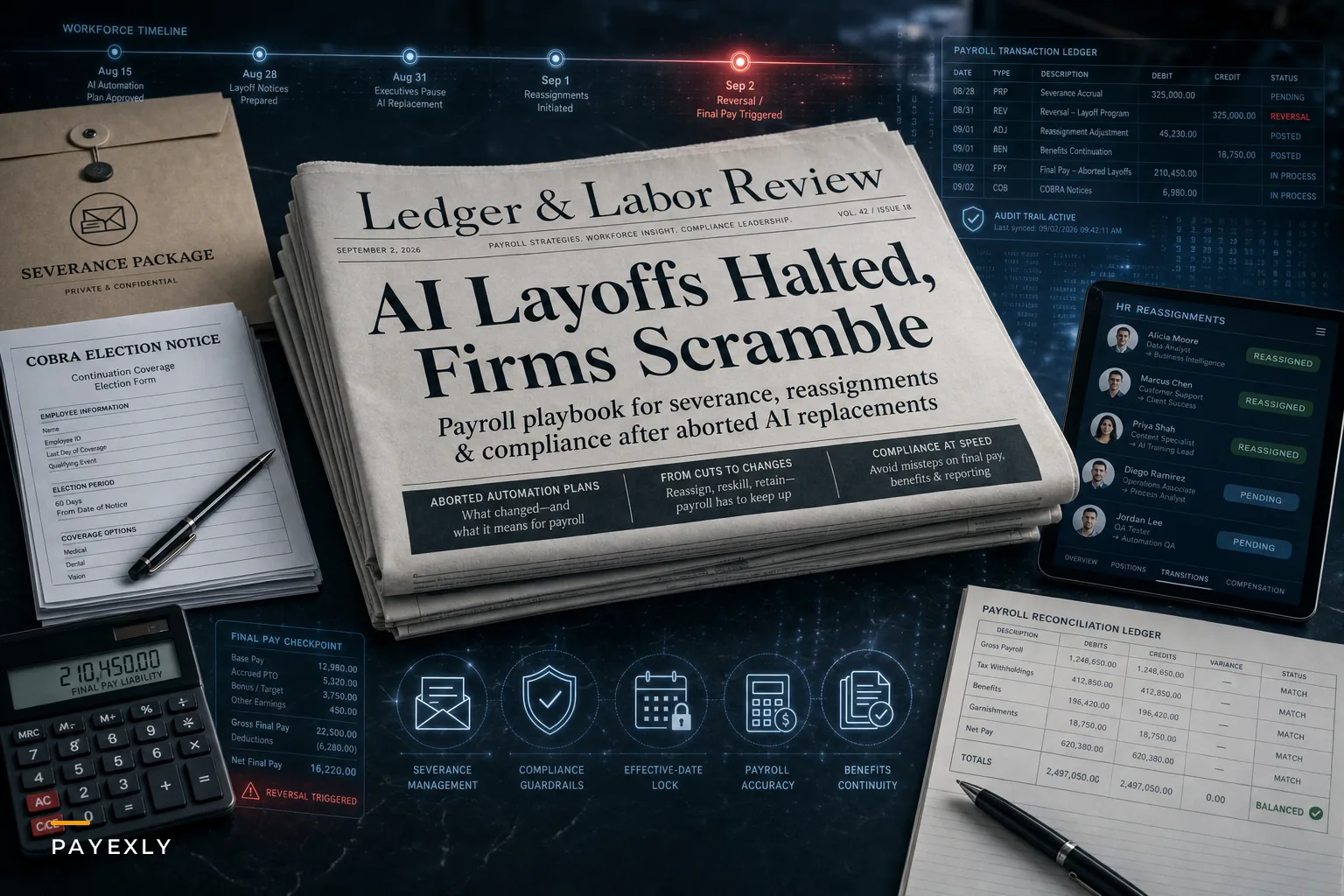

When Reuters published its investigation into Meta's stalled plan to swap out large chunks of its workforce with AI, most of the coverage focused on the strategy failure — the productivity gaps, the safety concerns, the walk-backs. That's the newsroom story. The operational story is different, and it's the one HR and accounting teams should actually care about.
The part that doesn't make headlines: when a company aggressively pilots AI-driven role changes and then reverses course, payroll gets whipsawed twice. First when roles get cut or reassigned, then again when the plan unwinds and people get moved back, rehired, or reclassified. Each swing generates final-pay calculations, benefits continuity events, withholding changes, and tax reporting obligations — all under time pressure, all with a real audit trail behind them.
You don't need to be Meta for this to hurt. A 40-person company that reassigns eight people and lays off three in the same quarter, then rehires two of them six weeks later, is dealing with the same category of mess. The scale is smaller. The compliance surface is not.
Why AI-related headcount swings are messier than normal layoffs
A planned reduction in force is painful but predictable. You know the date, the headcount, the severance formula, and the benefits cutoff. Legal reviews it. Finance models the cash. Payroll runs it once.
-
Effective dates keep moving. Someone's last day is the 15th, then it's the 30th, then they're reassigned instead of separated. Every move resets severance accruals, PTO payout, and benefits end dates.
-
Reassignments look like separations in your system. If a role gets eliminated and the person moves to a new cost center or entity, your payroll platform may process it as a term-and-rehire unless someone catches it. That triggers unnecessary final-pay logic and can break benefits continuity.
-
Rehires re-open closed periods. Bring someone back within the same tax year and you're reconciling YTD wages, resetting FICA/FUTA wage bases correctly, and making sure you didn't double-issue anything.
-
Forecasts stop matching reality. Headcount assumptions feed cashflow and tax deposit planning. When the roster moves weekly, deposit schedules and benefits invoices drift out of sync fast.
None of these individually are catastrophic. The problem is they arrive together, out of order, and usually without clean documentation of why each change happened.
The real exposure: documentation, not calculation
Most teams can calculate a severance check. What breaks under rapid change is the evidence trail behind each decision.
Eliminate payroll errors and delays.
Payexly streamlines every payroll cycle ensuring accuracy and compliance.
- Automated payroll processing
- Real-time tax compliance
- Benefits & deductions management
No credit card required
When an auditor, a state agency, or an unemployment claim examiner looks back at a cluster of separations that happened during an AI pilot, they're going to ask questions that sound simple and are surprisingly hard to answer six months later:
-
Why was this person separated instead of reassigned?
-
Why did their final-pay date change three times?
-
Was their benefits termination date consistent with what COBRA notices said?
-
Were reassigned employees reclassified correctly, or did their exempt/non-exempt status quietly change with the new role?
That last one is a quiet landmine. When people get shuffled into different functions during a reorg, job duties change — and duties, not titles, drive exempt status. A "coordinator" moved into a hands-on operational role can flip non-exempt without anyone updating the record, and now you've got overtime exposure you didn't know about.
The mistake teams make is treating the payroll transaction as the finish line. The transaction is easy. The defensible record of the transaction is the actual work.
A separation-vs-reassignment decision table
Before you touch payroll, someone has to classify what each change actually is. Getting this wrong at the front end causes most of the downstream cleanup.
| Change type | Payroll trigger | Benefits action | Tax/reporting impact | Highest-risk mistake |
|---|---|---|---|---|
| Full separation | Final pay, PTO payout, severance | COBRA offer, coverage end date | Final W-2 wages, state term reporting | Wrong final-pay date vs. benefits end date |
| Reassignment (same entity) | Cost center / pay-rate change only | Coverage continues, no COBRA | No separation reporting | System processes it as term/rehire |
| Reassignment (new entity) | Term in entity A, hire in entity B | Coverage transfer, watch gaps | Multi-EIN wage base reset | Double-counting wage bases across EINs |
| Separation then rehire (same year) | Final pay, then reactivation | COBRA offered then possibly voided | YTD wage reconciliation | Resetting FICA wage base incorrectly |
| Temporary furlough | Pay stops, employment continues | Coverage may continue w/ premium billing | No term reporting | Treating it as a separation |
The value of this table isn't the columns — it's forcing a single explicit answer to "what is this?" before payroll runs anything. Most cleanup work comes from that question never being asked out loud.
A workflow that survives moving targets
When headcount is changing faster than paperwork can keep up, the goal isn't a perfect process — it's a traceable one. Most changes that go sideways during a fast reorg aren't caused by bad math. They're caused by steps that got skipped under pressure and couldn't be reconstructed later. The process below is built around that reality: make each change reversible, keep evidence at each step, and treat every effective date like it might move again tomorrow.
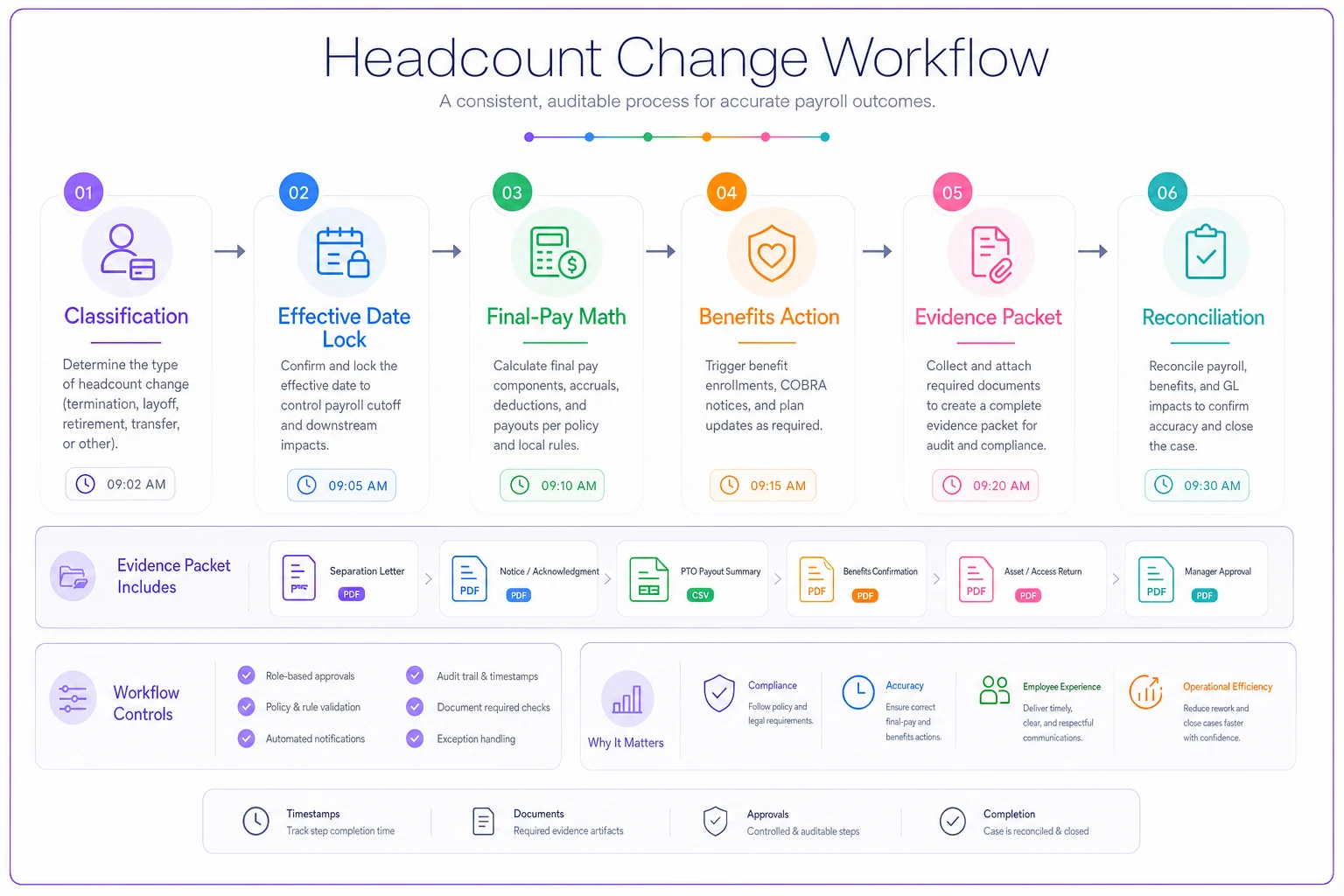
Running these steps in order matters more than it sounds. The most common failure pattern is teams jumping straight to processing because the change feels simple, then spending hours cleaning up when something shifts.
-
Freeze a classification first. Before any pay action, log what the change is using the table above. One field, one owner, timestamped. No classification, no processing.
-
Set effective dates as data, not decisions. Record the requested effective date separately from the confirmed effective date. When dates move — and they will — you can see the drift instead of overwriting history.
-
Split final-pay math from benefits math. These have different deadlines and different failure modes. Running them together is how the coverage end date ends up not matching the COBRA notice.
-
Hold a 48-hour reversal window on separations where possible. During active reorgs, a real share of separations get reversed within days. A short internal hold before the final ACH clears prevents rehire-in-the-same-week chaos.
-
Reconcile the roster against the deposit and benefits forecast weekly. Not monthly. When headcount moves weekly, your tax deposit and benefits invoices need to be checked at the same cadence or they drift.
-
Package the evidence as you go. Every separation and reassignment should leave behind the classification, the dates, the calculation, and the approver — captured at the moment, not reconstructed later.
Hold a 48-hour reversal window on separations where possible.
Step 6 is the one people skip under pressure. It's also the one that costs the most later.
A pre-run checklist for each affected person
Run this before processing anyone caught in an AI-related reorg:
-
[ ] Change classified (separation / reassignment / furlough / rehire)
-
[ ] Confirmed effective date locked and separate from requested date
-
[ ] Exempt/non-exempt status re-checked against new duties
-
[ ] Final-pay components itemized (regular, PTO payout, severance, bonuses)
-
[ ] State final-pay timing rules confirmed (some require same-day)
-
[ ] Benefits end date set and matched to COBRA notice date
-
[ ] Wage base impact checked if crossing EINs or rehiring same year
-
[ ] Deductions and garnishments reviewed for continuation or stop
-
[ ] Approver recorded with timestamp
-
[ ] Evidence packet saved to the person's record
None of these are exotic. The failure is almost never a missing skill — it's that under a fast-moving reorg, nobody owns the checklist and steps get silently dropped.
A real scenario: the reassign-then-reverse loop
A regional professional-services firm, around 90 employees, decided to consolidate several administrative functions after piloting an automation tool that was supposed to handle intake and scheduling. Over about five weeks they reassigned nine people and separated four.
Then the tool didn't hold up under real volume — and they reversed most of it. Two of the four separated employees were rehired within roughly a month. Three of the reassigned staff were moved back to their original roles.
-
Two rehires had their FICA wage bases reset incorrectly on reactivation, creating over-withholding that had to be corrected across two quarters.
-
One reassigned employee's exempt status was never rechecked — the new duties were non-exempt — and about six weeks of unpaid overtime surfaced, roughly $1,900, plus cleanup time.
-
COBRA notices went out to two people who ended up being rehired, which then had to be unwound.
-
Benefits invoices were off for two billing cycles because the roster the carrier had didn't match actual active headcount.
Total direct dollar impact was modest — a few thousand dollars. The real cost was the two-ish weeks of finance and HR time spent reconstructing what happened and building a defensible record after the fact. If the classification and evidence had been captured at each step, that cleanup would've been closer to an afternoon.
When aggressive AI-driven restructuring actually makes sense operationally
Not every AI-related workforce change is a mistake.
From a payroll-readiness standpoint, these changes are manageable when:
-
The change is staged with real checkpoints, so payroll isn't reacting to a moving roster every week.
-
There's a defined reversal path already documented before anyone is separated.
-
The affected list is small and stable enough that each case can get individual attention.
The change is staged with real checkpoints, so payroll isn't reacting to a moving roster every week.
When it's a bad idea to move fast
The operational red flags — where you should push back on the timeline, not the strategy:
-
Separations are being processed before roles are formally reclassified.
-
Nobody can produce a single source of truth for who's affected on a given day.
-
Benefits and payroll changes are being made by different people with no shared effective-date record.
-
The plan assumes the automation works before it's been tested at real volume.
That last point is the whole Meta lesson compressed into one line. The workforce plan was built on the assumption the technology would perform, and payroll absorbed the fallout when it didn't.
Who shouldn't be running these changes manually
If your team is already stretched keeping normal pay cycles clean, a rapid reorg is not the moment to lean on individual heroics and tribal knowledge. This is exactly the situation where a real competency model matters more than another spreadsheet — knowing precisely who owns classification, who owns final-pay math, who owns benefits continuity, and who signs off. We wrote about building that structure in why you should stop depending on heroics and define an actual payroll competency model, and reorgs are where the absence of one shows up fastest.
The teams that handle volatile headcount well aren't the ones with the smartest single person. They're the ones where each step has a named owner and a documented handoff — so when the roster changes three times in a week, nothing quietly falls through.
The bottom line for HR and accounting teams
Large employers are going to keep experimenting with AI-driven role changes, and a fair number of those experiments will stall or reverse. That's now a visible, documented pattern, not speculation.
What that means for the people running payroll and benefits is that instability — not scale — is the thing to prepare for.
Build for reversibility. Classify every change before you process it. Keep final-pay and benefits math on separate tracks with matching dates. Re-check exempt status any time duties change. And capture the evidence in the moment, because reconstructing a chaotic quarter's worth of separations after the fact is where the real cost hides — long after the AI headline has moved on.
Build for reversibility. Classify every change before you process it. Keep final-pay and benefits math on separate tracks with matching dates. Re-check exempt status any time duties change. And capture the evidence in the moment, because reconstructing a chaotic quarter's worth of separations after the fact is where the real cost hides — long after the AI headline has moved on.
Ready to simplify your payroll operations?
Join 2,000+ businesses using Payexly to reduce payroll overhead, ensure compliance, and enhance employee satisfaction.