

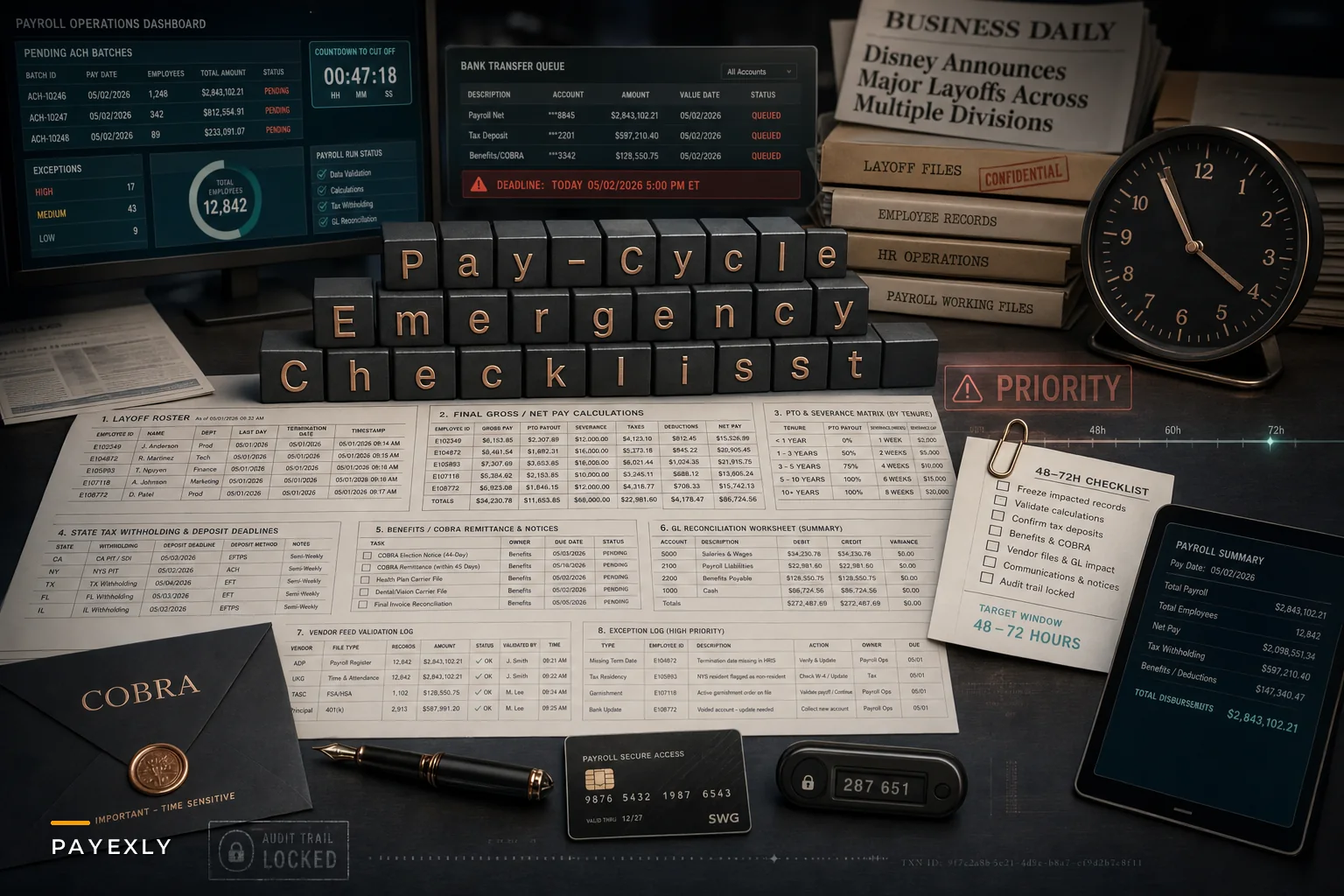

When Disney confirmed it was cutting a few hundred roles across HR and technology functions on September 29, 2026, the headline most people read was about strategy and cost-cutting. The headline payroll teams read was different: how many of those people are in the current pay cycle, and what do we owe them before Friday?
That's the part nobody outside the back office thinks about. Reuters reported the cuts hit HR and tech specifically — which, if you've ever run payroll through a reduction, is a quietly brutal detail. Those are often the same people who would normally help process the layoffs. When the HR coordinator who manages termination data is also on the list, your clean handoff just evaporated.
This post isn't about Disney. It's about what every sudden reduction exposes: payroll teams are expected to execute flawless final-pay math, tax, and benefits work under a compressed timeline, with incomplete data, while emotionally rattled themselves. The checklist below is built for exactly that moment — the open cycle, the clock running, decisions landing on your desk with no warning.
The real problem: a reduction is a data event before it's an HR event
Most teams treat layoffs as an HR action with a payroll follow-up. In practice, it's the reverse. The moment termination dates get set, you've got a cascade of data changes hitting systems that were built assuming people leave one at a time, with notice.
A single voluntary resignation gives you two weeks to stage everything. A batch reduction gives you hours, sometimes less. And the systems don't care that it's an emergency — they still process whatever's in them at cutoff.
The pattern that burns teams: the layoff list comes from leadership in a spreadsheet, the official termination dates come from HR in a different system, and payroll is working off a third source that hasn't been updated yet. When those three don't reconcile, you get people paid as active when they should be termed, people termed before their actual last day — cutting off a paycheck they're owed — and benefits deductions firing for employees who no longer have coverage.
In a normal week, one mismatch is an annoyance. In a reduction, you might have 40 of them at once, and each one is a potential wage claim or a benefits grievance.
Triage first: not every terminated employee is the same payroll problem
Before you touch a single calculation, sort the affected population. Teams that skip this step end up processing everyone the same way and miss the handful of cases that carry real legal and financial exposure.
Eliminate payroll errors and delays.
Payexly streamlines every payroll cycle ensuring accuracy and compliance.
- Automated payroll processing
- Real-time tax compliance
- Benefits & deductions management
No credit card required
| Category | Why it's different | Risk if mishandled |
|---|---|---|
| Final wages only (no severance) | State final-pay deadlines vary wildly | Late-pay penalties, some states daily |
| Severance recipients | Tax withholding treated as supplemental | Over/under withholding, FICA errors |
| Employees mid-leave or on PTO payout | Accrued balances must be valued correctly | Disputes, miscalculated payouts |
| Multi-state / remote workers | Final-pay rules follow work location | Wrong jurisdiction, wrong deadline |
| Equity / bonus eligible | Vesting and clawback interplay | Overpayment, tax reporting mess |
| Garnishments / support orders | Withholding obligations don't end at term | Legal liability, agency penalties |
Prioritize the 'Final wages only' and 'Multi-state / remote workers' tiers during reconciliation.
The multi-state row is where the most expensive mistakes tend to happen. A company headquartered in one state running a remote workforce has to apply each terminated employee's work-location rules — and some states require final pay on the last day of work, not the next scheduled run. Miss that by a cycle and the penalty in certain states accrues per day, per employee. Across a batch of a few dozen people, that math turns ugly fast.
The pay‑cycle emergency checklist
Work this in order. The sequencing matters — several steps depend on outputs from earlier ones.
-
Freeze the open cycle's affected records. Before anything else, flag every impacted employee so an automated run doesn't push standard pay for people who need custom handling. A frozen record you can unfreeze is safer than a payment you have to claw back.
-
Reconcile the three source lists. Layoff list vs. HR termination dates vs. payroll master. Resolve every discrepancy before you calculate. Do not proceed on "we'll fix it after."
-
Confirm each state's final‑pay deadline for the affected population based on work location, not company HQ. Build a simple deadline grid so nothing slips past a required date.
-
Separate severance from final wages in the calculation. They're taxed differently — severance is supplemental wages — and often need to be reported and sometimes paid separately. Blending them creates withholding errors that surface at year-end.
-
Value every accrued balance. PTO payout, unused vacation, floating holidays — apply your state and policy rules. This is a frequent source of post-termination disputes because people remember their balance and will check your math.
-
Verify garnishments and support orders continue correctly. A termination doesn't cancel an active order. If there's a final lump sum, some orders attach to it. Get this wrong and you've got agency exposure, not just an employee complaint.
-
Recalculate benefits deductions and stop future ones. Confirm coverage end dates, stop deductions for terminated coverage, and flag anyone who needs a partial-period adjustment.
-
Validate tax deposits against the changed liability. A batch of severance payments can meaningfully shift your deposit amount for the period. If you cross a deposit threshold, your schedule obligations can change — don't let the deposit math lag the payroll math.
-
Generate COBRA and continuation notices with correct dates tied to actual coverage end, not the pay date.
-
Lock an audit trail for every manual change. Who changed what, when, and why. Reductions generate appeals and unemployment inquiries for months. The team that documented cleanly in hour one looks very different six weeks later than the team that didn't.
The general flow looks something like this:
[Layoff list received] → [Freeze affected records] → [Three-source reconciliation] → [State deadline grid] → [Tiered calculations: final wages / severance / PTO] → [Garnishment & benefits review] → [Tax deposit validation] → [COBRA notices] → [Audit trail locked]
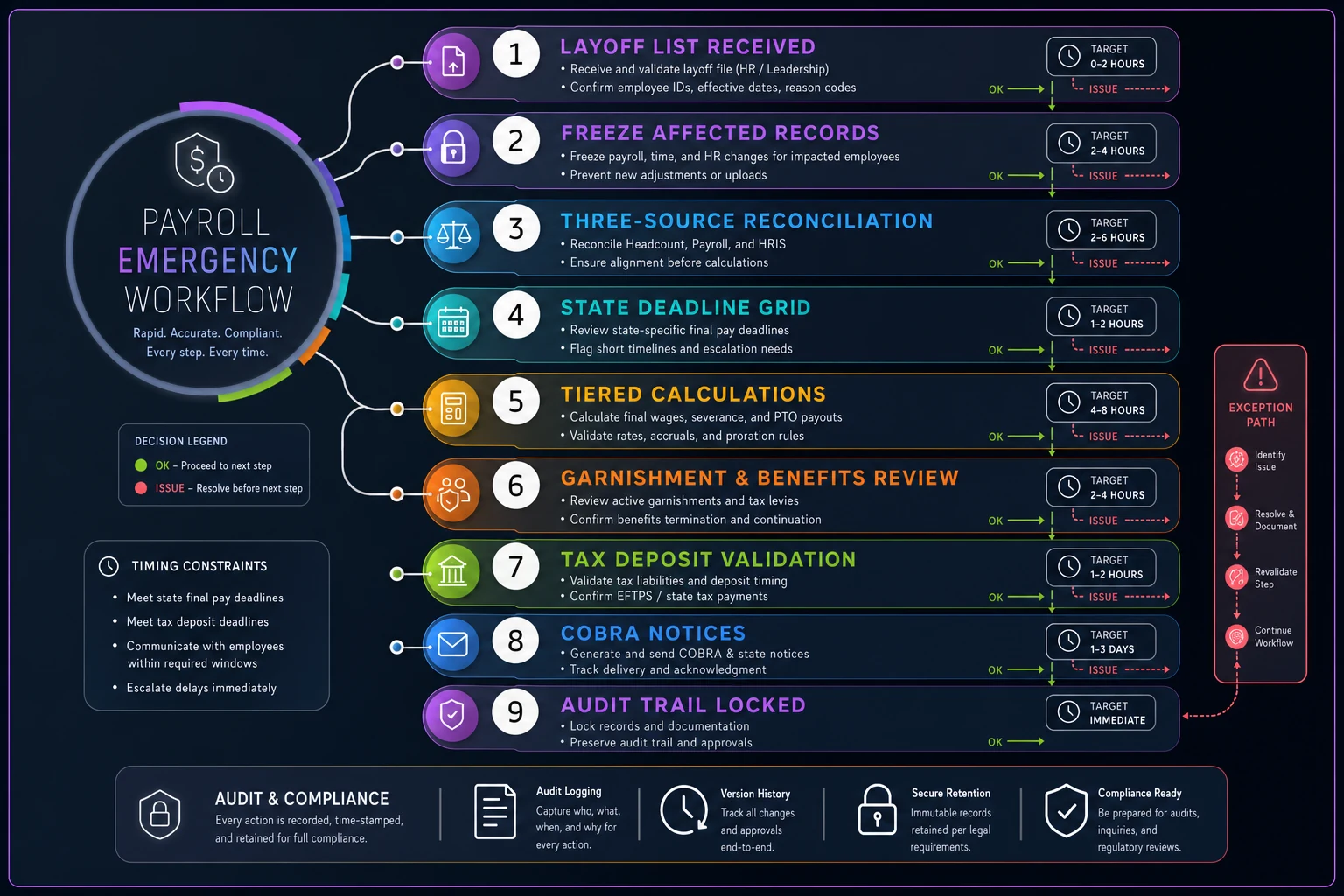
Every step feeds the next. Skipping reconciliation to save time is the single most common reason batches go sideways.
Why severance withholding quietly trips up experienced teams
Even strong payroll shops stumble on supplemental wage treatment during reductions, because they're calculating it in bulk under pressure instead of case by case.
Severance is supplemental income. You've got the flat supplemental rate option or the aggregate method, and they produce different take-home amounts. During a reduction, someone will inevitably ask why their severance check was "taxed so much," and if your team can't explain which method ran and why, trust erodes fast at exactly the wrong moment.
There's also the FICA piece. Severance is generally subject to Social Security and Medicare, and for high earners you've got the annual wage base interaction. A senior tech employee let go mid-year may have already hit or be near the Social Security wage cap — calculate as if they haven't and you've over-withheld, which means a correction later and an irritated former employee in between.
Decide your withholding method before the batch runs, document it, apply it consistently, and keep a one-paragraph plain-English explanation ready for the helpdesk. That last part sounds minor. It saves hours of back-and-forth once checks land.
A realistic scenario
A mid-size regional company — logistics and tech services, around 180 employees — had to process a reduction of 22 people three days before a scheduled biweekly run.
The affected group spanned four states. Nine had severance, six had meaningful PTO balances, two had active garnishments, and one was a remote worker in a state requiring final pay on the last working day. The HR termination dates and the payroll master disagreed on seven employees because the HR system update was still in progress.
The first instinct was to run everyone off the layoff spreadsheet to hit the deadline. Had they done that, two people would've been paid as active, the remote worker would have been paid a full cycle late — triggering a state penalty — and one garnishment would have dropped off the final payment entirely.
They stopped, reconciled the three lists first, and built the state deadline grid. Total extra work was roughly a day and a half of concentrated effort from two people. The avoided cost — late-pay penalties on the remote worker alone, plus the garnishment exposure, plus the near-certain wage claim from an underpaid PTO balance — was in the low five figures, before counting the cleanup time that never happened.
The reconciliation step feels like it's slowing you down when the clock is loud. It's also the step that prevents the expensive mistakes.
Where process beats heroics
Teams that handle reductions well aren't faster or smarter in the moment — they've reduced how much has to happen in the moment. When termination data flows from one source of truth into payroll and benefits systems automatically, the three-list reconciliation problem mostly disappears. When deadline rules by state are already codified, nobody's googling final-pay law at 9 p.m. When the audit trail captures changes as they happen, you're not reconstructing decisions weeks later for an unemployment hearing.
This is the operational muscle worth building before the next reduction, not during it. If you want the longer-view version — how to structure severance, reassignment, and compliance workflows so a sudden headcount change doesn't become a payroll fire drill — that's covered in depth in our playbook on AI-driven headcount changes, which gets into the structural side this checklist assumes you'll eventually build.
The broader trend is real. CNBC's coverage framed the Disney cuts as part of a wider September wave of cost-cutting and workforce changes. Whatever drives these decisions at the top, the pattern for payroll teams is consistent: reductions arrive compressed, with messy data, during open cycles. That's not going to change.
When the emergency checklist is actually the wrong tool
A quick caveat, because treating every workforce change like a crisis creates its own problems.
If you've got real lead time — a planned reduction announced weeks out — don't run the emergency sequence. Use the runway to stage data properly, pre-calculate severance, and give employees accurate final-pay figures before their last day. The checklist above is specifically for the abrupt case, where you're compressing a two-week process into two days.
And if your reduction is small — one or two people with notice — the full triage framework is overkill. The value of structured triage scales with the size and messiness of the batch. For a handful of orderly departures, your normal offboarding process handles it fine.
The emergency checklist earns its keep when you've got a batch, a short clock, multiple states, and incomplete data all at once. That's the Disney-shaped problem — and the one most teams only learn to handle after the first time it goes wrong.
Bottom line
A sudden reduction tests whether your payroll operation runs on process or on people staying late. The math isn't the hard part — final wages, severance withholding, PTO payouts are all solvable. The hard part is doing all of it correctly, in the right jurisdictions, with the right withholding, against reconciled data, while the clock runs and your own team may be affected. Sort before you calculate. Reconcile before you pay. Document everything. The reduction you can't control; the pay cycle you can.
Ready to simplify your payroll operations?
Join 2,000+ businesses using Payexly to reduce payroll overhead, ensure compliance, and enhance employee satisfaction.