

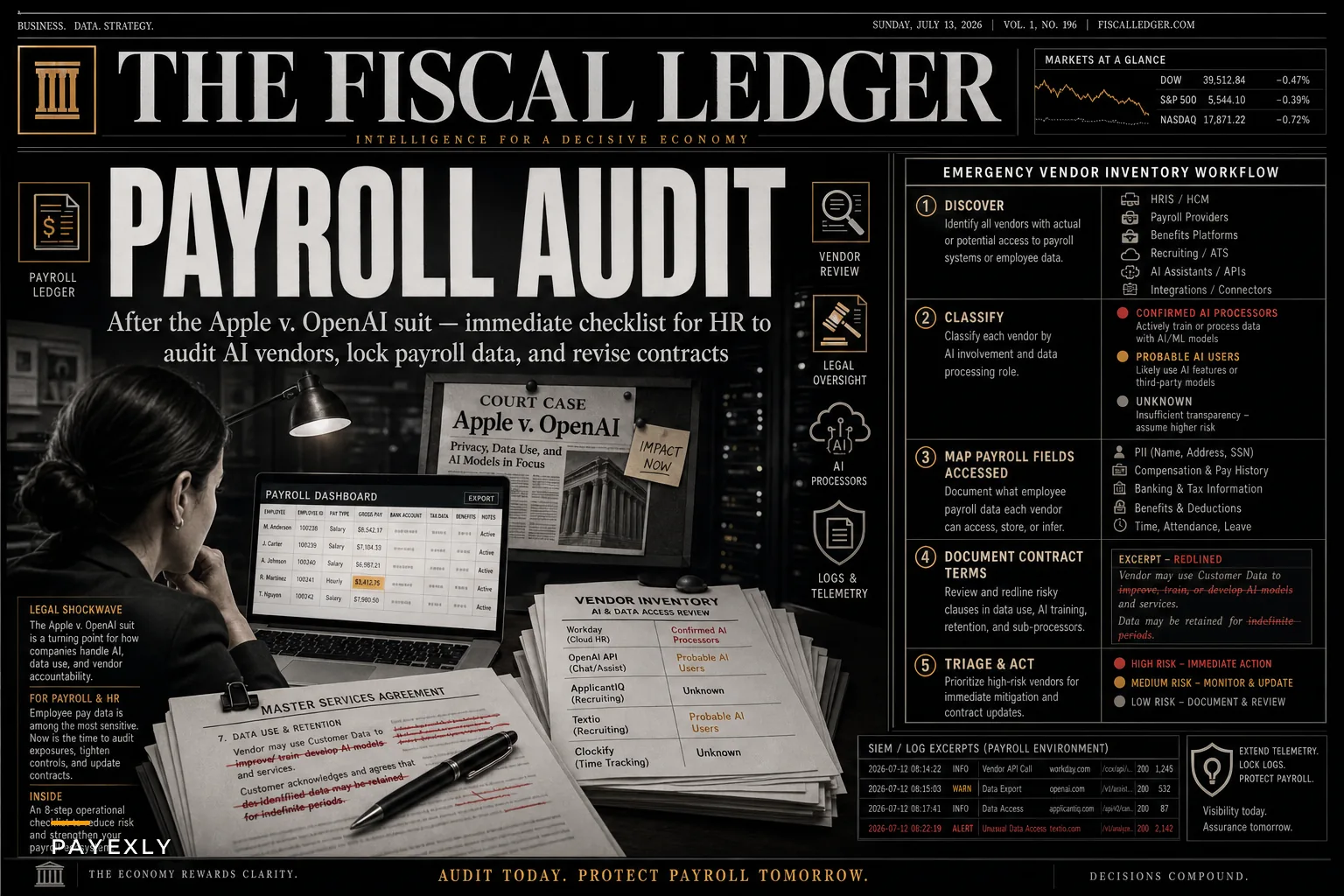

Apple's lawsuit against OpenAI landed last week with a thud that sent every tech vendor scrambling. According to CNBC, the filing alleges OpenAI trained its models on proprietary Apple data without authorization. This goes well beyond a typical patent dispute—it puts a direct question on the table: can AI companies legally use customer data for model training at all?
For HR and payroll teams, this isn't just tech industry drama. That AI-powered payroll assistant your vendor rolled out six months ago? The one that "learns from patterns across all clients to improve accuracy"? That's exactly the kind of functionality now under legal scrutiny.
The operational headache hits multiple fronts at once. Your payroll vendor's AI features might be processing employee SSNs, salary data, and performance metrics in ways that violate your data agreements and emerging legal precedents. And most HR teams have zero visibility into what actually happens to payroll data once it enters these AI systems.
The vendor audit gap nobody talks about
Most companies run vendor security audits annually, maybe quarterly if they're cautious. But auditing AI vendors for payroll data requires a completely different approach—one that tracks data flow continuously, not just at contract renewal.
-
Training a model that serves multiple clients
-
Generating synthetic data for testing
-
Creating embeddings stored separately from the source data
-
Feeding into recommendation engines for "similar companies"
The typical HR manager has no insight into any of these processes. Vendor contracts written before 2024 rarely address AI training rights explicitly. Even newer contracts often use vague "service improvement" language that could mean practically anything.
Running an effective AI vendor audit means mapping every touchpoint where payroll data enters an AI workflow—not just the obvious ones like chatbots or automated reports, but the hidden processes too: anomaly detection, predictive analytics, even support ticket systems that categorize issues using AI.
Step 1: Emergency vendor inventory with AI classification
Start with the vendors you've forgotten about. Not your main payroll processor—you already know they use AI. Focus on the edges: time tracking apps, benefits platforms, expense management tools, that employee engagement survey platform you signed up for two years ago.
Eliminate payroll errors and delays.
Payexly streamlines every payroll cycle ensuring accuracy and compliance.
- Automated payroll processing
- Real-time tax compliance
- Benefits & deductions management
No credit card required
| Bucket | Description |
|---|---|
| Confirmed AI processors | Vendors explicitly marketing AI features that touch payroll data. These need immediate attention. |
| Probable AI users | Vendors offering "smart" features, predictive analytics, or automated recommendations. Check their recent product updates—a lot of vendors added AI quietly over the past 18 months. |
| Unknown status | Any vendor who updated their platform in the last 18 months. Assume AI integration until proven otherwise. |
For each vendor, document:
-
What payroll data they access (SSNs, salaries, hours, benefits)
-
Their stated AI capabilities
-
Contract date and renewal terms
-
Data deletion rights and procedures
This isn't a compliance exercise for its own sake—it's operational triage. You need to know which vendors create immediate liability if their AI training practices look anything like what Apple alleges about OpenAI.
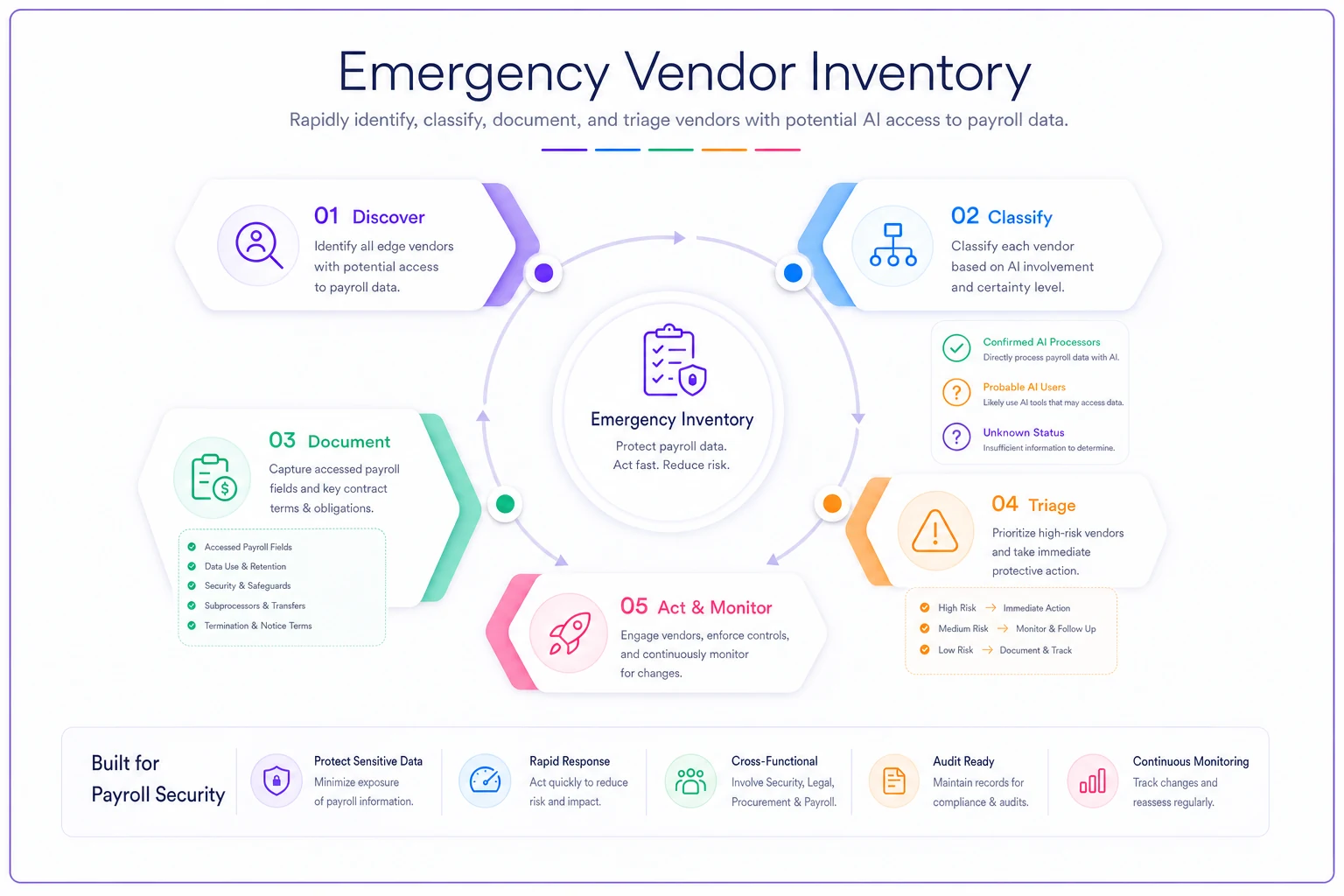
Create three buckets: Confirmed AI processors, Probable AI users, Unknown status and start triaging from there.
Step 2: Data minimization sprint
Most payroll integrations share way more data than they actually need. That benefits enrollment platform doesn't need full salary history—just current compensation. Your time tracking system doesn't need SSNs when employee IDs do the job fine.
Identify minimum viable data: What's absolutely required for the integration to work? Cut everything else.
Replace sensitive fields: Swap SSNs for generated IDs. Use salary bands instead of exact figures where the integration allows. Hash identifying information that has to move between systems.
Implement field-level controls: Modern payroll platforms support granular API permissions. Use them. If yours doesn't, that's a separate problem worth addressing.
Prioritize integrations that pull full payroll registers when starting your minimization sprint—you'll cut the largest exposure first.
A mid-sized marketing agency I worked with discovered their expense platform was pulling full payroll registers for "budget validation." They actually needed three fields: employee ID, department, and monthly allocation limit. Cutting the other 47 fields was one API configuration change and eliminated roughly 80% of their data exposure.
Step 3: Activate audit logging (the right way)
Most payroll systems have audit logs. Most HR teams ignore them until something breaks. The Apple lawsuit changes that—you need active monitoring for AI-related data access patterns, not just a log file nobody checks.
-
Bulk data exports (AI training typically requires large datasets pulled at once)
-
Unusual access patterns (repeated queries that might indicate data harvesting)
-
New API endpoints (vendors frequently add AI features through new endpoints without announcing it)
-
Data retention beyond stated periods
This connects directly to broader payroll logging and SIEM strategies—the same telemetry that catches payroll fraud can also surface suspicious AI-related access before it becomes a problem.
Step 4: Contract amendments for AI data rights
Your legal team is probably stretched thin, but you need emergency amendments to vendor contracts that explicitly address AI training rights. Don't wait for renewal cycles on this one.
Explicit AI training prohibition: "Vendor shall not use Client data for machine learning model training, synthetic data generation, or any form of artificial intelligence development without explicit written consent for each specific use case."
Data segregation requirements: "Client data must be logically separated from any multi-tenant AI systems and shall not contribute to insights, recommendations, or outputs provided to other clients."
Audit rights for AI systems: "Client reserves the right to audit Vendor's AI systems, training data, and model outputs for presence of Client confidential information with 30 days notice."
Getting vendors to sign these won't be easy. Some will refuse outright. That refusal tells you everything. A benefits platform unwilling to commit to keeping your salary data out of their training pipeline is one you should be actively replacing.
Step 5: Implement AI-specific access reviews
Traditional access reviews ask: "Should this person have access?" In 2026, that question isn't enough. You also need to ask: "Should this system have learning capabilities on this data?"
Monthly reviews should cover:
-
For each AI-enabled vendor
- What new AI features launched since the last review? - What data did they request access to? - What unexpected patterns appear in access logs? - Are they accessing data during off-hours in ways that suggest batch training?
-
For internal AI tools
- Who approved AI processing of payroll data? - What safeguards prevent training on sensitive fields? - How do you verify AI outputs aren't leaking confidential information?
A retail chain's HR team discovered their scheduling software's new "predictive staffing" feature was training on individual employee performance ratings—data they never authorized for that purpose. The vendor claimed it was covered under "operational optimization" in the original contract. The dispute took months to untangle.
Step 6: Create data breach scenarios for AI leakage
Existing breach response plans typically cover the obvious scenarios: lost laptop, phishing attack, database hack. AI breaches look different.
Training data poisoning: A vendor's AI model gets compromised, and your payroll data was in the training set. You might not know your data was exposed until the model starts outputting employee SSNs in another client's reports.
Cross-client inference: AI systems can sometimes infer information about one client from another client's data. If your competitor uses the same payroll AI platform, the model might inadvertently expose salary benchmarks or hiring patterns.
Synthetic data leaks: Vendors often create synthetic datasets from real data for testing purposes. If synthetic employee records traceable back to real employees leak, does that count as a breach? The answer isn't clear yet legally.
-
Detection methods (how would you even know this happened?)
-
Legal notification requirements (current breach laws don't cleanly address AI training data)
-
Employee communication templates
-
Vendor liability procedures
Build runbooks for each scenario and include: detection methods, legal notification requirements, employee communication templates, and vendor liability procedures.
Step 7: Establish AI vendor monitoring cadence
Quarterly vendor reviews don't hold up when vendors push AI updates on a weekly basis. You need continuous monitoring with clear escalation triggers.
-
Vendor announcements
Any mention of AI, machine learning, or automation in vendor release notes triggers a review.
-
Terms of service changes
Auto-flag any updates mentioning data usage, training, or artificial intelligence.
-
Security advisories
AI systems carry unique vulnerabilities—model inversion attacks, training data extraction, prompt injection if they use large language models.
Bloomberg's coverage of the Apple lawsuit notes that training data disputes are likely to multiply as more companies realize their data has been used without explicit consent. Vendors who are upfront now about their AI practices are the ones worth keeping. The ones who deflect or go quiet deserve a harder look.
Step 8: Build internal AI governance for payroll data
You can't control every vendor, but you can control how your organization handles payroll data internally. With people now using AI tools for everything from drafting emails to analyzing spreadsheets, payroll data faces exposure risks that didn't exist two years ago.
Prohibited AI uses: No uploading payroll data to ChatGPT, Claude, or any public AI service. This includes "anonymized" data—de-anonymization techniques keep getting better, and the risk isn't theoretical anymore.
Approved AI tools: If you're using AI-powered operational software for payroll processing, make sure it's built specifically for sensitive data with proper safeguards. Look for platforms that process data locally or in isolated environments, not shared training pools.
Disclosure requirements: Any team using AI tools that could touch payroll data needs to document the tool, vendor, and specific use case—including adjacent systems like HR chatbots that might reference compensation data.
Training requirements: Every person with payroll data access needs to understand AI data risks. Not a generic security training, but specific scenarios: "What happens when you paste salary data into an AI writing assistant?"
The operational upside hiding inside all this compliance work
While the Apple lawsuit creates immediate compliance pressure, auditing vendors and reviewing data flows also surfaces inefficiencies that have nothing to do with AI risk.
That manual process where someone downloads a payroll report, uploads it to another system, then manually checks for errors? It's a candidate for automation—not AI automation necessarily, just solid, reliable workflow automation that keeps data inside your controlled environment.
The vendors most transparent about their AI practices tend to have better APIs and more thoughtful automation capabilities overall. They've worked through the data governance questions, built proper isolation, and documented their systems clearly. Those are the vendors worth integrating more deeply with your operations.
A lot of payroll teams find that reducing AI vendor risk and reducing manual work happen in parallel. When you cut unnecessary data sharing, redundant processes often disappear with it. When you implement better logging, you catch errors earlier. When vendors have to be explicit about data usage, the contract quality improves across the board.
A six-month reality check
The Apple lawsuit won't resolve quickly. Legal experts expect years of litigation, appeals, and eventually new regulations. Payroll teams can't wait for legal clarity that might not come for half a decade.
In six months, you'll be in one of three situations:
Best case: You've audited all vendors, updated contracts, implemented monitoring, and can demonstrate real control over payroll data in AI systems. When regulators or plaintiff attorneys come knocking, you have answers.
Realistic case: You've identified the highest-risk vendors, cut unnecessary data flows, and have monitoring in place for critical systems. Some legacy vendors still present issues, but you have documented remediation plans and can show progress.
Worst case: You did nothing, hoping the issue would blow over. Then an employee discovers their salary data surfacing in an AI model output, reporters start calling, and you're explaining to the CEO why you didn't act when the warning signs were obvious.
The operational lift feels like a lot. But the alternative—explaining to employees why their personal data trained an AI model without their knowledge or consent—is worse. Start with the highest-risk vendors and most sensitive data. Build momentum through small, concrete wins: one vendor audit, one contract amendment, one data flow cut.
Your payroll data is already inside AI systems somewhere. The question is whether you take control of that now or wait for a crisis to force your hand. The Apple lawsuit just made that timeline a lot shorter.
Ready to simplify your payroll operations?
Join 2,000+ businesses using Payexly to reduce payroll overhead, ensure compliance, and enhance employee satisfaction.